Coup de cœur
With Karine Taïlamé, a multidisciplinary artist and exhibition curator from Martinique
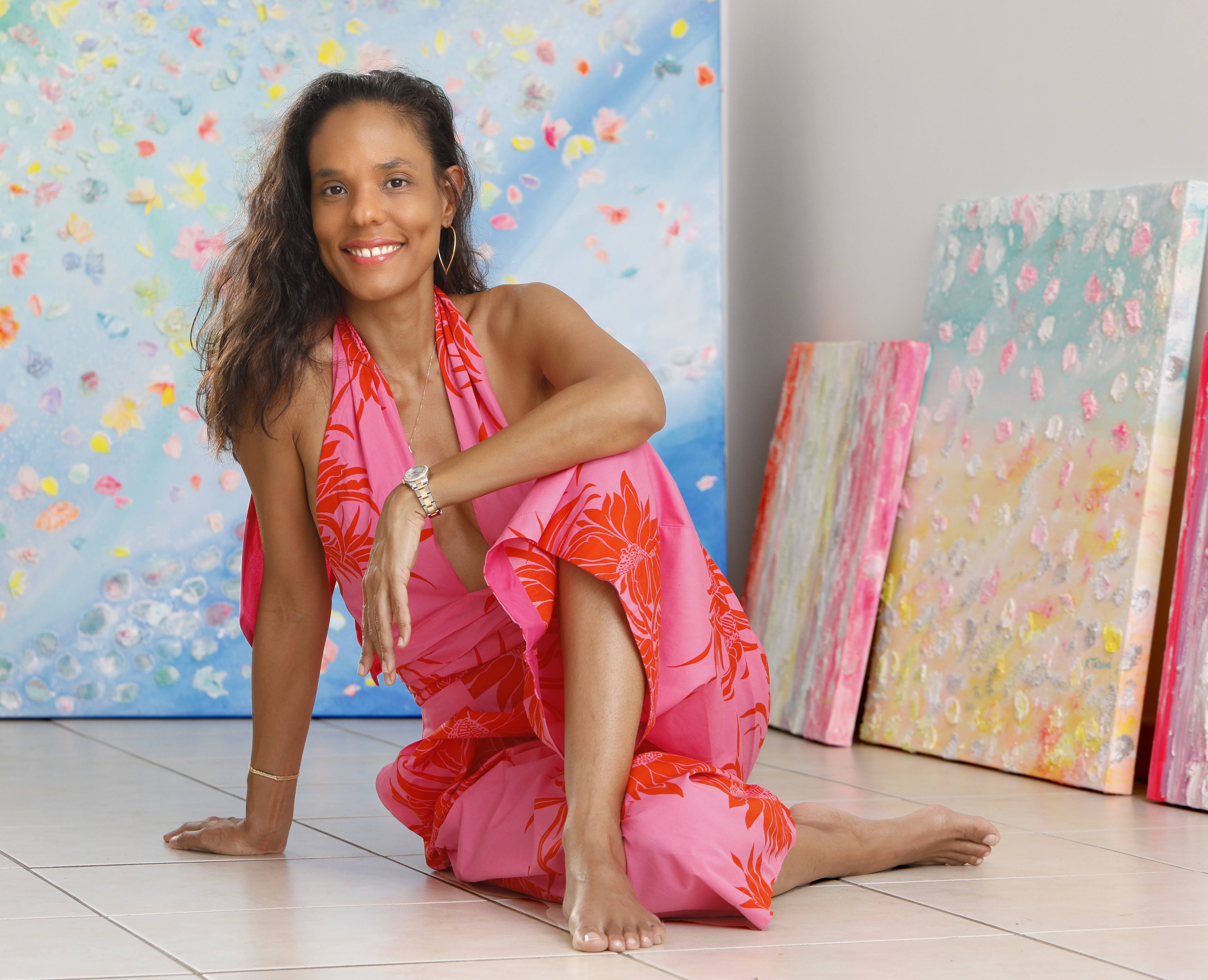
Born in Martinique and a graduate of the Fine Arts schools in Martinique, Nice, and Paris, as well as the Haute École de Joaillerie in Aix-en-Provence, the artist Karine Taïlamé has been making her mark on the Caribbean art scene since 2008 with work deeply connected to nature and her native island. A painter, draftsman, sculptor, and installation artist, she considers her calling to be, above all, to celebrate life and bring joy. She is our Favorite Artist.
Asakan: To start our interview, would you like to introduce yourself?
Karine Taïlamé: I’m a multidisciplinary Caribbean artist, born in Martinique. I define myself as a painter of color and, for the past twenty years, have been developing an artistic practice that combines painting, sculpture, jewelry, photography, and installation. Through these various mediums, my work explores the aesthetic, sensory, and identity-related dimensions unique to the Caribbean.
Nature is at the heart of it all; the transparency of the ocean, the Creole garden, medicinal plants, and the zenithal light of the tropics are an inexhaustible source of inspiration. I never treat them as mere subjects: for me, plants and minerals are a living memory of Martinique. I therefore create works that bring to life that moment when light becomes a true expression of the island’s poetry.
My reflection focuses on how a place and its light can help shape a culture of the gaze. In this approach, the thought of Édouard Glissant and his idea of the “Tout-monde” guide me in my creative process: Martinique becomes a place of connection, where the island’s singularity engages in dialogue with the world’s diversity.
And then there is joy. My friend Robert Manscour, the great Martinican master glassblower, once called me “joy incarnate.” I really love this name because it so accurately captures my intention: to celebrate the beauty of life and to do good through my art.

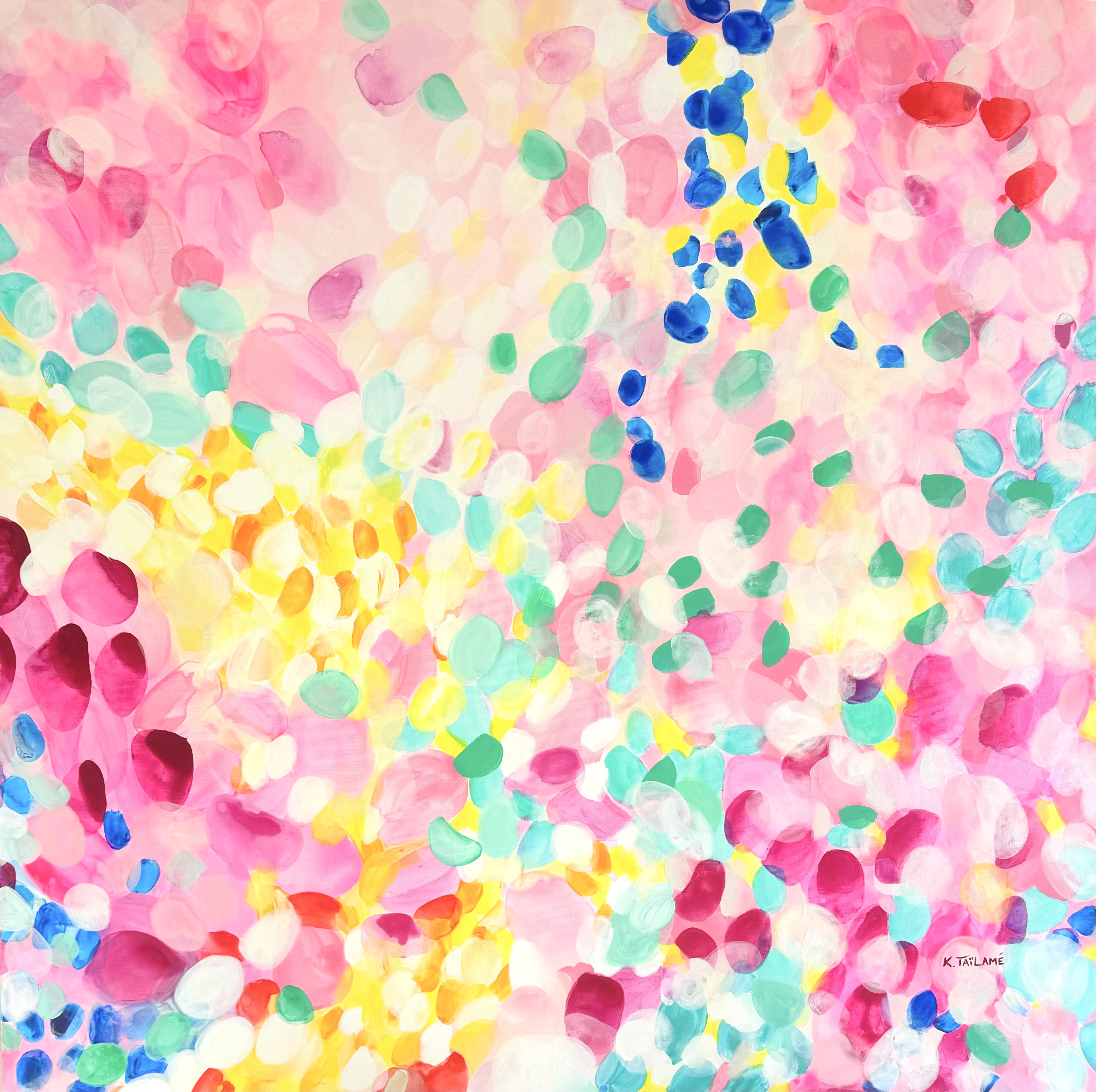
Karine Taïlamé, “Rainbow Filibo,” 2024. Acrylic on canvas, 120 x 120 cm. Courtesy of the artist. Photo credit: Jackie and Vianney Saintenoy
Asakan: How would you define art? And how do you view contemporary art?
Karine: Art is the expression of an artist’s emotion. It arises from a shared experience and, above all, creates an encounter between two sensibilities that discover each other for the first time, then meet again and eventually form a relationship. It’s a love story between the artist and the audience, and the artwork serves as the bridge between them. I deeply believe that a work of art lays an artist bare. It’s an intimate, deeply personal relationship that brings two souls into resonance.
For me, a work of art is experienced much like savoring a pineapple. You begin by peeling away its protective scales, before reaching the delicious flesh that nourishes, soothes, and heals. Etymologically, to refer to this exceptional fruit, Native Americans doubled the word “nana nana,” which literally means “the fragrance of fragrances.”
I like to think that my art acts like a fragrance on the viewer—like the lingering echo of a memory that touches the heart, like a balm that soothes a hidden or invisible inflammation, and brings a smile back to their face.
I believe that “the artist creates what he is.” He cannot cheat. The artwork is not merely a product; it is a part of myself that I choose to share.
I see contemporary art, above all, as a space for freedom, inquiry, and connection. It can first and foremost move, unsettle, expose, question, soothe, or simply evoke an emotion. And perhaps that’s what interests me most: creating this space for connection between my work and the viewer.
Asakan: When did you know you would devote your life to art?
Karine: I don’t think I ever really decided to become an artist. Art chose me.
When I was four, one Sunday morning, my parents woke up and found me on the bunk bed, drawing a huge mural covering the entire wall. They never repainted it, by the way. That might have been my first site-specific work!
But more seriously, I think this anecdote reveals something essential: art is a way of being even before you can put it into words.
My childhood memories have greatly shaped my perspective. Swimming in the crystal-clear sea, Filibo candies, the scent of vanilla, and my bare feet in the wet grass of the Creole garden—all these little things have, over time, become a sensory memory.
Then, during my studies at the Ateliers de Sèvres, the Beaux-Arts, and the Haute École de Joaillerie in Aix-en-Provence, this intuitive sensitivity evolved into a genuine artistic vision.
I crossed the Atlantic on a banana freighter during one of my artist residencies. This experience deeply moved me—a 360-degree expanse of blue between sky and sea, a perfect unity. Being completely disconnected from the world and from social media, I learned to see things differently, to seek out what is essential, and to understand that color and light form a single, unified language.
Asakan: As an artist, how would you define yourself? How did you come to develop your distinctive style?
Karine: I have a deep connection to color, light, and life. I paint colors that “sing,” that “vibrate,” that become “emotional matter.”
My painting has its own music. I especially love the idea that, in a work, the relationship between colors, the organization of space, and the composition must all be in harmony… Nothing is incidental.
I invite viewers to look at my paintings the way one looks at the sea. I pay constant attention to the interplay of transparency and opacity, to atmospheric effects, and to memory.
My painting takes shape slowly, through successive layers, wash after wash—a technique I call “the superimpositions of patience.”
My artistic voice has been shaped by my devotion to my obsessions: nature, the sea, and light.
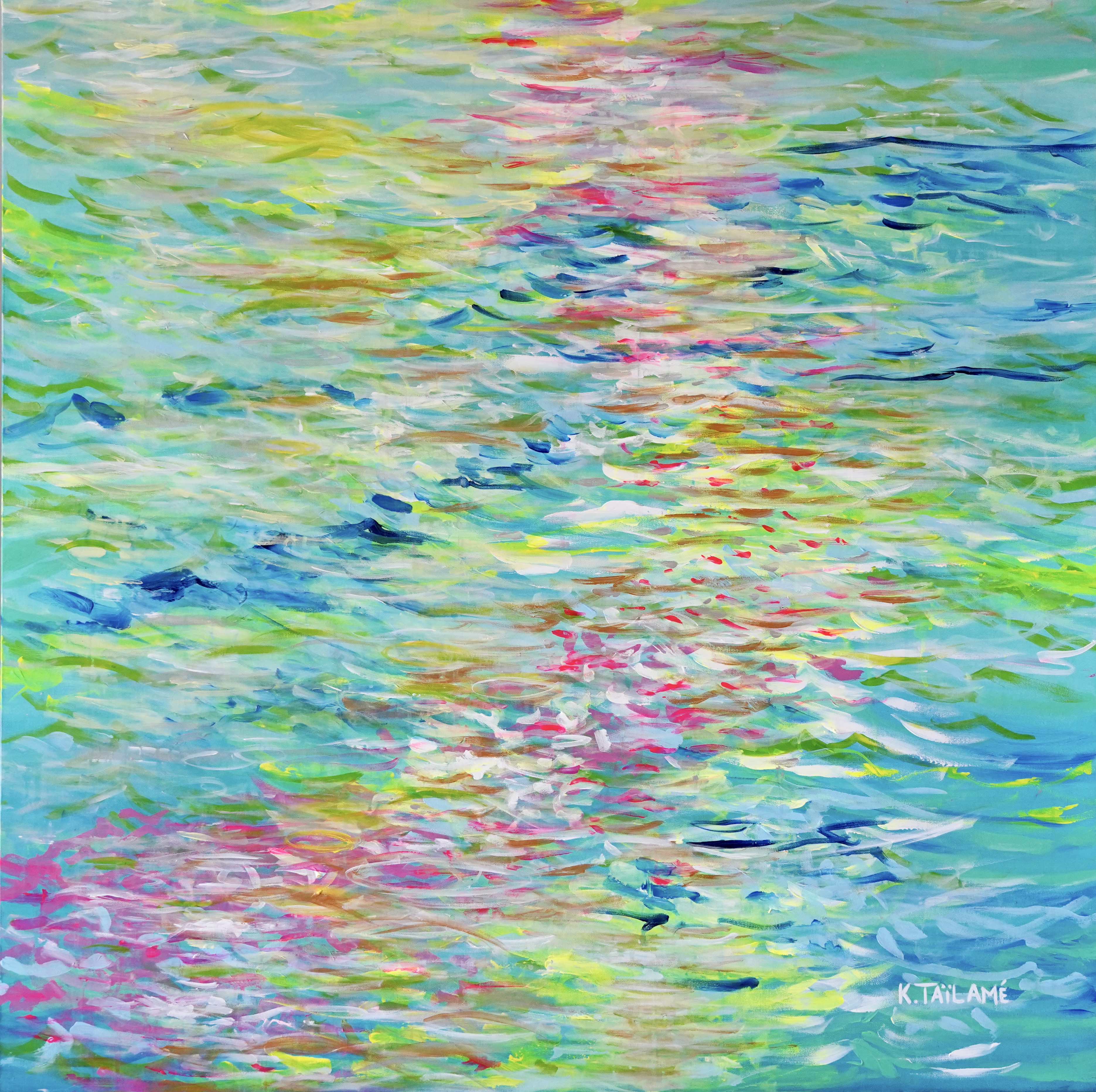
Karine Taïlamé, “Envolée Caribéenne,” 2024. Acrylic on canvas, 120 x 120 cm. Courtesy of the artist. Photo credit: Jackie and Vianney Saintenoy
Karine Taïlamé, “Frisson d’or au matin,” 2026. Acrylic on canvas, 120 x 120 cm. Courtesy of the artist. Photo credit: Karine Taïlamé
Asakan: What are your artistic inspirations and influences? What themes and emotions do you try to convey in your works?
Karine: That’s a difficult question, because I have many sources of inspiration. Right now, I’m drawing inspiration from the poem “Presque rien” by L’oiseau Noir, which paints a picture of the world’s beauty with its words and touches my heart.
I also regularly draw inspiration from Alvin Ailey’s work “Night Creature.” This ballet evokes a nocturnal world of animals, with sumptuous, vibrantly colored feathered costumes that fuel my imagination.
I’m a huge fan of Claude Monet, particularly for his work with light, water, and atmospheric effects. Henri Matisse is also essential to me. In his *Writings and Remarks on Art*, he said, among other things, “Color exists in and of itself, possessing its own beauty”—a sentiment I’ve made my own. I’m always moved by his stained-glass windows in the Chapel of Vence.
Pierre Soulages’ work speaks to me for almost the opposite reason, with his deeply moving “black light,” where light emerges through the material. I’m also very drawn to Victor Anicet’s work; his tribute to the memory of Native Americans through his stained-glass windows at Saint-Pierre Cathedral is exceptional. And then there’s Mark Rothko. He said that he painted neither form nor color, but fundamental human emotions: joy, fear, ecstasy, tragedy, and solitude. What moves me deeply in his work is the sensation that color seems suspended in a parallel space-time. It isn’t simply there to be looked at: it envelops us, absorbs us.
As for the emotions I try to convey, I would simply say that “my paintings speak of beauty.”
Being born on an island means, in a way, belonging to it. And even though it can sometimes make me long to be elsewhere, when I return home, I find it even more beautiful. Being surrounded by water, separated from the continents with all that this entails, has shaped my identity as an artist, which has been built in part around this geographical specificity. Insularity fosters a unique relationship with nature. A dazzling beauty that inspires and transcends me. In my exploration of this, I examine my territory, time, belonging, and memory.
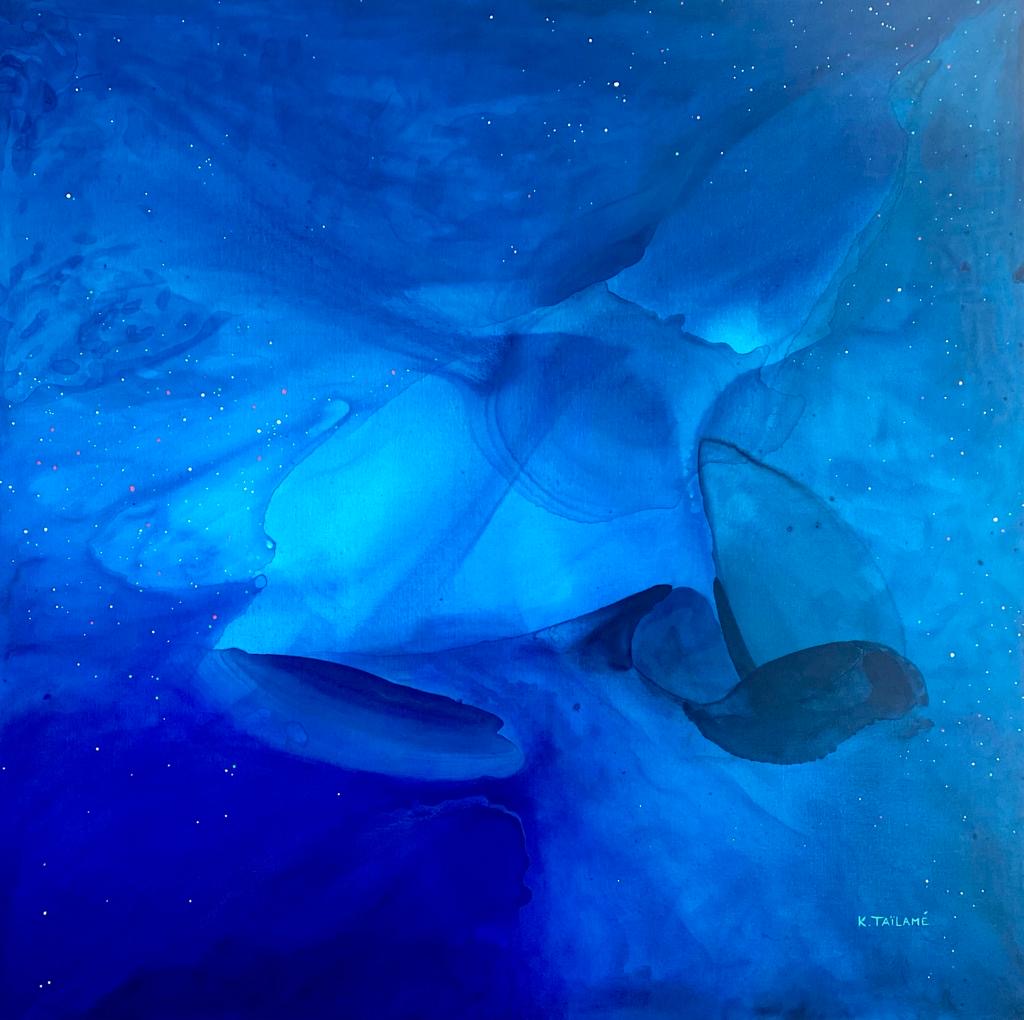
Karine Taïlamé, “Cosmos Luminescence,” 2023. Acrylic on canvas, 150 x 150 cm. Courtesy of the artist. Photo credit: Karine Taïlamé
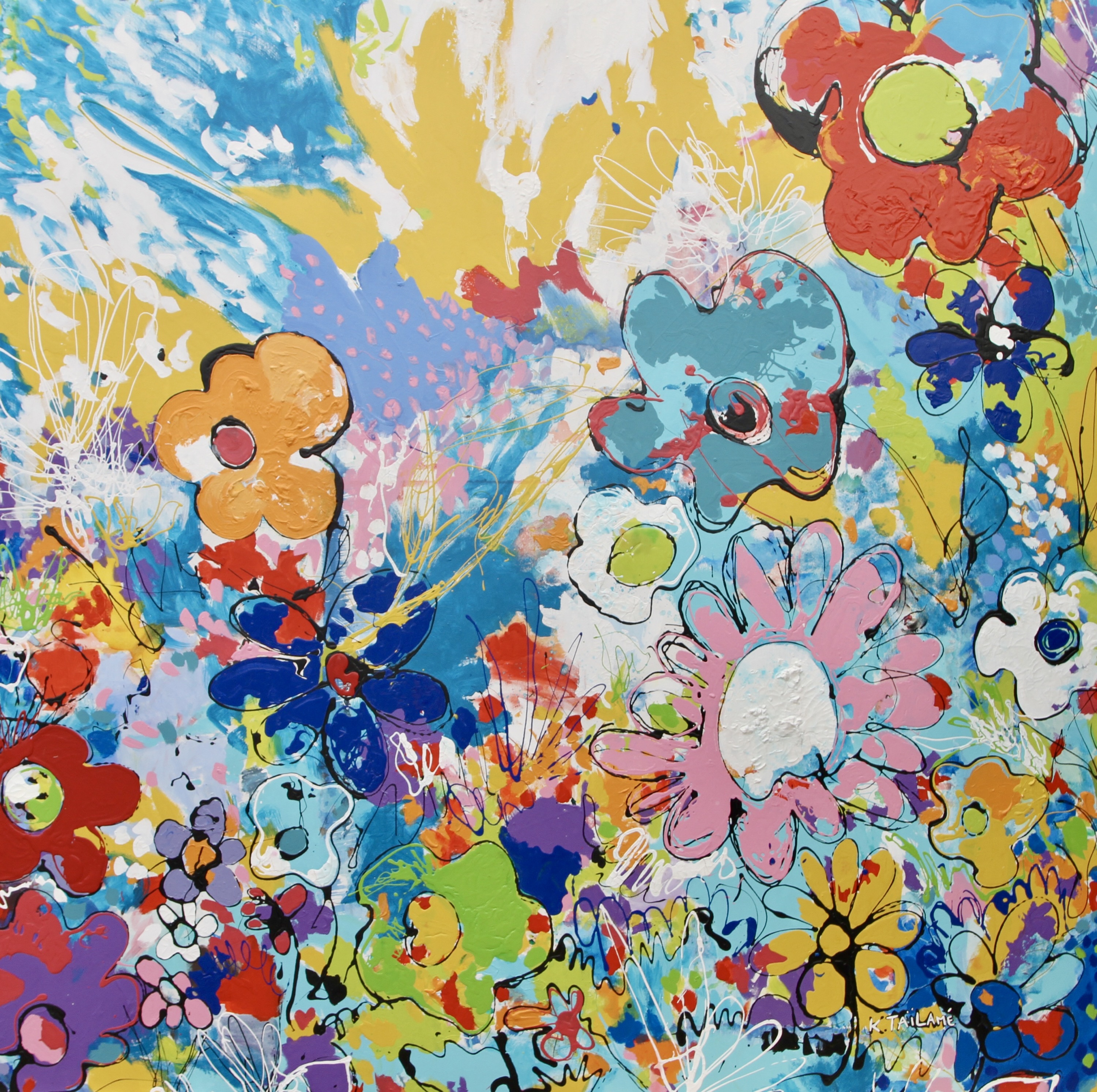
Karine Taïlamé, “Madinina Beauty,” 2013. Acrylic on canvas, 200 x 200 cm. Courtesy of the artist. Photo credit: Jackie and Vianney Saintenoy
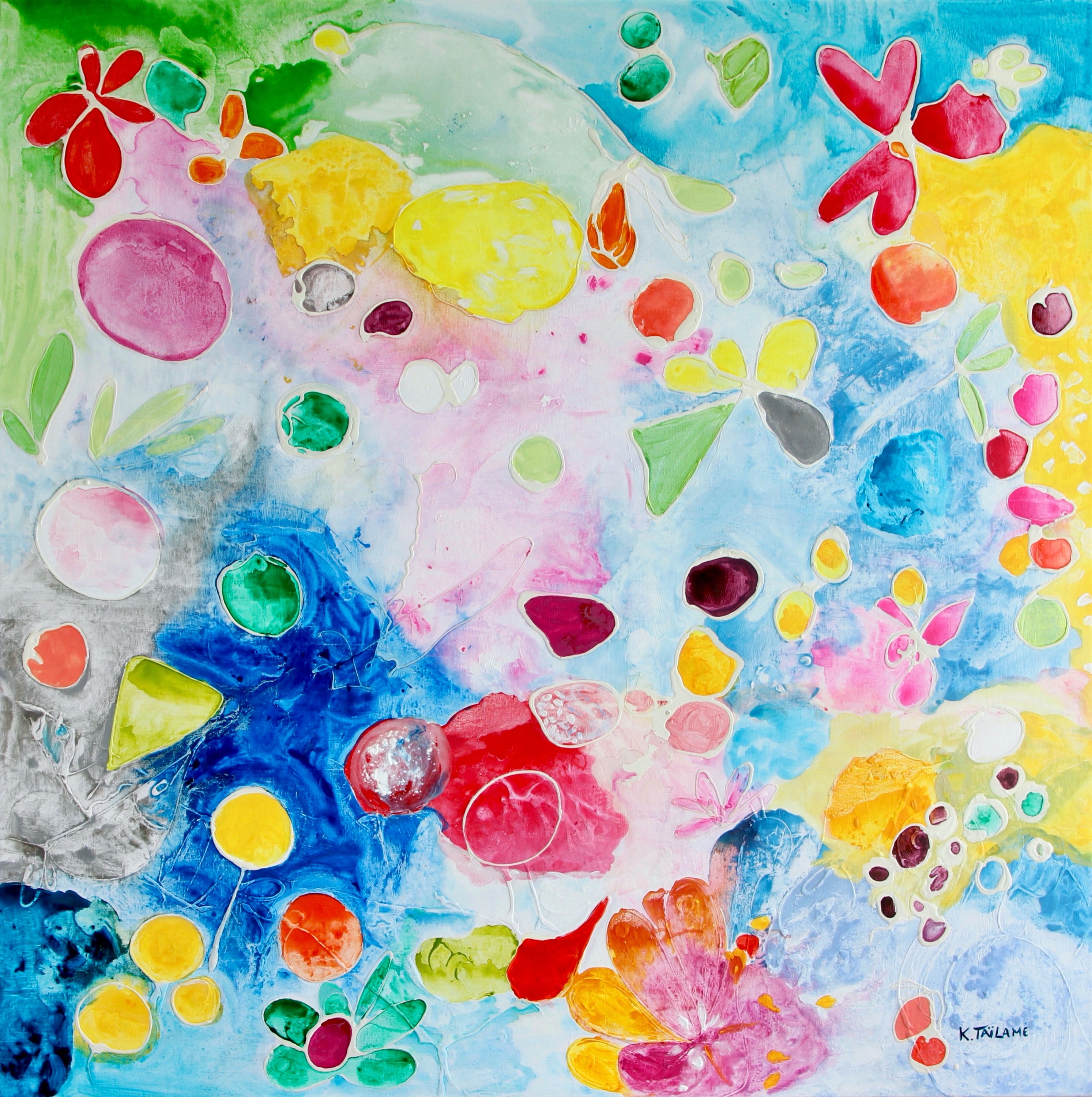
Karine Taïlamé, “Happy Ending,” 2019. Acrylic on canvas, 120 x 120 cm. Courtesy of the artist. Photo credit: Jackie and Vianney Saintenoy
Asakan: How is your work perceived by the public? And by the art community?
Karine: The public often sees me as an artist who uses vibrant colors—in English, they call this a “bright color painter”—and also as an artist who brings joy and a sense of calm. I believe that this joy truly infuses my paintings. It’s a sense of fulfillment that means a great deal to me.
The art world’s perception has developed more slowly, through a gradual accumulation—much like my painting technique.
I’ve been working as an artist for eighteen years, and for the past thirteen years, my works have been part of the permanent collection of the Clément Foundation (a major institution specializing in Caribbean contemporary art), which has been a significant institutional recognition in my career.
Today, my work is represented by two galleries, at opposite ends of the globe: Seimandi & Leprieur Gallery in Santa Barbara, California, and Sarto Galerie in Paris.
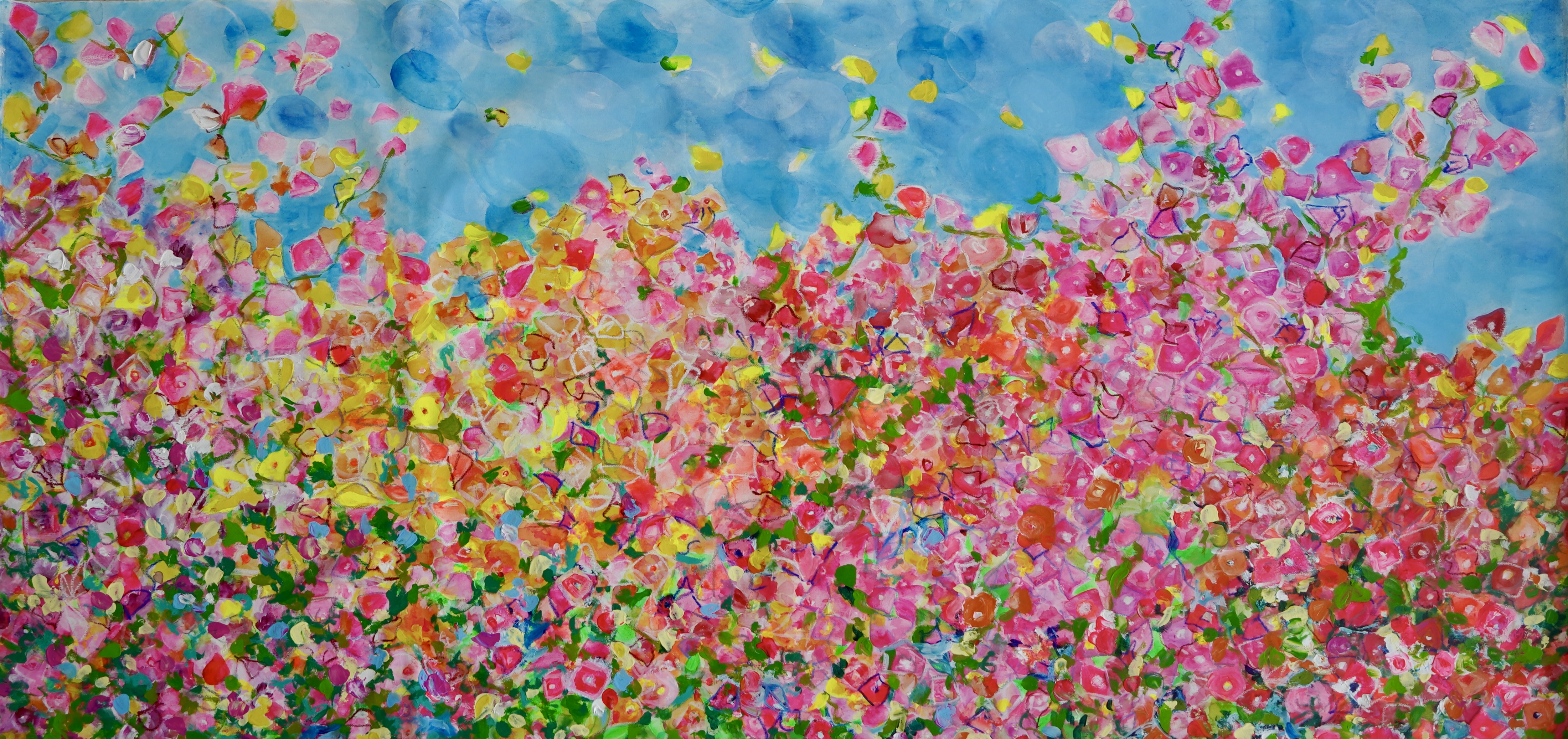
Karine Taïlamé, “Les Bougainvilliers No. 1,” 2026. Acrylic on canvas, 213 x 108 cm. Sarto Galerie. Courtesy of the artist. Photo credit: Karine Taïlamé
Axel Rondouin often says that an artist is a “diligent worker”: someone who relentlessly hones their technique, because without technique, no work of art can endure. And I identify strongly with this idea. It is precisely from this demand that my technique of “layers of patience” was born.
In addition, I had the honor of being appointed curatorial director by the Wall House Territorial Museum in Saint-Barthélemy and conceived the exhibition “Martinique, Intimate Cartographies,” which ran from May 9 to August 1, 2026, in Gustavia. This exhibition, which brought together twenty-five artists from Martinique for the first time at the Wall House, was a resounding success with the public and institutions alike. It contributed to the international recognition of Martinique’s art and is set to become a traveling exhibition.
Asakan: What advice would you like to share with other young people eager to pursue a career in art?
Karine: I would tell them, above all, not to try to be anyone other than themselves. Don’t strive to become a famous artist; instead, strive to be a remarkable artist.
Finally, don’t be afraid of coming from a small place. Your physical location may be small, but your imagination knows no boundaries.
For more information on Karine Taïlamé’s work, visit her website at https://www.karinetailame.com or follow her on Instagram @karine_tailame.
À lire également
With the Franco-Moroccan Illustrator La Bulle
His distorted drawings, often featuring solitary figures suspended in a neutral space, challenge our emotional perspectives on what we know about the…

With French Artist and Curator Isabelle Arvers
A pioneer in art and video games in France, as well as a curator and painter, Isabelle Arvers (born in 1972) grounds her work at the intersection of a…
With Violine Jacquot, a French painter based in Lausanne
Violine Jacquot, who was born and raised near Besançon, France, is a self-taught painter who lives and works in Lausanne, Switzerland. Inspired by the…
With Paul Moustapha Ledron, an artist and designer of Martinican origin based in Abidjan
At just 30 years old, Paul Ledron is a young designer whose work draws on Caribbean, African, and European cultural influences. With a master’s degree…
Commentaires