
Coup de cœur
With Violine Jacquot, a French painter based in Lausanne
Violine Jacquot, who was born and raised near Besançon, France, is a self-taught painter who lives and works in Lausanne, Switzerland. Inspired by the vastness of Lake Geneva and its shifting light, as well as the relationship between the water and the sky—and the boundary between the two that is sometimes almost impossible to distinguish— the artist builds her work around a contrast between large, minimalist spaces and small, figurative depictions of birds painted with disconcerting precision against a backdrop of blue. This is her way of avoiding the imposition of a single emotion—let alone a definitive interpretation—and instead creating images open enough for everyone to project their own experiences onto them. She is our Favorite Artist.
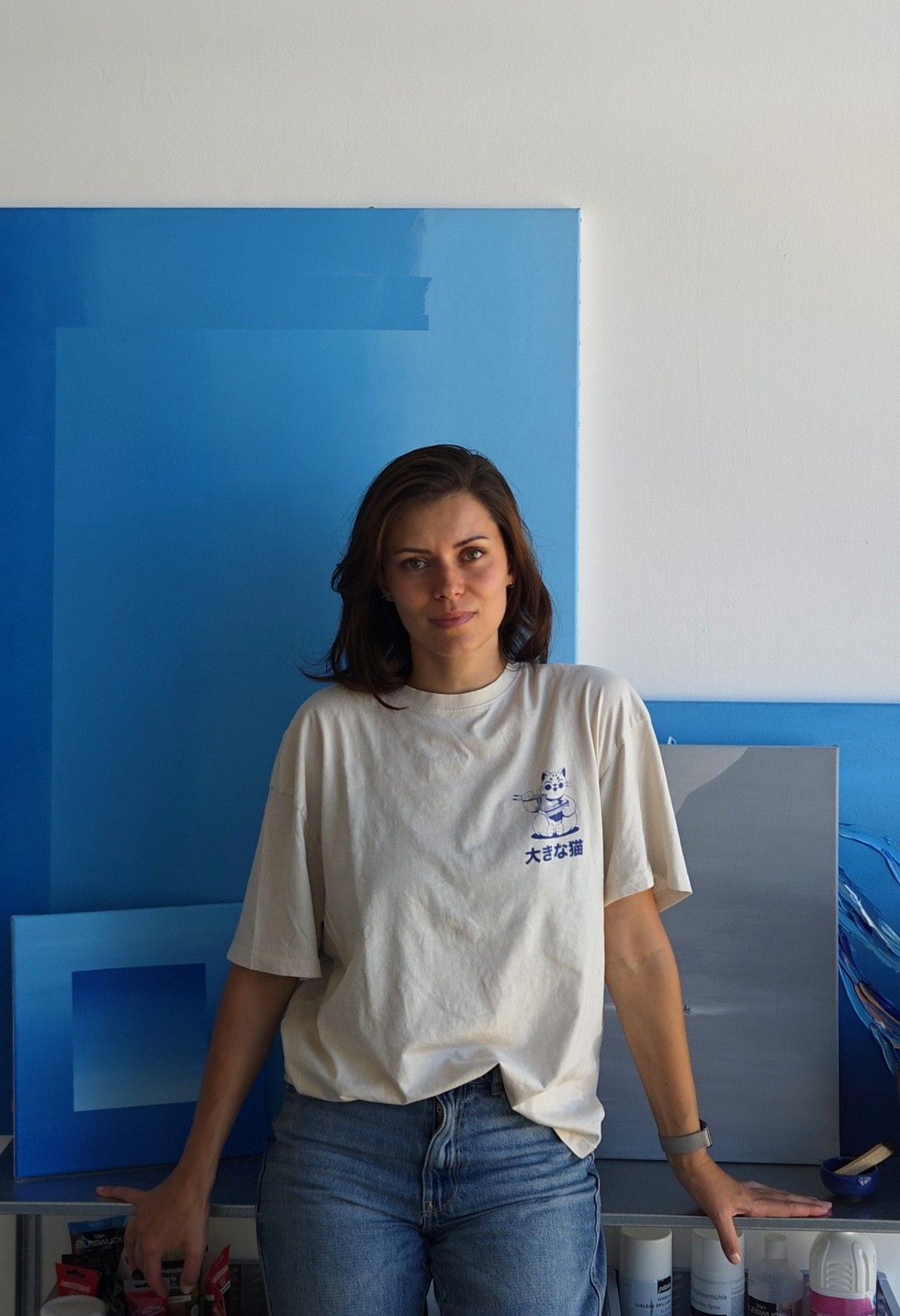
Asakan: To start our interview, would you like to introduce yourself?
Violine Jacquot: My name is Violine Jacquot. I’m a self-taught painter, born in France and now living in Lausanne. For as long as I can remember, painting has always been a part of my life, even though my career path initially took a different direction.
After studying business law, I worked for a few years as a lawyer. Over time, I felt an increasingly strong need to get closer to a creative, hands-on, and visual world. I then turned to floristry, which was an important first step in this life change.
Painting, however, continued to play a central role, and I eventually realized that I no longer wanted to practice it solely as a side activity. So I chose to devote myself to it fully. For the past few years, it has thus become my main occupation and now shapes my entire daily life.
Asakan: How would you define art? And how do you view contemporary art?
Violine: For me, art is a way of shifting our perspective. It can start with something very simple or very familiar and, through the way the artist transforms it, lead us to perceive it differently. A work of art can evoke an emotion, a surprise, a question, or simply spark a thought we wouldn’t have had otherwise.
I don’t think a work of art needs to be beautiful—or even fully understood—to be powerful. What interests me most is what it triggers in the viewer. It can unsettle us, intrigue us, or draw us in without us immediately knowing why. For me, a successful work of art is one that continues to exist in our minds after we’ve left it behind.
That’s what I particularly love about contemporary art. It allows us to move away from an obvious representation of reality and explore other ways of constructing an image, a sensation, or an idea. I like it when a work doesn’t provide all the answers, when it leaves room for ambiguity and truly gives the viewer a voice. Everyone can then engage with the work through their own experience and interpret it differently.
I’m also very attuned to the way an idea takes shape: the choice of materials, the composition, the gesture, and the technique. For me, the power of a work often comes from the intersection between an intention and the very concrete way it’s realized.
Asakan: When did you realize you would devote your life to art?
Violine: As far back as I can remember, I’ve always painted. Painting has always been a part of my life, but for a long time it occupied whatever time I could spare outside of my studies, my job, and the rest of my daily life.
The decision to devote myself to it fully came about gradually. As I gained experience in various professional roles, my need to create became increasingly clear. I eventually realized that I no longer wanted painting to be something I did only when I had spare time, but rather to build my daily life around it.
I think that was the real turning point: realizing that I no longer wanted to view painting as a side activity, but as my profession and as something I wanted to develop over the long term. From that moment on, the decision to make it my primary focus came quite naturally.
Asakan: As an artist, how would you define yourself? How did you come to develop your distinctive style?
Violine: I’d describe myself as a painter who seeks to create a dialogue between minimalism and precision. My work is based on large spaces built around different shades of blue, within which small, highly detailed figurative elements—mainly birds—are depicted. I particularly love this contrast between an image that seems almost abstract from a distance and becomes figurative and meticulous when viewed up close.
My artistic identity has developed gradually, through painting extensively and gradually eliminating what didn’t seem essential to me. The vast spaces, the blue, the gradients, and these small figurative elements emerged naturally until they became my artistic language. What interests me is precisely the intersection of these two approaches: a very minimalist and contemporary composition, combined with a more figurative precision of brushwork.
Today, I know where I want to go with my painting. I want to continue developing this world, while exploring new techniques or mediums in the future that can enrich it.
Asakan: What are your artistic inspirations and influences? What themes and emotions do you try to convey in your works?
Violine: My influences come first and foremost from what I observe and what feeds my perspective on a daily basis, rather than from any one artist in particular. Since I’ve been living in Lausanne, Lake Geneva has played an important role in my work, though I don’t seek to depict it directly. What interests me is its atmosphere: the vast expanses, the variations of blue, the reflections, and that boundary—sometimes difficult to define—between the water and the sky. I like to preserve this ambiguity in my paintings, so that viewers don’t always immediately know which space they’re looking at.
Blue has naturally become central to my work. It’s a color I love as much for what it evokes (water, the sky, space) as for the diversity of shades and intensities it allows. Over time, it has become a true signature of my painting.
Birds have also become essential to my work. They allow me to introduce a presence into the image without imposing a specific identity or story. A human figure would guide the viewer’s interpretation and emotional response much more directly; with a bird, on the other hand, I can leave more room for each person’s own projection and interpretation. Often very small in relation to the space around them, they also provide a sense of scale to the image: an almost abstract surface can suddenly become vast. I don’t see them as lost or isolated, but rather as free and fully at home.
Through my works, I also seek to slow down the viewer’s gaze. From a distance, a painting may seem very simple, but one must get closer to discover the bird and the precision of its details. In an age when we tend to glance at everything very quickly, I like it when a work demands a little more time and when that discovery can alter how it is interpreted.
I seek less to convey a specific emotion than to let each viewer construct their own interpretation, centered on concepts such as freedom, space, presence, or a form of chosen solitude—which is never melancholic.
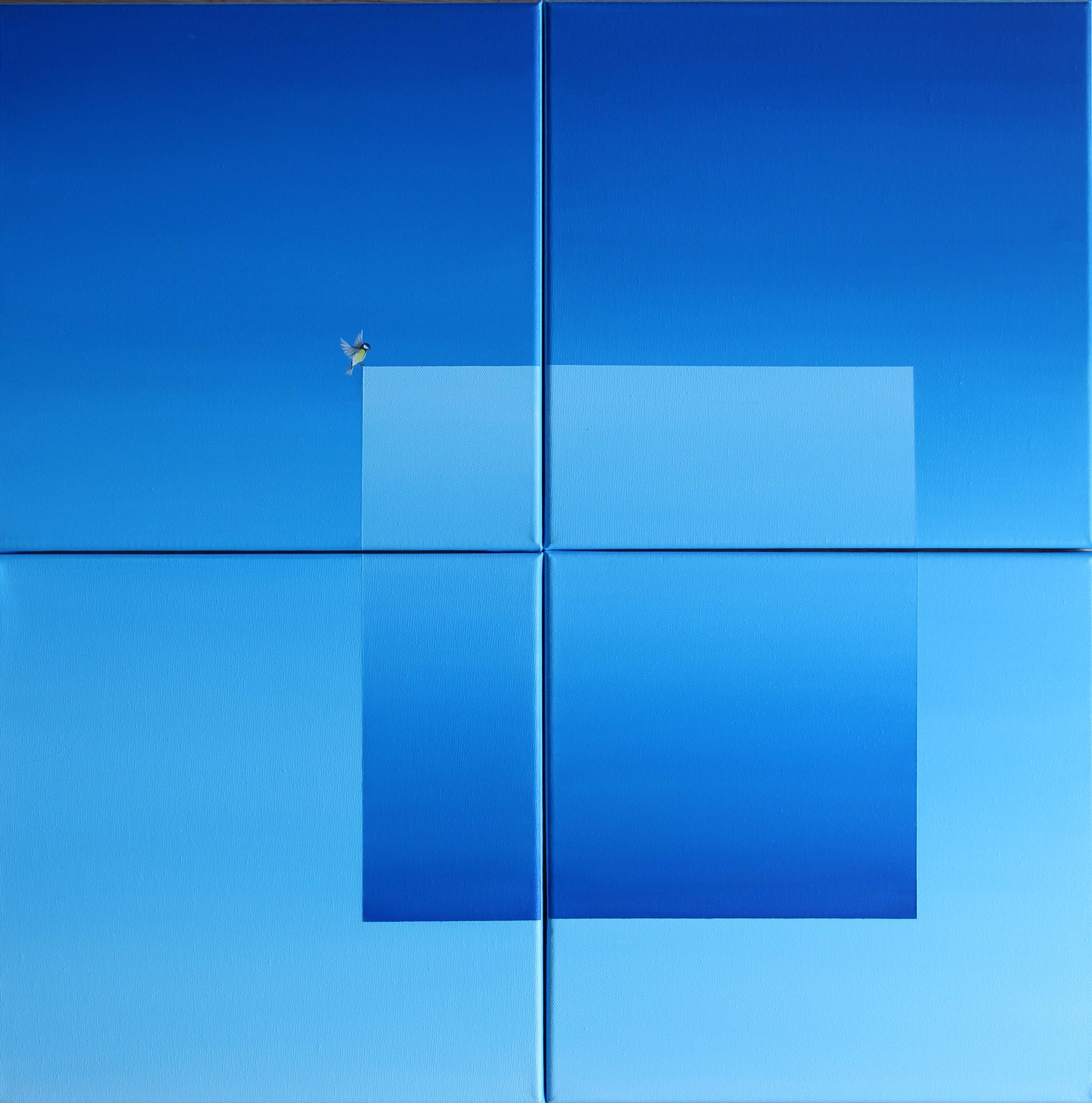
Violine Jacquot, “Effleure,” October 2025. Acrylic on canvas, 30 x 30 cm. Courtesy of the artist
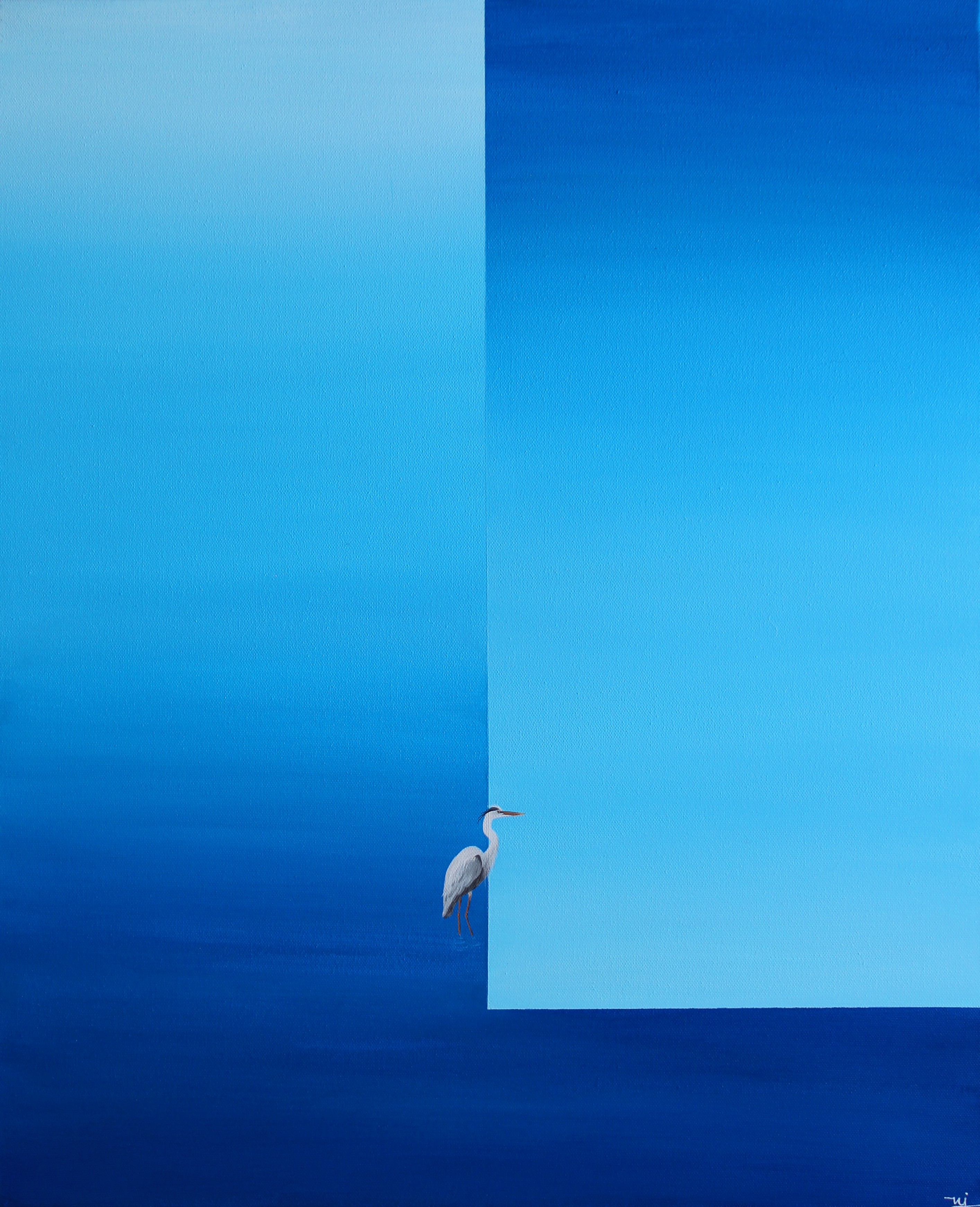
Violine Jacquot, “Sereno,” March 2025. Acrylic on canvas, 61 x 50 cm. Courtesy of the artist
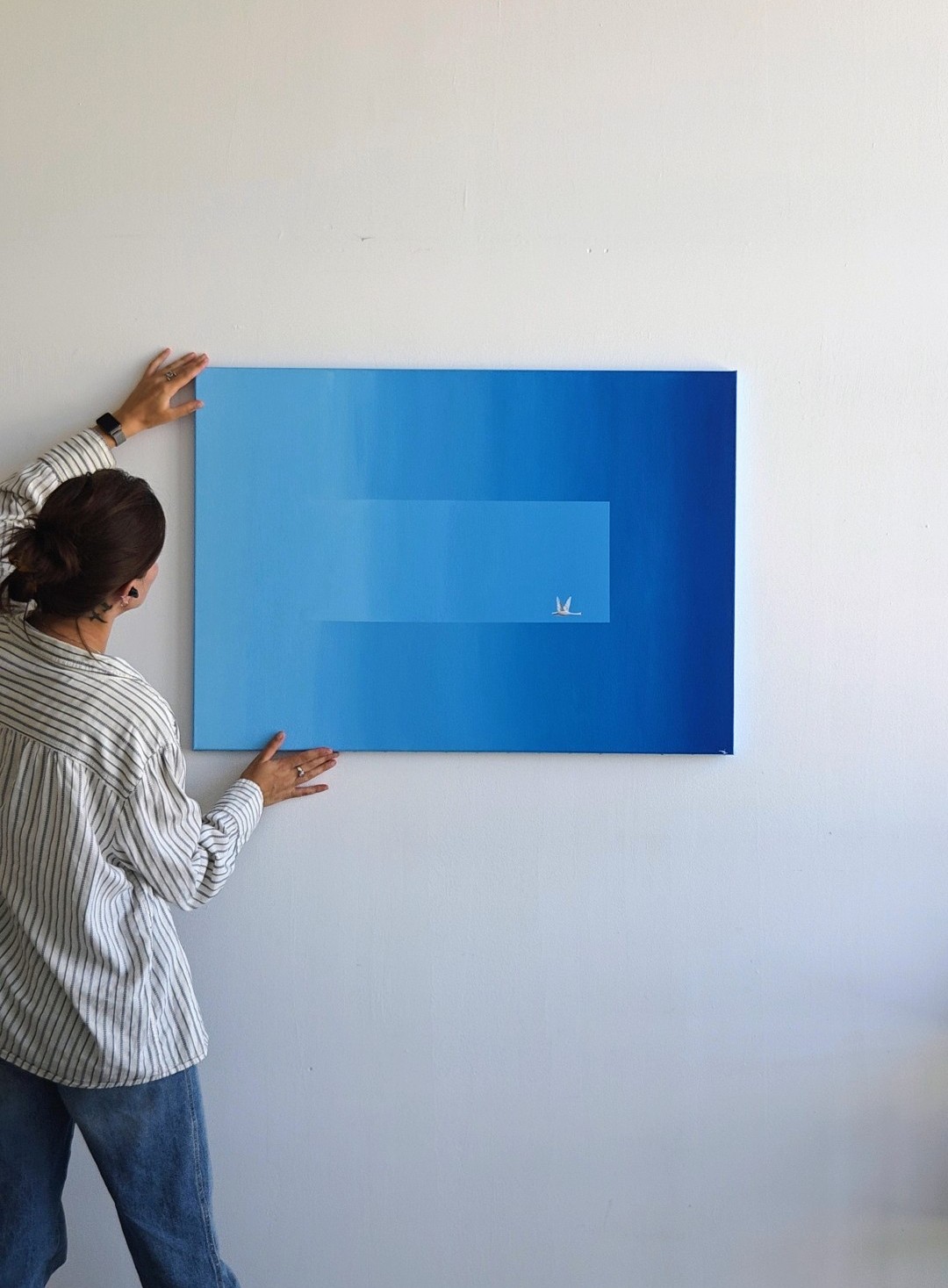
Violine Jacquot, “Horizon,” March 2026. Acrylic on canvas, 65 x 92 cm. Courtesy of the artist
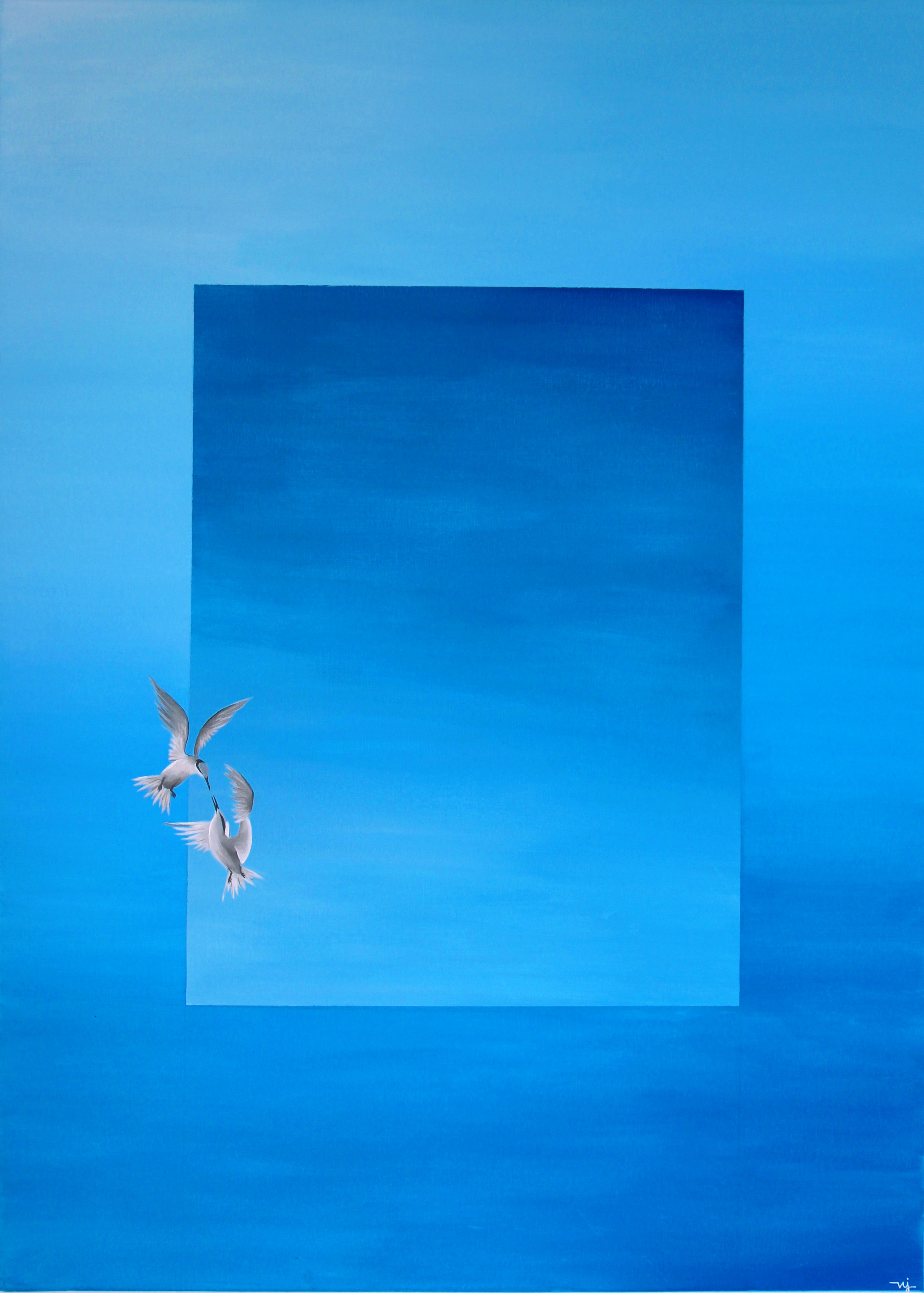
Violine Jacquot, “Fenêtre,” January 2025. Acrylic on canvas, 90 x 65 cm. Courtesy of the artist
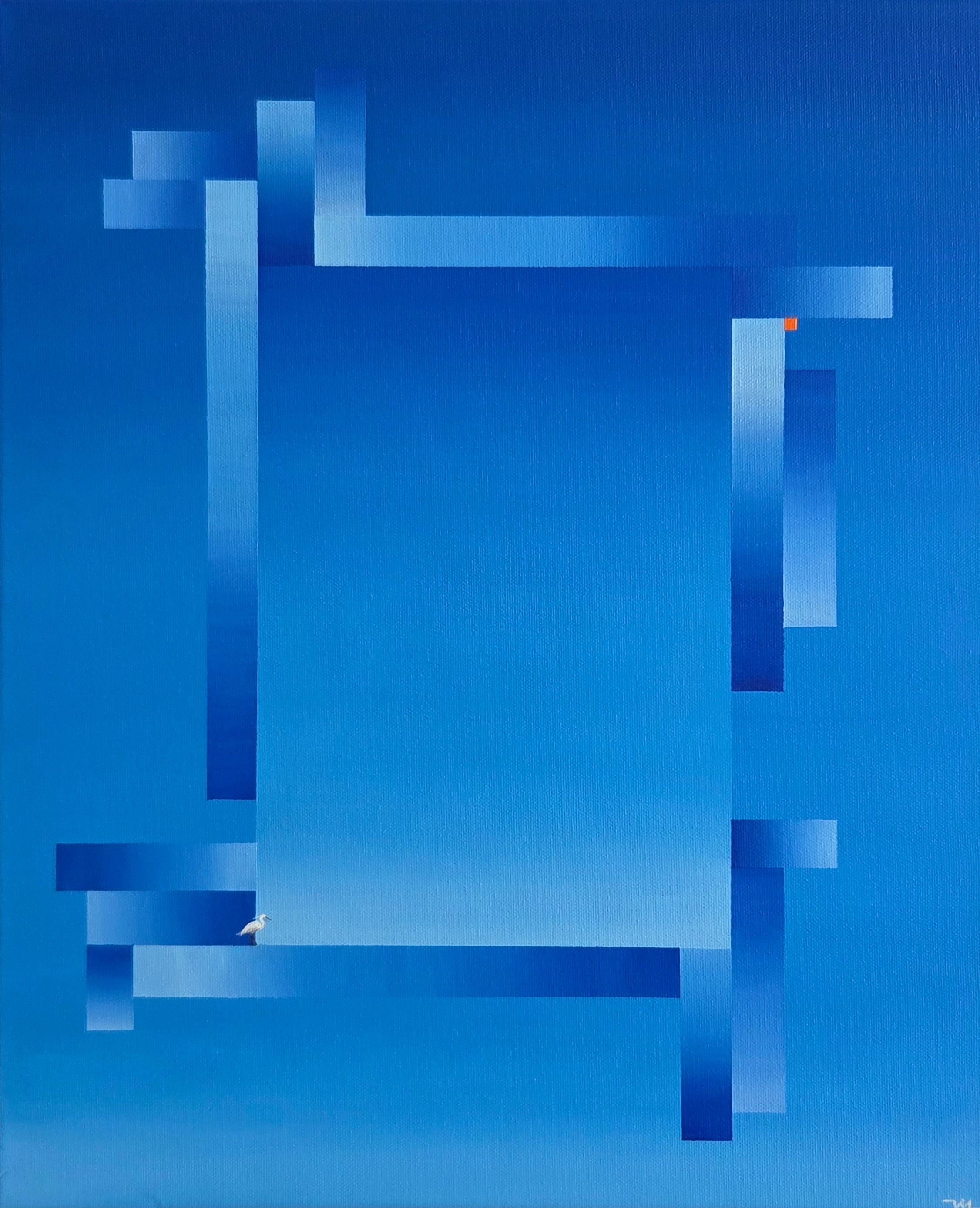
Violine Jacquot, “Courant 01,” September 2026. Acrylic on canvas, 50 x 40 cm. Courtesy of the artist
Asakan: How is your work perceived by the public? And by the art community?
Violine: The public often reacts first to the shades of blue and the very minimalist style of my paintings. Then, as they get closer, people discover the birds and the details, which often creates an element of surprise. That’s something I particularly like, because it reinforces the idea of a painting that doesn’t reveal itself completely at first glance.
I also find it interesting that some people project emotions or interpretations onto my works that I hadn’t necessarily thought of myself. This aligns quite well with my desire to give the viewer’s perspective a significant role.
Within the art world, feedback often focuses on the visual identity of my work, my use of blue, and the contrast between abstraction and figuration.
My solo and group exhibitions have also allowed me to test this artistic language against different perspectives and to see that it is now clearly recognizable.
Asakan: What advice would you like to share with other young people eager to pursue a career in art?
Violine: First, I’d say to practice a lot and not wait until you have all the answers before taking the plunge. An artistic identity isn’t decided in advance—it’s built through working, experimenting, and gradually understanding what you naturally gravitate toward.
I’d also advise taking your work seriously and giving it the space it deserves. I myself painted for a long time in whatever spare moments I had between my studies and my job, before realizing that if I really wanted to make progress, I had to make painting a priority.
Finally, I think it’s important to stay curious, look at a lot of art, experiment, and draw inspiration from your surroundings—without trying to copy what works for others. Finding your own artistic voice takes time, but above all, it requires a lot of hard work and consistency.
For more information on Violine Jacquot’s work, visit her website at violinejacquot.com or follow her on Instagram @violinejcqt.
À lire également
With the Franco-Moroccan Illustrator La Bulle
His distorted drawings, often featuring solitary figures suspended in a neutral space, challenge our emotional perspectives on what we know about the…
With Karine Taïlamé, a multidisciplinary artist and exhibition curator from Martinique
Born in Martinique and a graduate of the Fine Arts schools in Martinique, Nice, and Paris, as well as the Haute École de Joaillerie in Aix-en-Provence…

With French Artist and Curator Isabelle Arvers
A pioneer in art and video games in France, as well as a curator and painter, Isabelle Arvers (born in 1972) grounds her work at the intersection of a…
With Paul Moustapha Ledron, an artist and designer of Martinican origin based in Abidjan
At just 30 years old, Paul Ledron is a young designer whose work draws on Caribbean, African, and European cultural influences. With a master’s degree…
Commentaires