Coup de cœur
With French Artist and Curator Isabelle Arvers
A pioneer in art and video games in France, as well as a curator and painter, Isabelle Arvers (born in 1972) grounds her work at the intersection of art, video games, and research. A specialist in particular in machinima (films created using video game engines), and a globetrotter (she undertook a world tour titled “Art Games World Tour”), she creates a poetic and visual choreography that gives voice to marginalized cultures, genders, sexualities, and geographies. She is our Favorite Artist.

Asakan: To start our interview, would you like to introduce yourself?
Isabelle Arvers: I’m an exhibition curator, machinima artist, and researcher, based in Meyrargues, Provence.
My background didn’t start with art history: I studied political science in Aix-en-Provence, but my real influences came from Marseille, where I was immersed in hip-hop, graffiti, and rave parties—that’s where I discovered digital imagery through fractal images.
Political science taught me, above all, that power taints everything it touches, and that if I wanted to take action, it would be through activism rather than politics. It was this conviction, along with meeting Nathalie Magnan in 1999—an activist, cyberfeminist, and French filmmaker—that led me toward hacktivism (activism and hacking) and active feminism.
Since 2009, I have been leading machinima workshops on creating films using video games—workshops initially designed for audiences considered “culturally marginalized,” and later for a wide variety of audiences in France and abroad—with the goal of transforming an object of mass consumption into a tool for producing meaning. Today, I use these workshops to raise awareness of games from the Global South and to decolonize the imaginaries of video games.
I have thus been working at the intersection of digital art and video games for twenty-five years, with a particular focus on feminist, queer, and decolonial practices originating from the Global South. In 2024, I defended a dissertation at the University of Lisbon titled *Decolonizing Art and Video Games*, based on field research conducted in eighteen countries and approximately three hundred interviews with artists and game designers.
Today I am continuing this work through several projects: “Aux Futurs Ancestraux,” a video game and three hybrid machinima films on Vodun cosmologies created with Atelier ElonM in Benin; “Immersions Beyond Green Games” with Brazilian artist Livia Diniz
; “Cruzoscópio,” a project with Benjamin Abras rooted in the Afro-Amerindian tradition of Jurema d’EXU—the deity of crossroads, street people, and markets—and the spirit of Mestre Zé Pelintra; and “Coral Sounds,” a marine bioacoustic research project on coral reefs.
Starting October 2, I will present the exhibition “Déjouer les mondes,” a countercolonial art and video game exhibition at the Grenier à Sel in Avignon (https://www.isabellearvers.com/2026/09/dejouer-les-mondes-exposition-art-et-jeu-video-grenier-a-sel-avignon/) and, from October 9 to 16, 2026, at the Embassy of the Bermond Islands in Marseille, the immersive exhibition “Inventerre,” in which I present my paintings, ceramics, video, virtual reality installation, and machinima centered around an island—a veritable micro-nation of non-humans. (More information: https://www.eventbrite.fr/e/billets-habiter-une-ile-2001045168967).
Asakan: How would you define art? And how do you perceive contemporary art?
Isabelle: For me, art is a space of counter-fiction: a place where we can reinvent narratives that colonial history has frozen or erased. I don’t separate it from video games, nor from ancestral worldviews—Vodun, Candomblé, Malandragem—which I see as contemporary systems of thought with which to engage in dialogue.
I chose video games as my field precisely for this reason: one day in the mid-1990s, while listening to teenagers tell me that they dreamed through video games and would rather see those images on television, I realized that this was a serious issue
— that video games were shaping the imagination of younger generations, and thus their way of thinking.
It was based on this observation that I decided to become a curator of art and video games, to promote alternative practices and show how artists subvert this medium to produce a distanced, critical vision of a world of simulacra.
Contemporary art, as it continues to be institutionalized in Europe, often remains centered on a Western canon. What interests me, on the contrary, is entering into a dialogue with other lineages—those that thinkers such as Audre Lorde, Djamila Ribeira, Ailton Krenak, David Kopenawa, Joseph Tonda, Ngũgĩ wa Thiong’o, and Viveiros de Castro help shed light on.
Asakan: When did you realize you would devote your life to art?
Isabelle: My first machinima dates back to 2012: “I is an other,” which explores questions of identity and otherness in video games. My first real artistic endeavor dates back to 2015, with my first residency in Brazil at the Rural Scapes farm, near São José do Barreiro. Until then, I had mainly been a curator; there, invited by artists Rachel Rosalen and Rafael Marchetti to lead machinima workshops, I carried out my very first experiments as an artist: “Santa Teresa Reloaded,” a work exploring glitches in the 3D rendering of the farm and its surroundings.
It was in this place, surrounded by cows, giant bamboo, and a way of life based on DIY (“Do It Yourself” / “Fais-le toi-même”), and a dialogue with the local environment, that I realized the game engine wasn’t just an object to curate, but a tool I could wield myself to tell stories.
The following year, this approach was further solidified with “Heroic Makers vs Heroic Land” (2016), a machinima documentary filmed in the “jungle” of Calais using a game engine, photos taken on site, and interviews with refugees.
However, my path has never been linear, but rather a series of shifts—curation, machinima, doctoral research—always guided by the same thread: understanding how art can give voice to marginalized communities and worldviews.
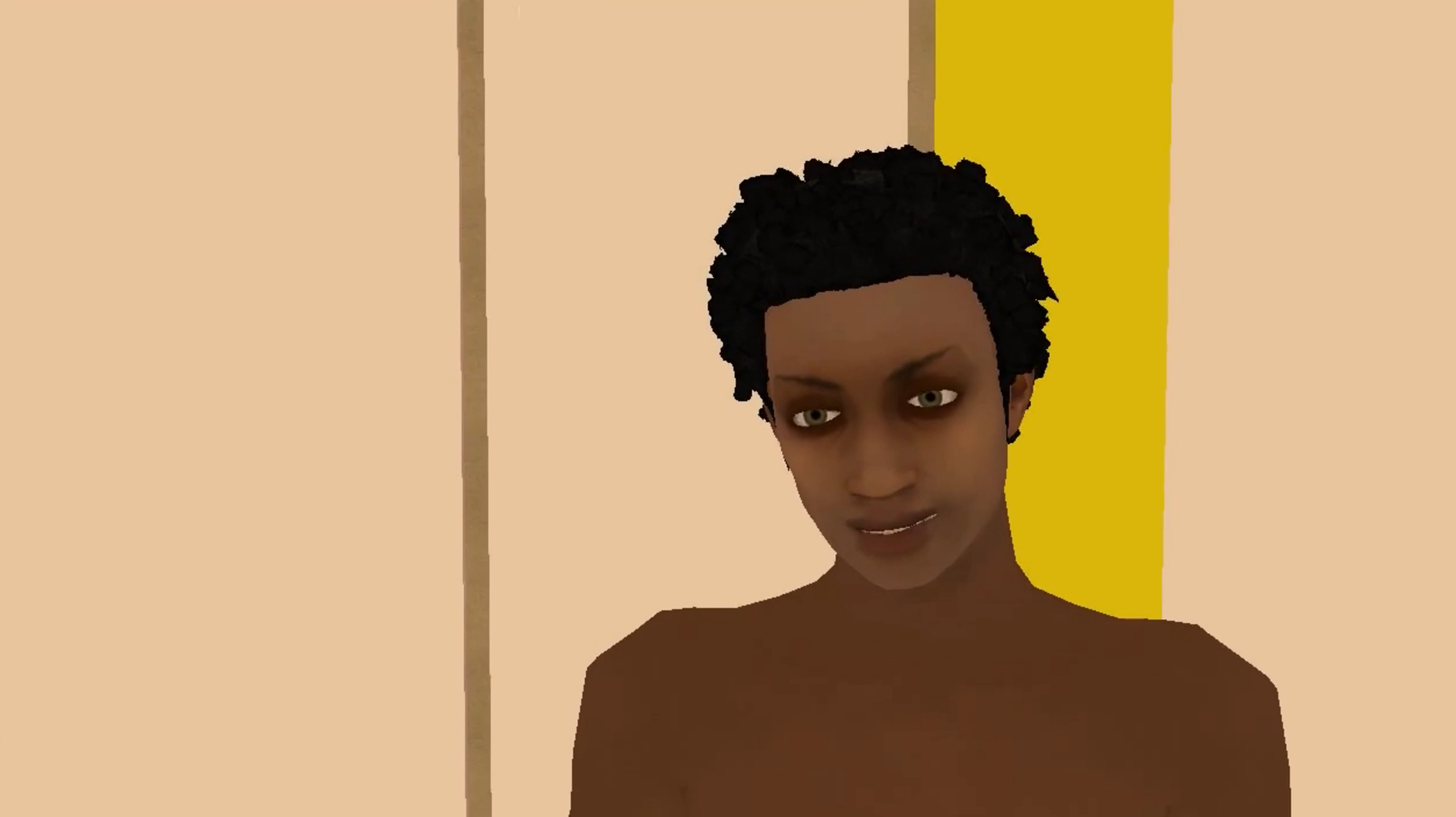
Isabelle Arvers, “I is an other,” 2012. Machinima Courtesy of the Artist
Asakan: As an artist, how would you define yourself? How did you come to establish your artistic identity?
Isabelle: I define myself first and foremost as a curator—a term I’ve come to embrace after twenty-five years of practice, rather than “traveler,” which would downplay the scientific and relational dimensions of my fieldwork. But I am also an artist, working in machinima: I repurpose video game engines to create films that lie at the intersection of documentary and audiovisual experimentation.
My artistic identity has been shaped film by film, workshop by workshop—I’ve led over a hundred workshops since 2009 in France and abroad, ever since, as you may recall, my first personal machinima in 2012: “I is an other.”
So, after “Heroic Makers vs Heroic Land” (2016), there was “La Mer” (2019), born out of a machinima screening I had organized in Belo Horizonte, Brazil, in 2009, during which someone in the audience asked me about the influence of video games on storytelling: I definitively turned my back on all linear storytelling in that work to move toward a more abstract and immersive form.
In 2021, my appointment to the scientific committee of the “EDEN ARTECH” research project on tree ecology and communication led me, in late 2021, to interview artists attuned to the powers of trees and traditional practitioners in Casamance and elsewhere in Senegal. From this fieldwork emerged an entire series of films: “Virtual Tree, A Journey to the Heart of the Baobabs” (Crea.sen EUNIC Senegal residency, 2022), “Infinitree” (2023, for the Guy Gi exhibition in Dakar), “Liquid Forest” (2023–2024, 8'37, with a soundtrack by Congolese musician Gaël Manangou), and the short documentary “The Power of Trees,” directed in collaboration with Brazilian artists Livia Diniz and Bruno Qual. “Liquid Forest,” meanwhile, blends seas and forests and delves into coral reefs, endless forests, and baobab trees to show that everything is interconnected. The film was presented at the Milan Machinima Festival and on the VRAL platform.
This same vein continues in “Aux Futurs Ancestraux,” where I serve as co-artistic director alongside the ElonM studio on a triptych of film-games about the elements—Sakpata/Earth, Tohossou/Mami Wata/Water, Heviosso/Fire—rooted in Vodun cosmologies.
At the same time, I have been painting in watercolor since 1995, working in small formats—a practice that has accompanied my entire career as a curator and video artist. I love watercolor for its transparency, that sensation of passing through colors and emerging on the other side of the image; it’s the same quality that draws me, in video, to accidents and glitches.
My global journey exploring art and video games, which began in 2019, has been punctuated by numerous watercolor paintings. In March 2020, stranded in Ghana due to border closures, I eventually continued by road to Togo and spent five months in Lomé with the artist Eli Kokoutse Folly, who taught me how to mount a stretcher and paint large-format works in acrylic. Since then, I no longer stretch my canvases: I paint them directly on the ground—sand, rocks, shorelines—then roll them up like scrolls to transport them, in the same bag that holds my fins and my freediving mask.
I don’t seek to depict what surrounds me, but to convey what I feel when faced with the sea, the trees, and the earth. The critic Jean-Paul Fargier notably said of my video installation “Ce qui me manque,” presented in 2019 at Vidéoformes, that I provided the key to the rainbow—I am so fascinated by colors that I want to swim in them, and I sometimes say that I paint the Milky Way in color.
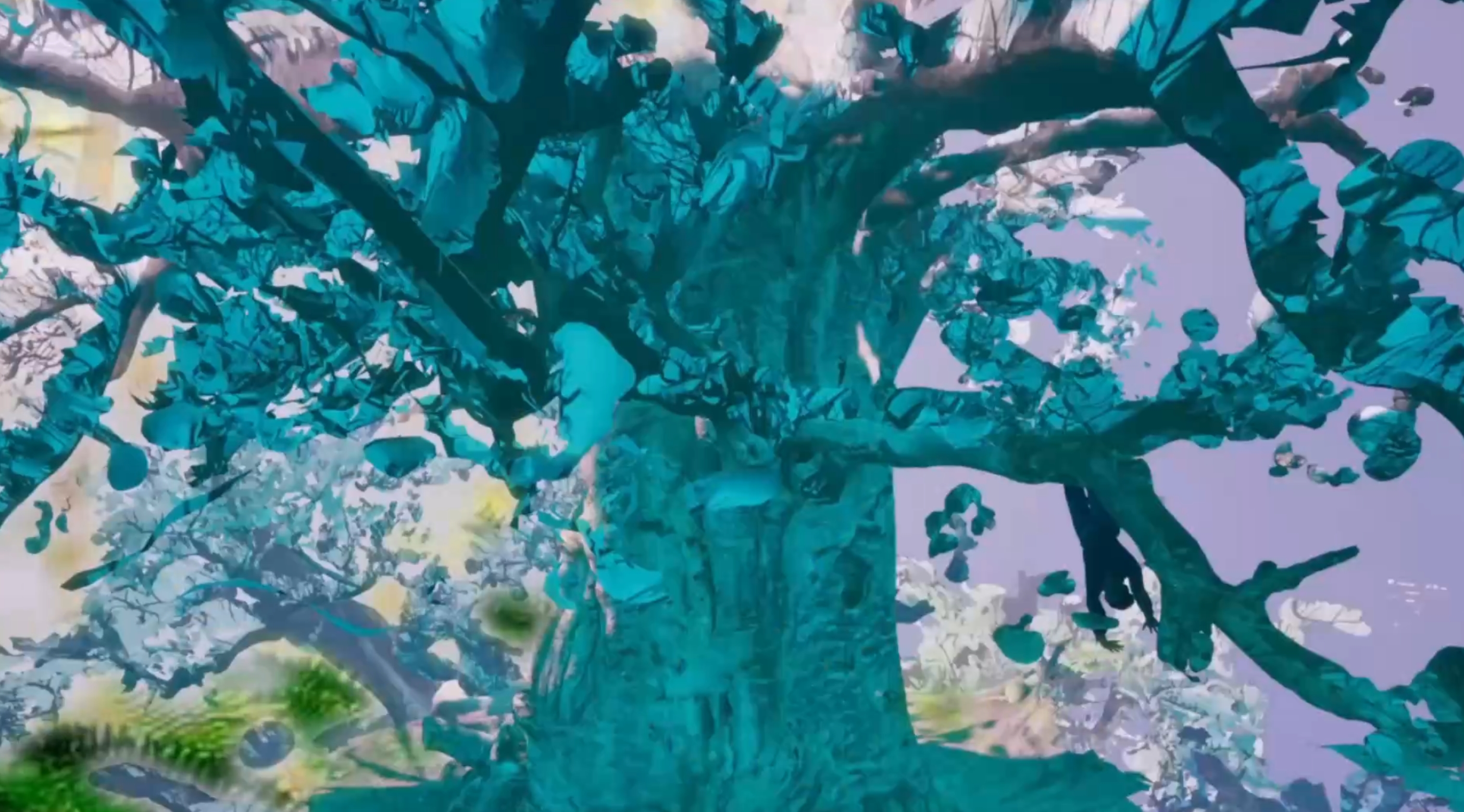
Isabelle Arvers, “Liquid Forest,” 2023–2024. Machinima with sound design by Gael Manangou. Courtesy of the artists
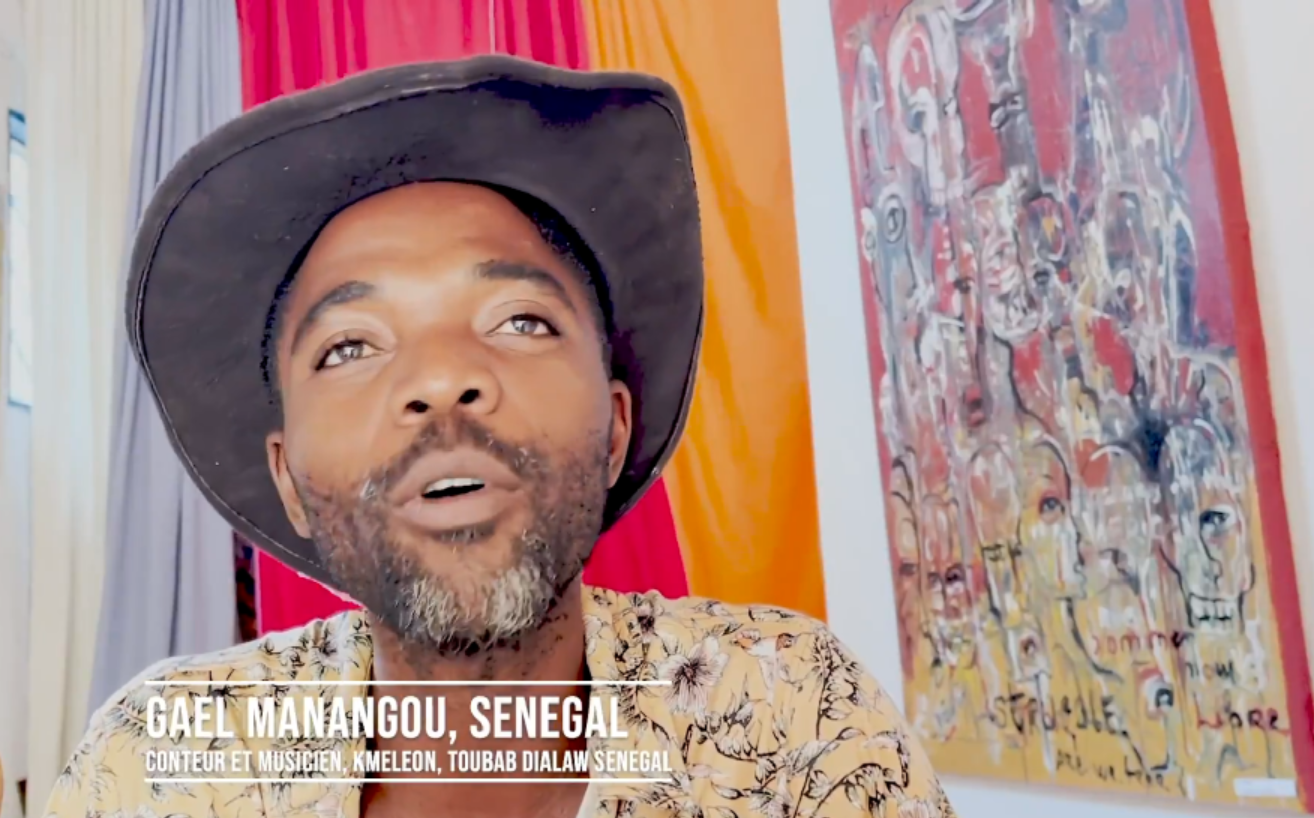
Isabelle Arvers, Livia Diniz & Bruno Qual, “The Power of Trees,” Documentary, 2023
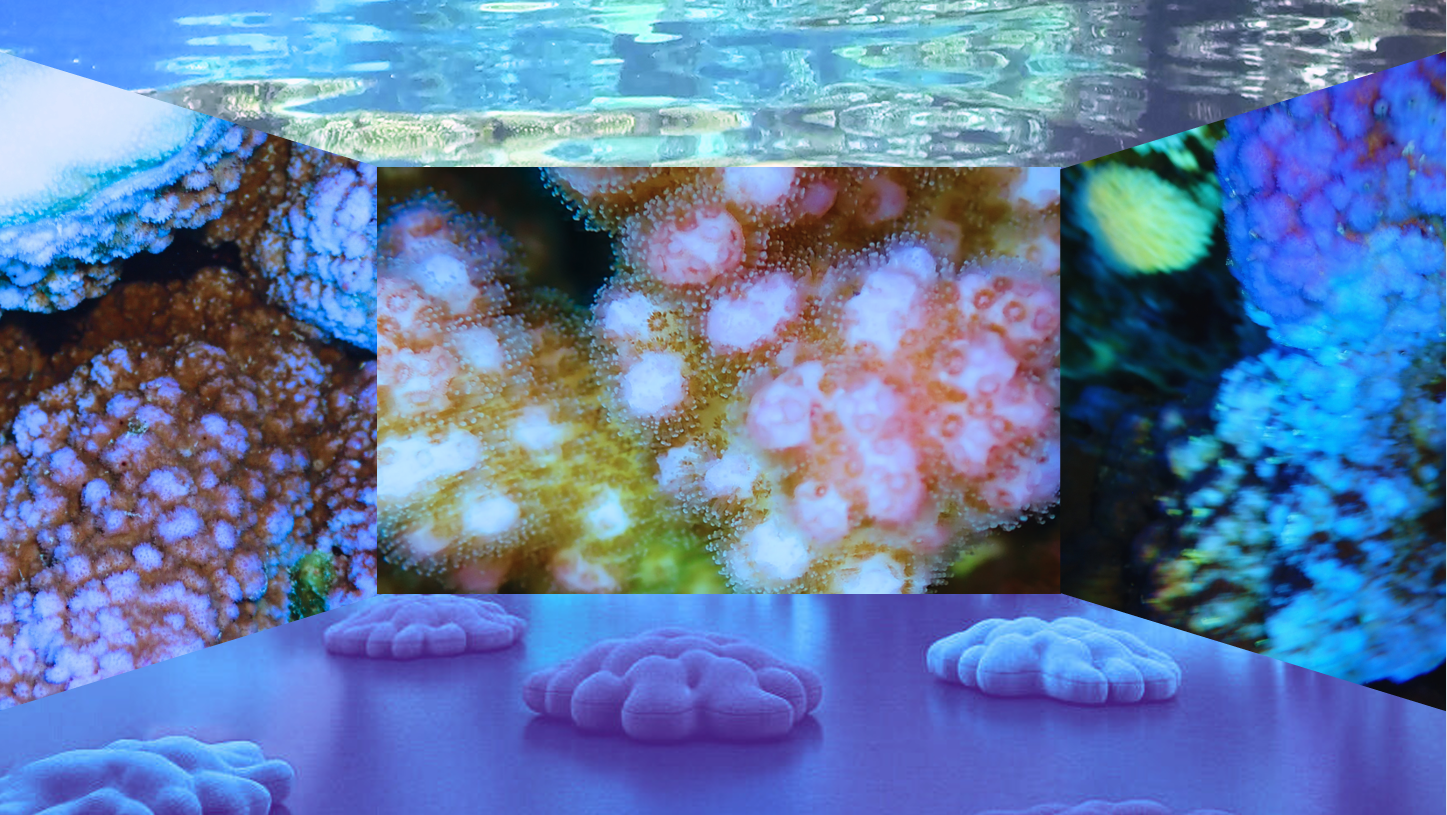
Isabelle Arvers, “Coral Sounds,” 2026, immersive installation on coral communication. Courtesy of the artist
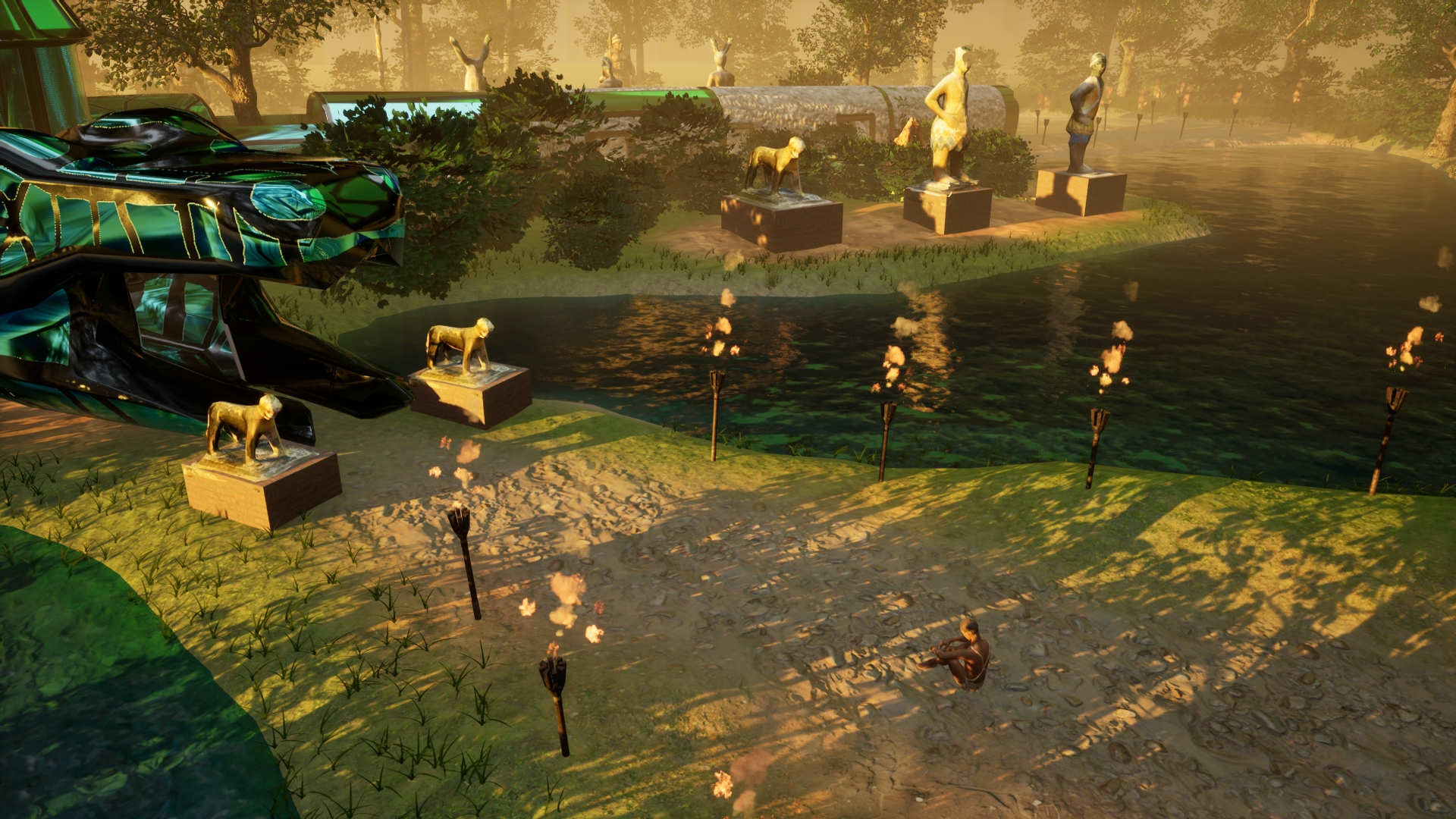
Isabelle Arvers, “Game of Ancestral Futures, ElonM Workshop,” 2026. Courtesy of the artist
Asakan: What are your artistic inspirations and influences? What themes and emotions do you seek to convey in your work?
Isabelle: The themes that run through my work are counter-fictions, technofeminism, queer and Indigenous struggles, interspecies imaginaries, co-creation, and ancestral and non-human knowledge.
My machinimas serve as a direct laboratory for these ideas: “Heroic Makers vs Heroic Land,” for example, explores how to recreate humanity in a refugee camp using a game engine; “La Mer” explores nonlinear forms, closer to sensation than to narrative; my series on trees—“Virtual Tree, Infinitree, Liquid Forest, La Puissance des arbres” — emerged from my work on the EDEN ARTECH scientific committee and my interviews with traditional Senegalese practitioners, and dissolves the boundaries between the kingdoms—baobabs, corals, vertical rivers—to make the fragility of ecosystems palpable; and finally, the triptych “Aux Futurs Ancestraux” translates the Vodun cosmologies of earth, water, and fire into play and imagery. In every case, I seek the same thing: an emotion strong enough to take action where discourse alone is not enough.
At the moment, it is Vodun cosmologies and the bioacoustics of coral reefs that most inform my research— “Coral Sounds” emerged directly from the gesture of “Liquid Forest,” which was already swimming among corals and trees—with, in the background, the same question: how to listen to and give form to worlds that the dominant narrative has rendered inaudible.
I have also been painting in parallel since 1995—a more intimate practice that stems from the same intention as my films: to connect with the elements and convey their vibration.
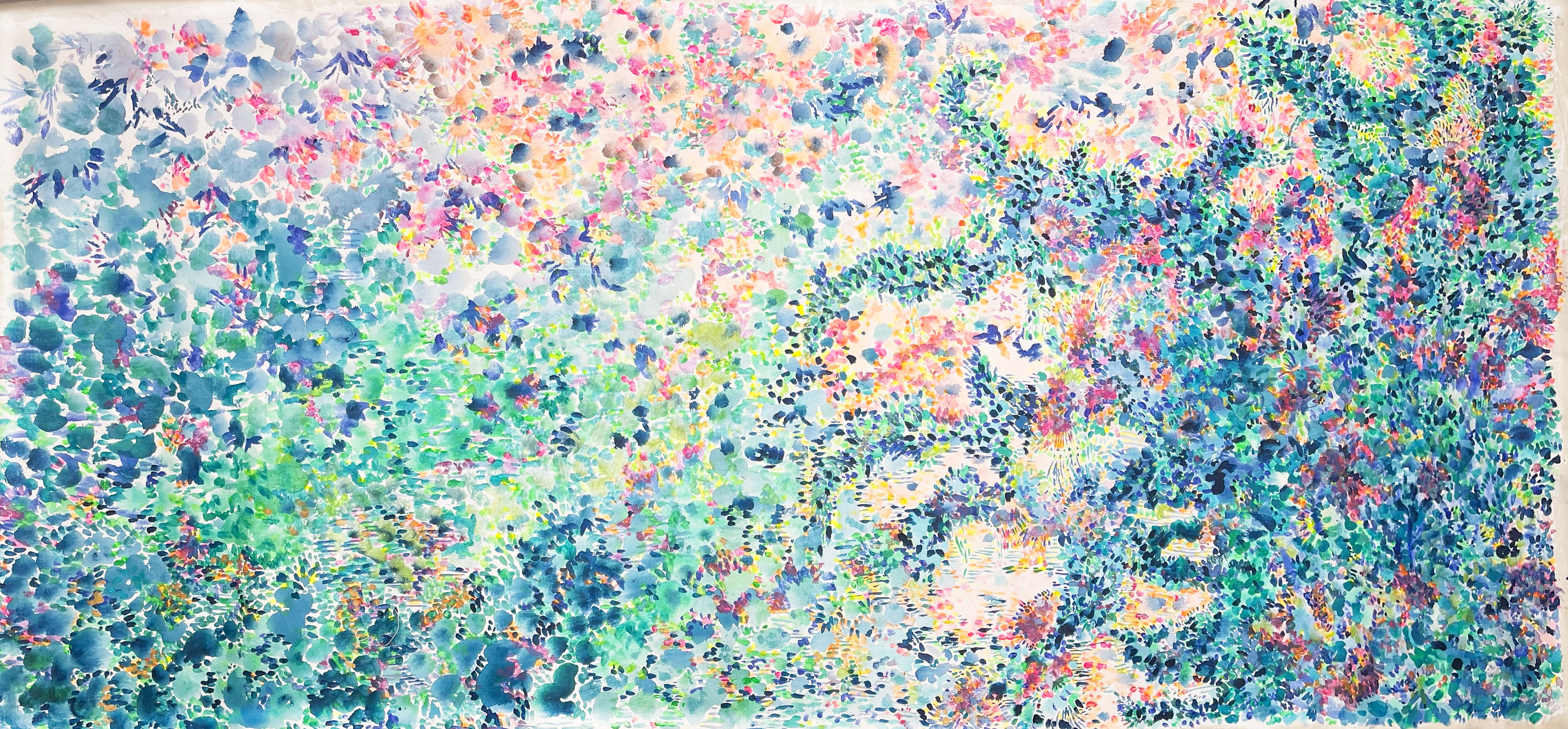
Isabelle Arvers, “Le Grand Zamana,” 2023. Acrylic on canvas. Courtesy of the artist
Asakan: How is your work perceived by the public? By the art community?
Isabelle: For “Aux Futurs Ancestraux,” the audience response was one of the strongest I’ve ever received.
At Espace Gantner, the installations immersed visitors in colors, scents, and music, and their ritualistic nature gave the audience a genuine sense of being cared for—several people told me they left feeling soothed, almost healed by the experience.
In Porto-Novo, the feedback took on a different dimension: many visitors came to thank us for the tribute paid to their ancestors, and the children were particularly happy to be able to play a video game set in Benin, within their own cosmologies.
During my first major video game exhibition at the Villette Numérique festival in 2002, the newspaper *Le Monde* wrote that the only appeal of this exhibition was to see
“thugs”… For a long time, video game exhibitions in a cultural context were misunderstood; since video games were not considered a cultural asset in France for many years, they had no place in art schools, museums, or art galleries and were mocked. That’s changing now, which is excellent news, but it’s still taking a little time. As for the institutional perspective, after 25 years, there is finally recognition of these practices.
Asakan: What advice would you like to share with other young people eager to pursue a career in art?
Isabelle: I’d say: don’t listen to all those who tell you that what you’re doing isn’t interesting or isn’t innovative enough, or that your practice is already over… Also, don’t just follow what others are doing; have dreams and make them come true.
Believe in your work because no one else can fight to promote it except yourself. Get out into the field, meet artists, rather than limiting yourself to what major institutions showcase.
I’d also say don’t hesitate to mix media—video games, machinima, sound, performance, and more—because the cosmologies and narratives that interest us most often defy disciplinary boundaries.
And finally, I’d add that you need patience: an artistic and curatorial practice is built over years, through relationships of trust, encounters, and intuition.
For more information on Isabelle Arvers’s work, visit her website isabellearvers.com, her accounts at https://youtube.com/zabarvers and https://vimeo.com/isabellearvers, or follow her on Instagram @zabarvers.
À lire également
With the Franco-Moroccan Illustrator La Bulle
His distorted drawings, often featuring solitary figures suspended in a neutral space, challenge our emotional perspectives on what we know about the…
With Karine Taïlamé, a multidisciplinary artist and exhibition curator from Martinique
Born in Martinique and a graduate of the Fine Arts schools in Martinique, Nice, and Paris, as well as the Haute École de Joaillerie in Aix-en-Provence…
With Violine Jacquot, a French painter based in Lausanne
Violine Jacquot, who was born and raised near Besançon, France, is a self-taught painter who lives and works in Lausanne, Switzerland. Inspired by the…
With Paul Moustapha Ledron, an artist and designer of Martinican origin based in Abidjan
At just 30 years old, Paul Ledron is a young designer whose work draws on Caribbean, African, and European cultural influences. With a master’s degree…
Commentaires