Coup de cœur
With Paul Moustapha Ledron, an artist and designer of Martinican origin based in Abidjan
At just 30 years old, Paul Ledron is a young designer whose work draws on Caribbean, African, and European cultural influences. With a master’s degree in branding from New Bulgarian University in Sofia, following a bachelor’s degree in industrial design from Brunel University in London, he doesn’t hesitate to use local materials from West Africa to create objects and furniture that reject a particularly expressive and maximalist aesthetic, but instead embraces an innovative, sophisticated, technologically ambitious, and forward-looking design, while retaining genuine cultural and emotional depth. He is our Favorite.
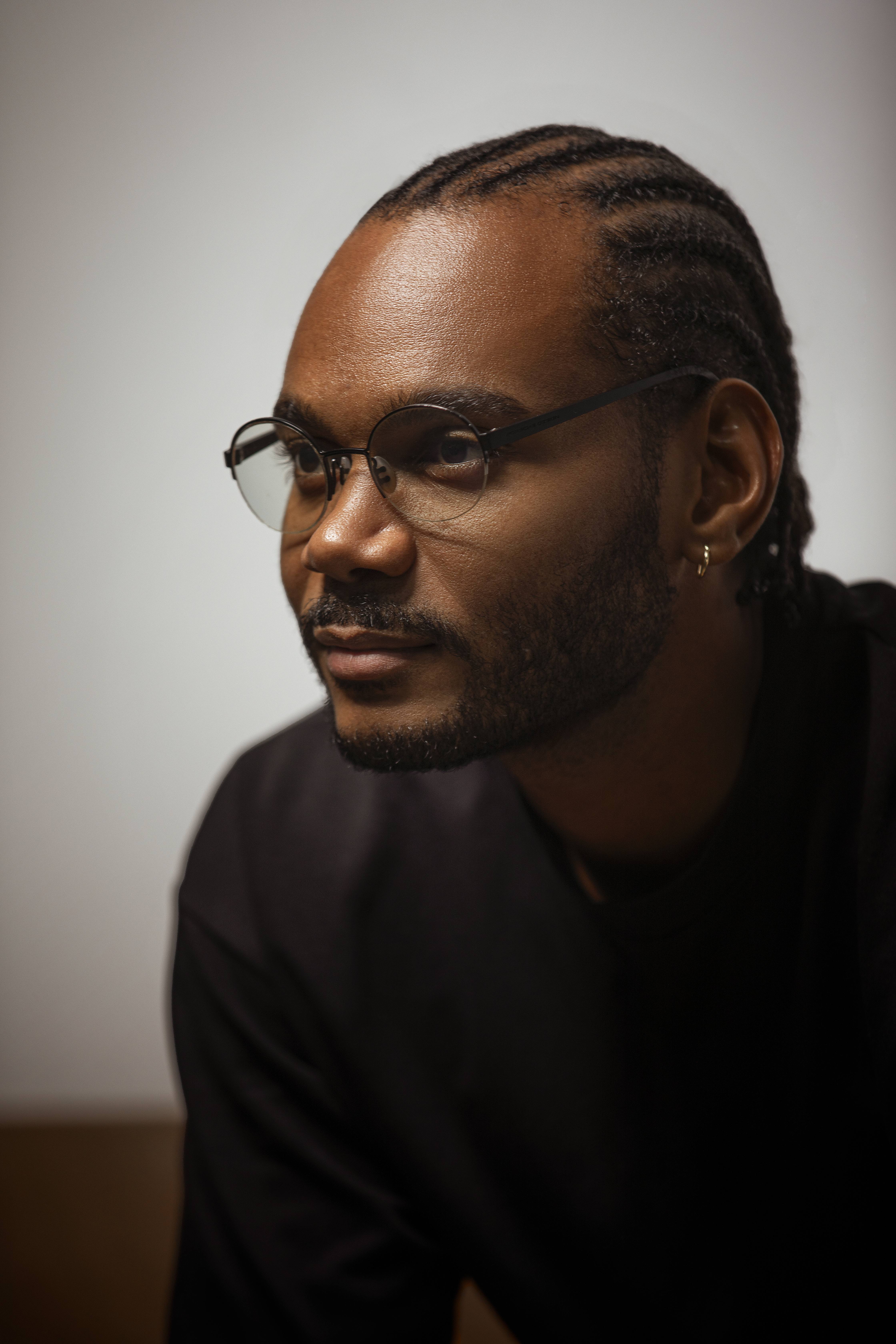
Asakan: To start our interview, would you like to introduce yourself?
Paul Moustapha Ledron: My name is Paul Moustapha Ledron. I’m a designer and artist based in Abidjan, Ivory Coast.
My practice lies at the intersection of art and design: I create both one-of-a-kind pieces and limited-edition works—similar to collectible design—as well as objects intended for mass production.
My identity is also shaped by a multicultural heritage. My mother is of Malian and German descent, while my father is from Martinique. I’ve lived in several West African countries and was also fortunate enough to travel extensively before settling in Côte d’Ivoire. These diverse roots and experiences naturally shape my perspective and my creative process.
Asakan: How would you define art? And how do you perceive contemporary art?
Paul Moustapha: For me, art begins when a work manages to evoke an emotion in another person. This emotion can be positive, uncomfortable, soothing, or even hard to define.
Thus, a work of art can fill us with wonder, but it can also unsettle us or make us feel uncomfortable. As long as it touches us and transforms—even briefly—the way we see or feel something, it falls, for me, within the realm of art.
I find contemporary art particularly stimulating because it allows new voices, new mediums, and new ways of thinking to emerge. Many artists today are exploring territories that are still largely unknown.
Nevertheless, I feel that the people who are truly seeking to renew artistic languages or propose radically new approaches are not always the ones who receive the most visibility.
Asakan: When did you realize you would devote your life to art?
Paul Moustapha: I wouldn’t exactly say I’ve dedicated my life to art. I’ve primarily dedicated myself to design, even though my practice today maintains a close dialogue with art.
Even as a child, I loved making things, combining ideas, and imagining new uses for them. I wanted to become an inventor, without really knowing that a career existed that matched that desire. It was in high school that I discovered industrial design. I immediately realized that this discipline—at the intersection of art, science, the humanities and social sciences, and technology—brought together several things that appealed to me: curiosity, creativity, and the search for solutions.
However, it wasn’t until after I finished my studies, around 2018 or 2019, that I truly realized I wanted to focus on furniture design. At the time, I was working primarily in graphic design and branding, but I continued to design furniture in my free time, simply for the joy of it. I then realized that this practice had naturally taken on a central role in my life and that I needed to make more room for it so it could fully express itself.
Furniture allows me to balance function with personal expression. And even though an object must fulfill its purpose, I’m just as interested in its history, its materials, the craftsmanship that went into making it, and the emotional connection we can develop with it.
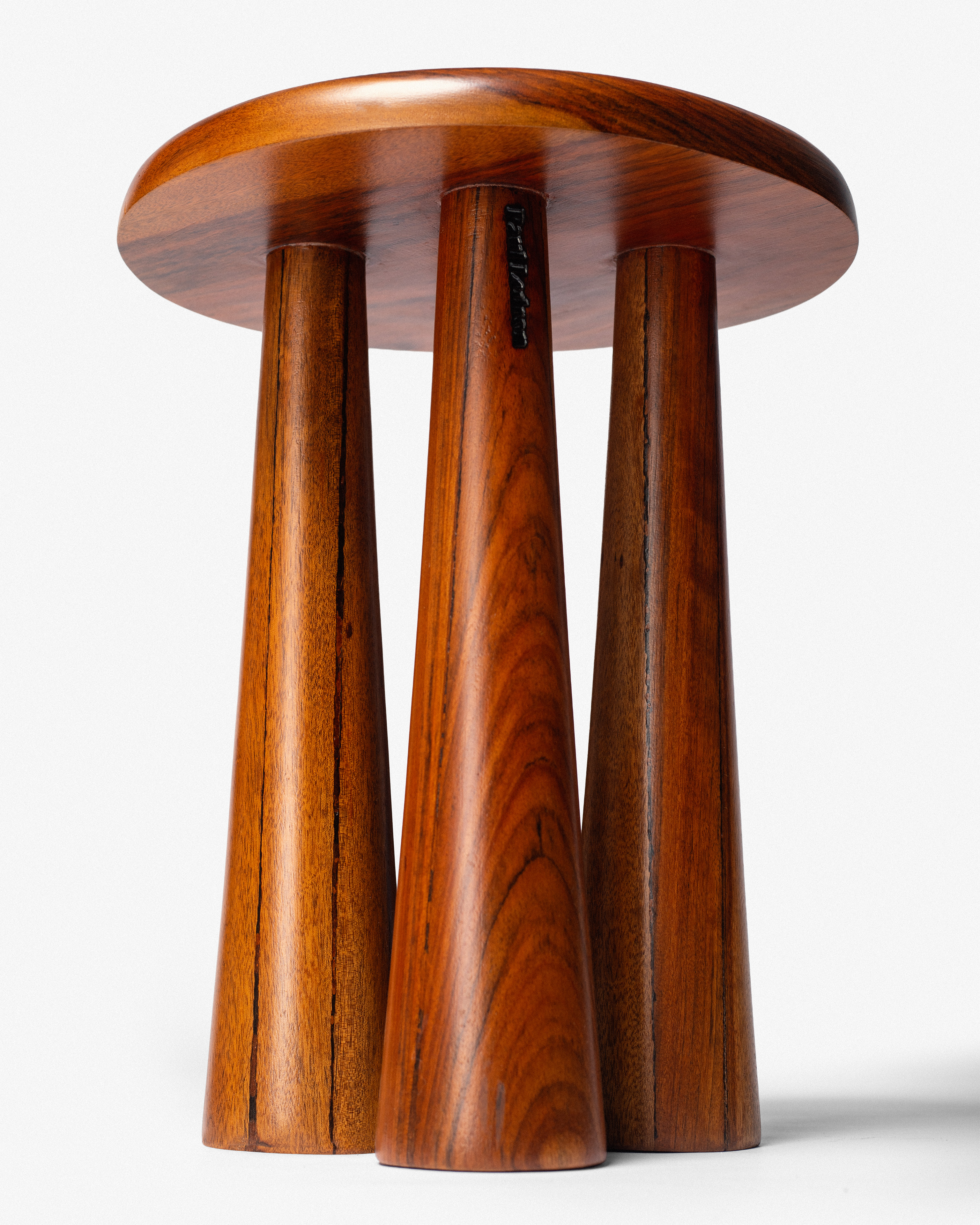
Paul Moustapha Ledron, “Sédjan,” 2023. Wooden stool made of Amazakoué wood with a matte finish, 42 × 33 × 33 cm. Photo credit: Pimii Pango (@pimiipic)
Asakan: As an artist, how would you define yourself? How did you come to develop your distinctive style?
Paul Moustapha: I define myself first and foremost as a designer, even when some of my creations take the form of art pieces. Design seeks to address a need or a problem. In my work, one of these issues is the lack of cultural representation in our contemporary interiors.
I therefore seek to create objects that carry a memory and are culturally relevant, whether they are one-of-a-kind pieces or mass-produced items. This aspect can be expressed through a material, a narrative, a craft technique, or even a familiar form whose function I transform.
My artistic language has emerged from the intersection of my training in industrial design and a more artistic, narrative, and cultural sensibility, even though I don’t consider my artistic voice to be fully formed. It is constantly evolving. It took me several years just to begin to recognize a direction that felt truly personal to me. Even today, I can design an object that I find beautiful, yet still feel that it doesn’t quite capture what I’m trying to express.
I can’t always explain precisely what makes a piece fully “Paul Moustapha Ledron,” but I can sense it when it strikes the right note.
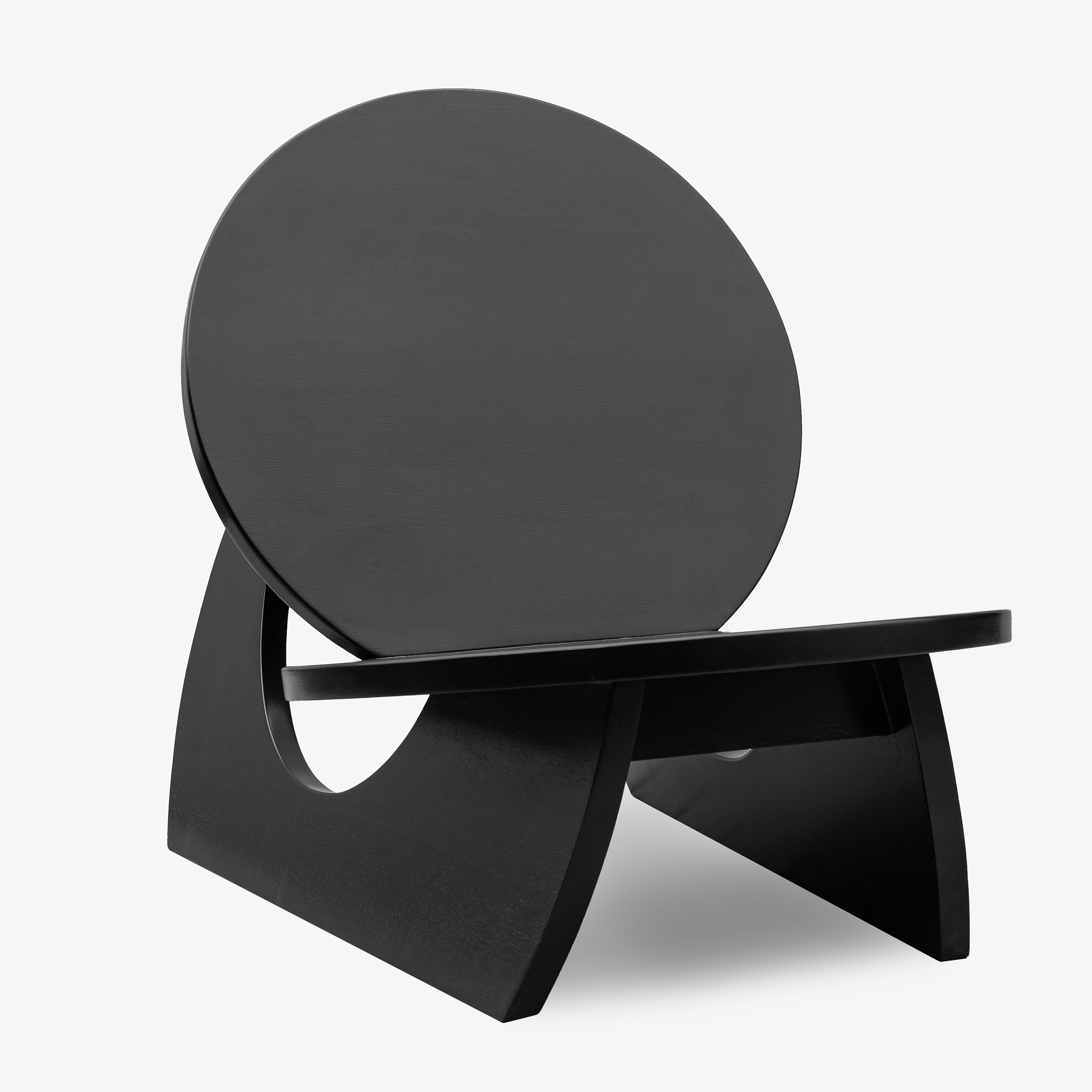
Paul Moustapha Ledron, “Sama,” 2023. Fraké wood armchair, black paint, 82 × 65 × 105 cm Photo Credit: Paul Moustapha Ledron (@paul.ledron)
Asakan: What are your artistic inspirations and influences? What themes and emotions do you try to convey in your works?
Paul Moustapha: My influences stem more from certain approaches and movements than from a specific list of favorite artists. I’m particularly drawn to Japanese minimalism, which I believe manages to preserve warmth, life, and an emotional presence while focusing on the essential. Simplicity doesn’t mean the absence of all sensitivity.
I’m also interested in Japan because of its ability to maintain a strong connection to its history and traditions while remaining at the forefront of creativity and innovation. It’s a balance I’d like to see more of in African design: contemporary and ambitious objects that fully engage with international trends without abandoning their cultural roots.
Among the designers who inspire me are Constantin Brâncuși and Isamu Noguchi, for the way they work with form, material, and the presence of the object. I also appreciate the work of Studio David Pompa in Mexico, particularly for its use of local materials in a decidedly contemporary style. I also follow with great interest the work of ALTIN Studio, a design studio based in Tunisia, which creates beautiful pieces using natural materials, local resources, and traditional techniques.
Through my work, I seek primarily to convey a sense of cultural pride, but also curiosity. I want to show that it’s possible to be deeply attached to one’s culture while also evolving it and offering something new.
I reject reductive interpretations of African creativity that suggest it is defined primarily by scarcity, recycling, or resourcefulness, or that it must necessarily adopt a particularly expressive and maximalist aesthetic. African design can be innovative, sophisticated, technologically ambitious, and forward-looking, while retaining genuine cultural and emotional depth.
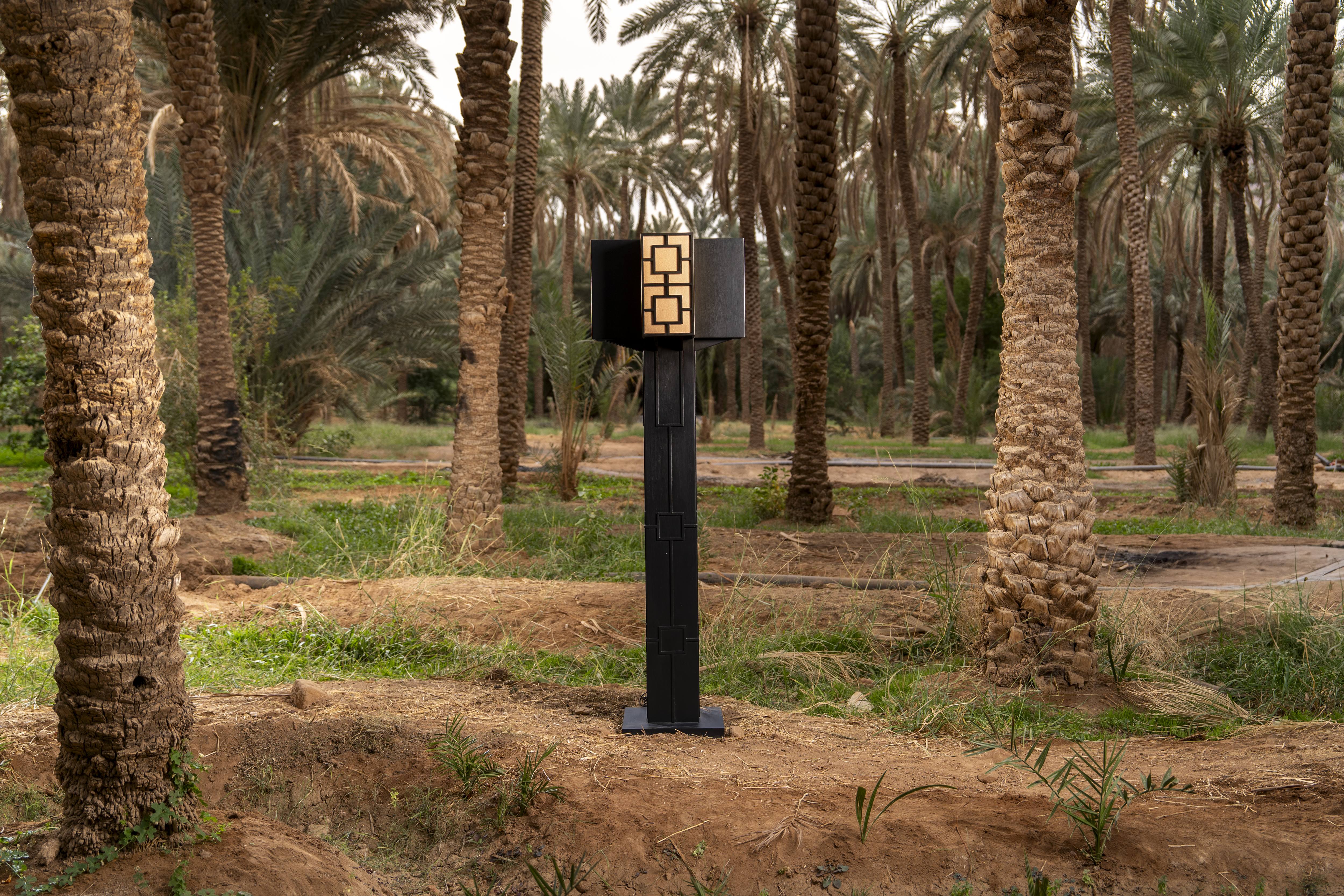
Paul Moustapha Ledron, “Tamara Ja,” 2025. Totem-style light fixture made of meranti wood, hand-crafted palm-leaf paper tiles, and black paint, 195 × 60 × 60 cm Photo credit: Paul Moustapha Ledron (@paul.ledron)
Asakan: How is your work perceived by the public and the art community?
Paul Moustapha: How my work is perceived depends a great deal on the person looking at it. I’ve noticed that people who have a connection to West Africa—whether because they’re from there, live there, or have lived there—often find it easier to recognize the references in my pieces. They recognize a certain familiarity, even when it’s expressed in a contemporary or indirect way.
When I exhibit outside the African continent—particularly in the West—some people sometimes feel that my work doesn’t seem “African” enough. This reaction can be frustrating, but it raises an important question: What do people expect from an African object, and by what standards do they judge its “African-ness”?
My work is African because it stems from my experience; it is conceived and produced in Africa, using materials, techniques, and craftsmanship tied to this vast continent. But it does not necessarily seek to replicate the forms of the past. It contributes to the development of a new and contemporary African language.
I believe our generation has a specific role to play in broadening this perception. We must be able to create works that express our current realities, without having to conform to a static or inherited image of Africa. That is also what motivates me in my research.
Asakan: What advice would you like to share with other young people eager to pursue a career in art?
Paul Moustapha: I would advise them to be fully themselves and not to apologize for what they want to create. It’s not about living in a bubble or ignoring others. You have to stay curious, observe the world, listen to criticism, and understand how your work is received.
But you also have to learn to filter that feedback. Not every comment needs to be incorporated into your work. It’s up to the artist or designer to decide which comments can help them grow and which might lead them away from their own vision. Because, before trying to please others, follow a trend, or conform to a dogma, you have to strive to create something that truly reflects who you are and that you believe in.
For more information on Paul Moustapha Ledron’s work, visit his website at paulledron.com or follow him on Instagram @paul.ledron.
À lire également
With the Franco-Moroccan Illustrator La Bulle
His distorted drawings, often featuring solitary figures suspended in a neutral space, challenge our emotional perspectives on what we know about the…
With Karine Taïlamé, a multidisciplinary artist and exhibition curator from Martinique
Born in Martinique and a graduate of the Fine Arts schools in Martinique, Nice, and Paris, as well as the Haute École de Joaillerie in Aix-en-Provence…

With French Artist and Curator Isabelle Arvers
A pioneer in art and video games in France, as well as a curator and painter, Isabelle Arvers (born in 1972) grounds her work at the intersection of a…
With Violine Jacquot, a French painter based in Lausanne
Violine Jacquot, who was born and raised near Besançon, France, is a self-taught painter who lives and works in Lausanne, Switzerland. Inspired by the…
Commentaires