Coup de cœur
With Angela Koua Houphouët, an Ivorian painter based in New York
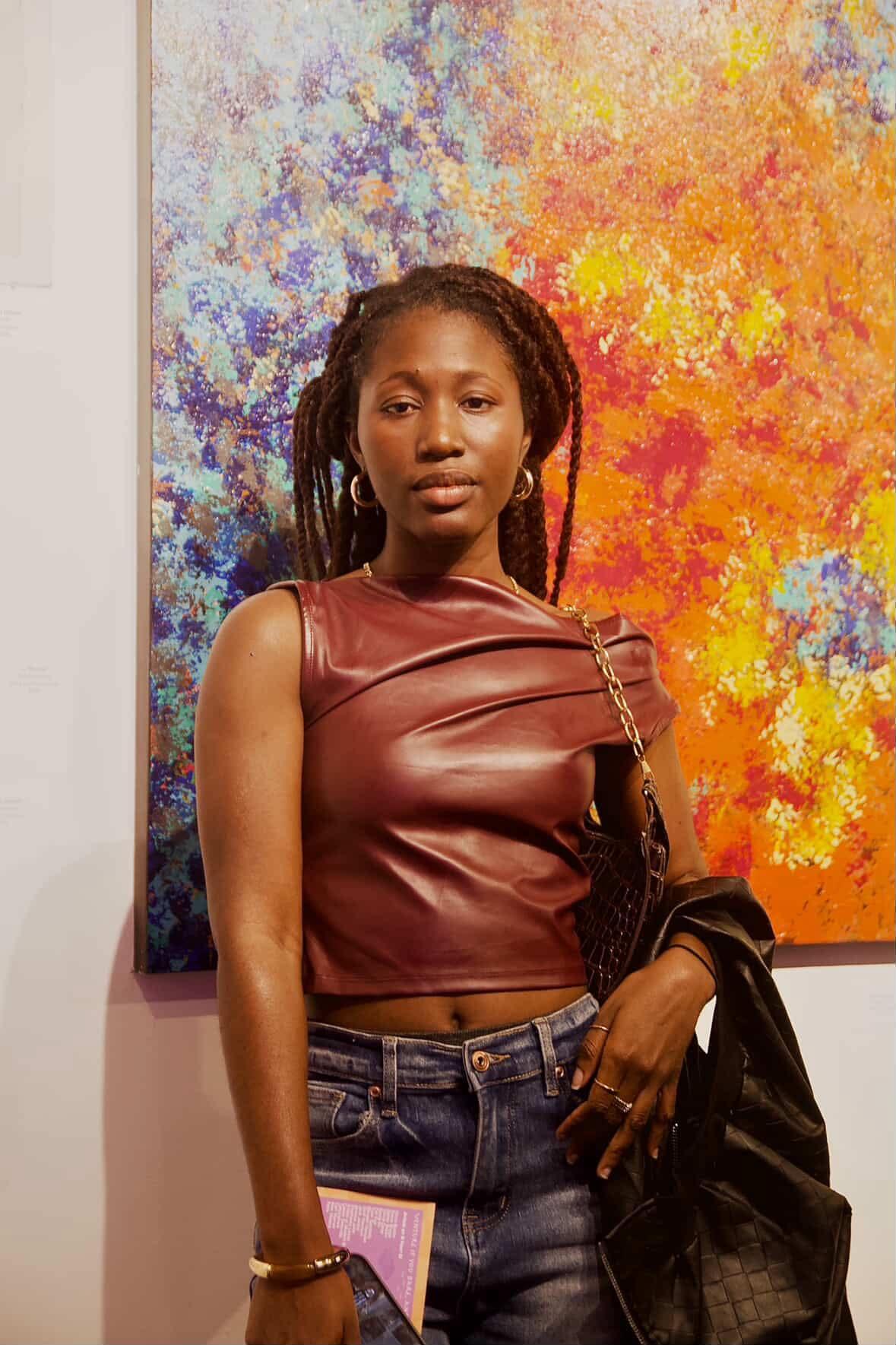
Houphouët Koua is a young painter born in 2002 in Abobo, in the city of Abidjan, Ivory Coast. While studying interior design at INSAAC, she taught herself to paint during the COVID-19 pandemic. Two years later, she moved to New York City in the United States, where she explores identity, the invisible dynamics of human relationships, and the inner transformations they can bring about. She is our Favorite Artist.
Asakan: To start our interview, would you like to introduce yourself?
Angela Koua Houphouët: My name is Houphouët Angela Koua. I am a self-taught painter, born and raised in Côte d’Ivoire. I currently live in the United States, in New York State.
My artistic journey has developed gradually, shaped by my personal history, my experiences, and my desire to translate into images emotions or realities that are sometimes difficult to express in words.
Asakan: How would you define art? And how do you view contemporary art?
Angela Koua: For me, art is above all a way to express my emotions, to let go, and to free myself from what I might be holding inside.
I also see art as a powerful tool for speaking out, reflecting, and learning. Artists can sometimes express what others are unable to put into words. Through a work of art, they can challenge, question, and even change the way we view certain subjects or realities.
When it comes to contemporary art, I find that it is much more accessible today—and above all, much broader and freer—than it used to be. It’s precisely this freedom that I love so much: the ability to break the rules, experiment, and express myself with true individuality, without necessarily having to fit into a specific framework.
Asakan: When did you realize you would devote your life to art?
Angela Koua: At first, I enrolled at the Institut National Supérieur des Arts et de l’Action Culturelle (INSAAC) in Abidjan to study interior design. It was during that time that I literally fell in love with painting. I began teaching myself and training on my own, and that’s really when it all started.
Painting came into my life during a rather dark period. It allowed me to express certain deeply buried emotions, to visualize what I couldn’t always explain with words. Little by little, it took on an increasingly important role in my life until it became second nature.
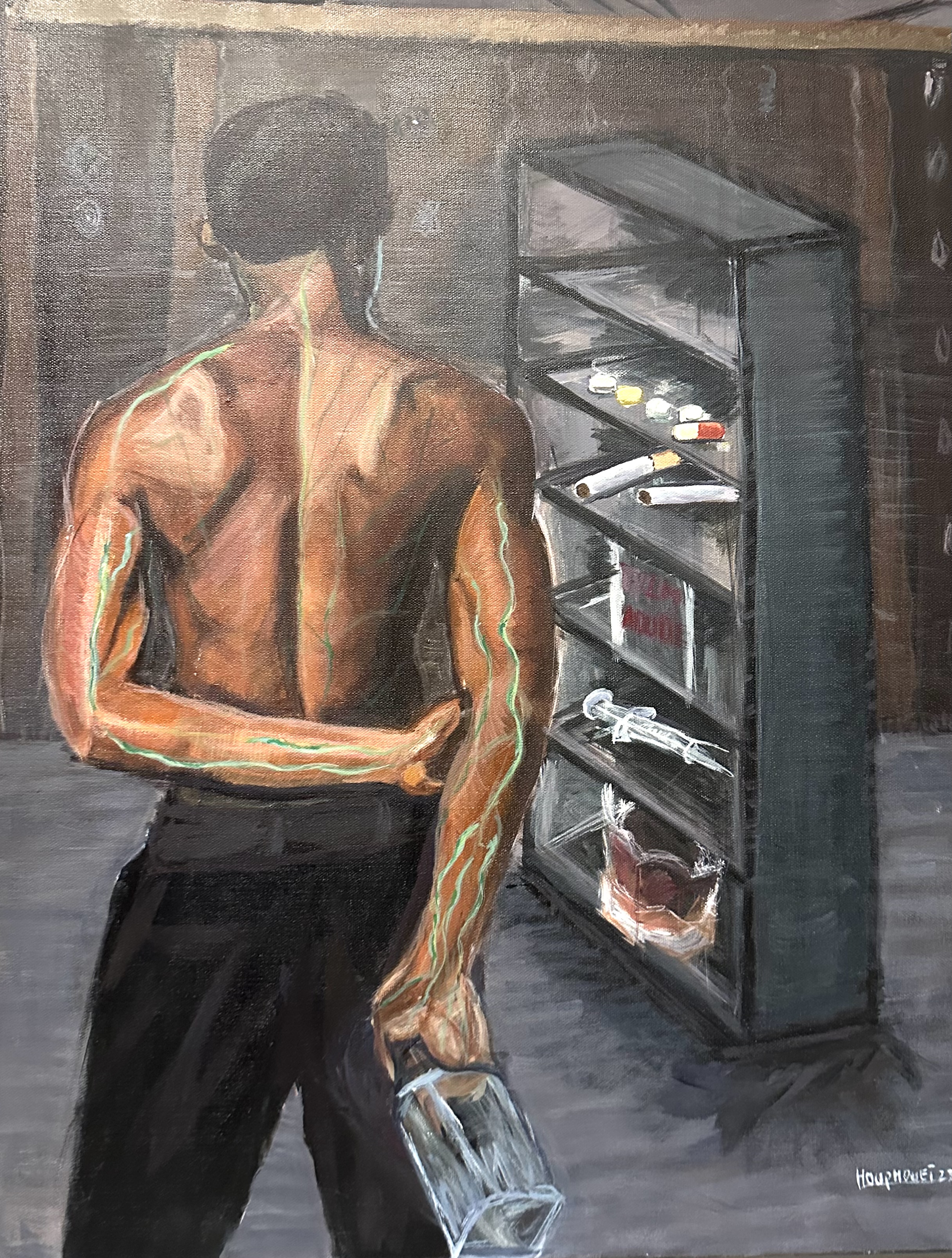
Angela Koua Houphouët, “L’Etreinte du vide,” 2023. Acrylic on canvas, 56.5 x 71 cm. Courtesy of the artist
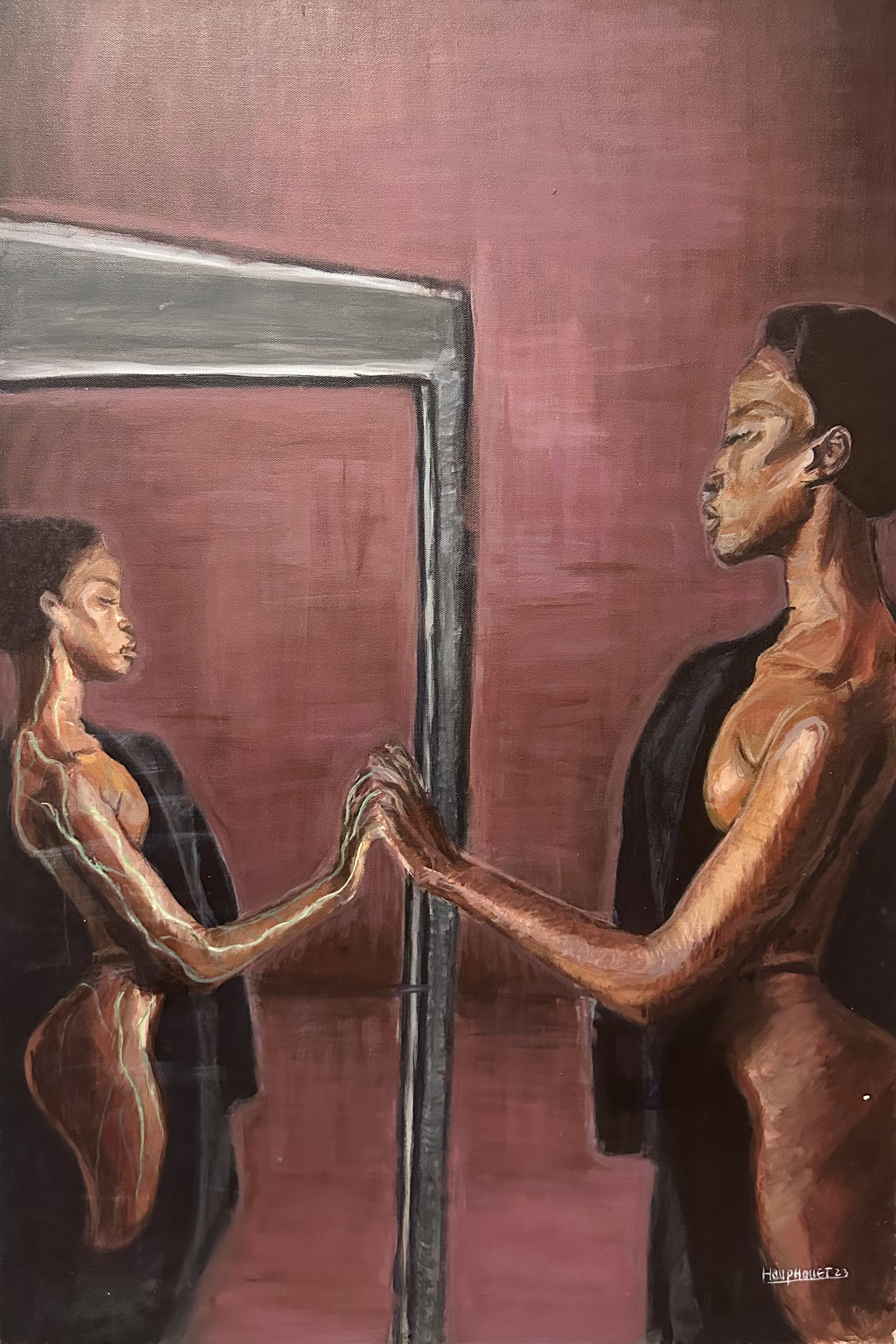
Angela Koua, “Toward the Essence,” 2023. Acrylic on canvas, 61 x 92.5 cm. Courtesy of the artist
Asakan: As an artist, how would you define yourself? How did you come to develop your distinctive style?
Angela Koua: I would describe myself as a free and committed artist.
Free, because I don’t like feeling confined to a specific way of creating. I like being able to follow an idea, an emotion, or an intuition and let each work find its own direction.
Committed, because my work doesn’t just seek to create something beautiful. I like to tackle human, emotional, and sometimes social themes. Many of my works explore what we don’t necessarily see in a person: their wounds, contradictions, pressures, fears, or hidden emotions.
My artistic style has developed naturally over time. At first, I was mainly looking to experiment and understand what felt true to me. Then certain elements, certain ways of representing emotions, and certain symbols began to recur in my work. But I think this style will continue to evolve, because I myself am evolving as a person and as an artist.
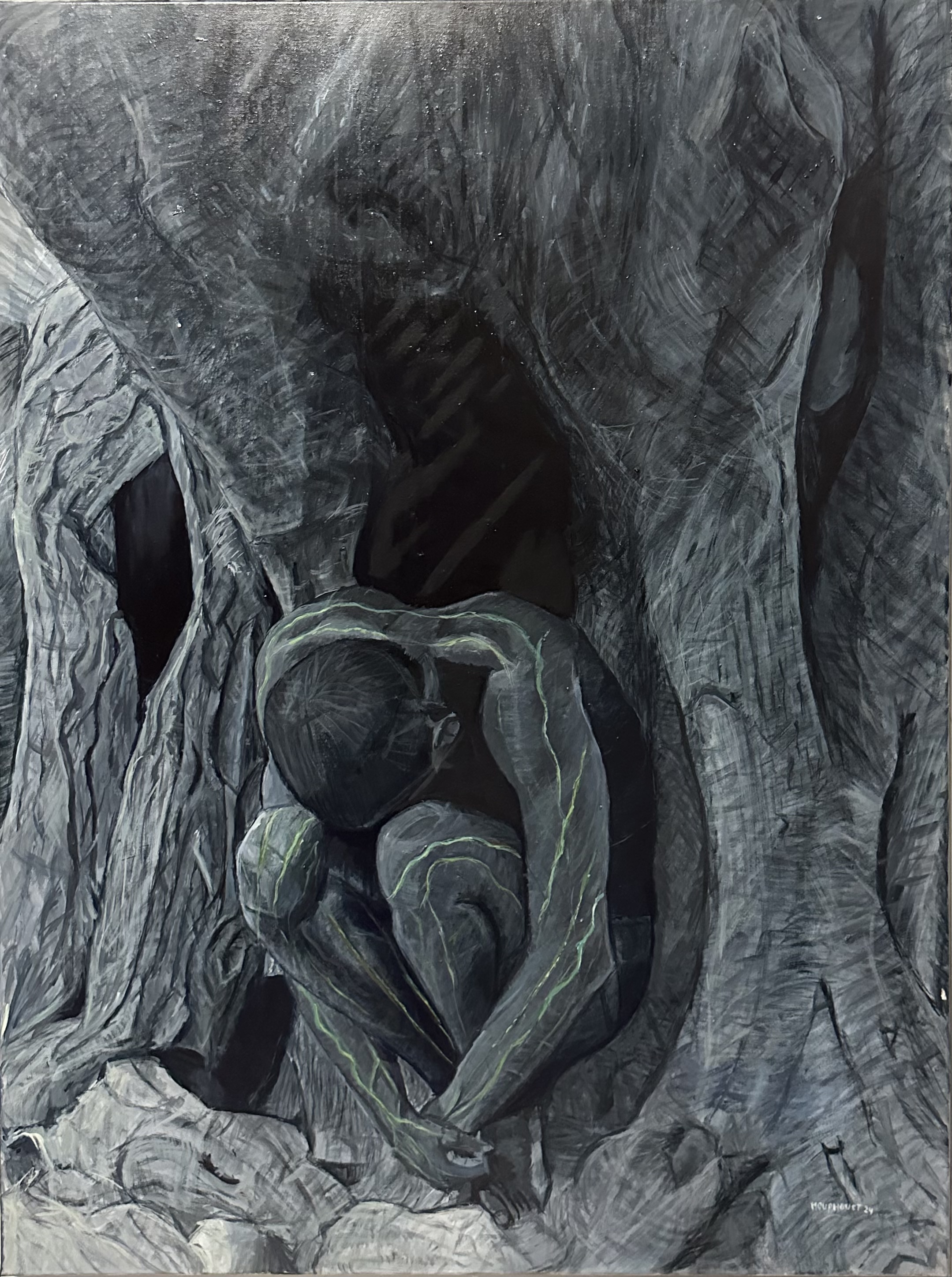
Angela Koua, “Silent Echo,” 2024. Acrylic on canvas, 91 x 122 cm. Courtesy of the artist
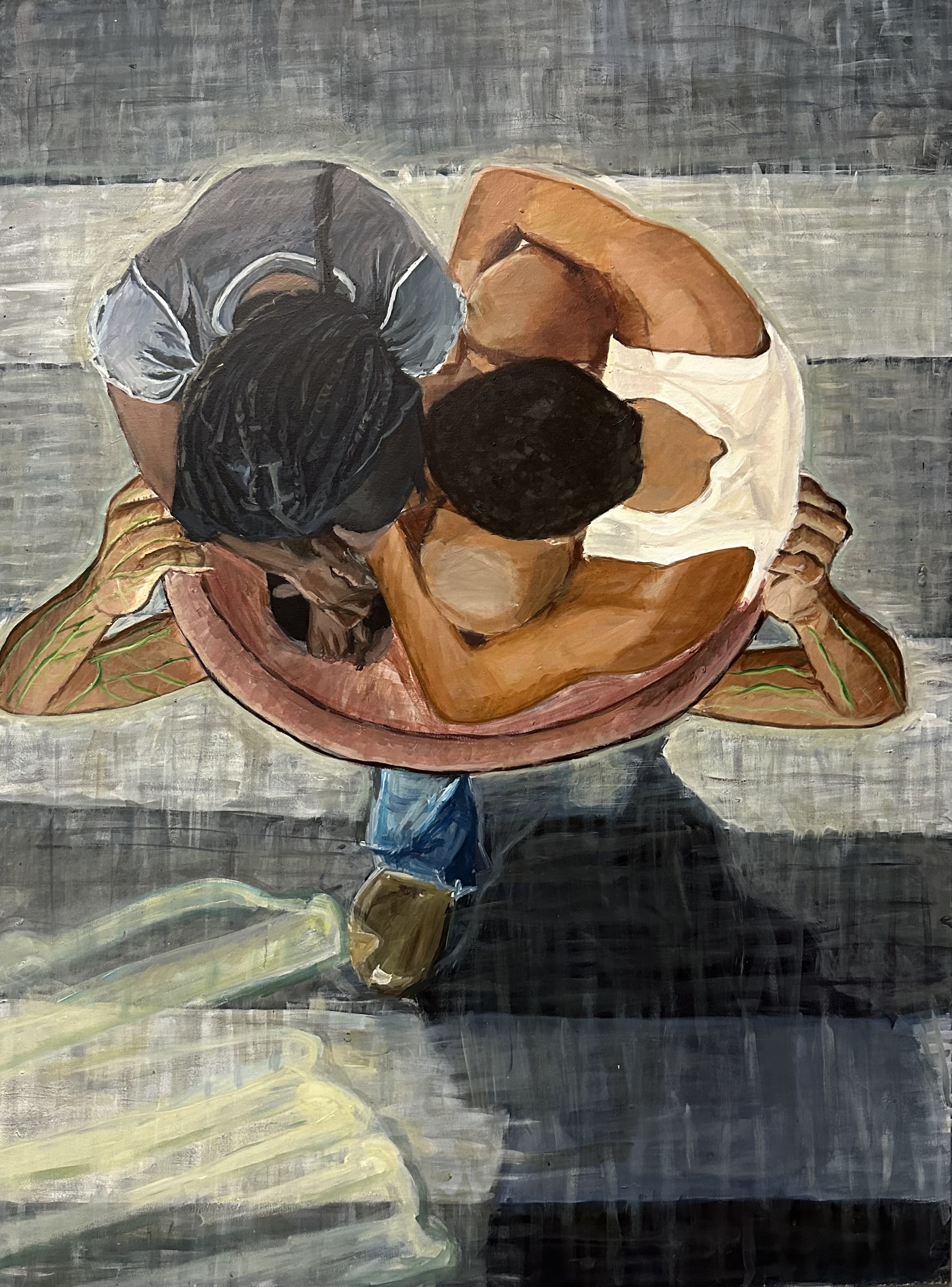
Angela Koua Houphouët, “Le Fret,” 2025. Acrylic on canvas, 91 x 122 cm. Courtesy of the artist
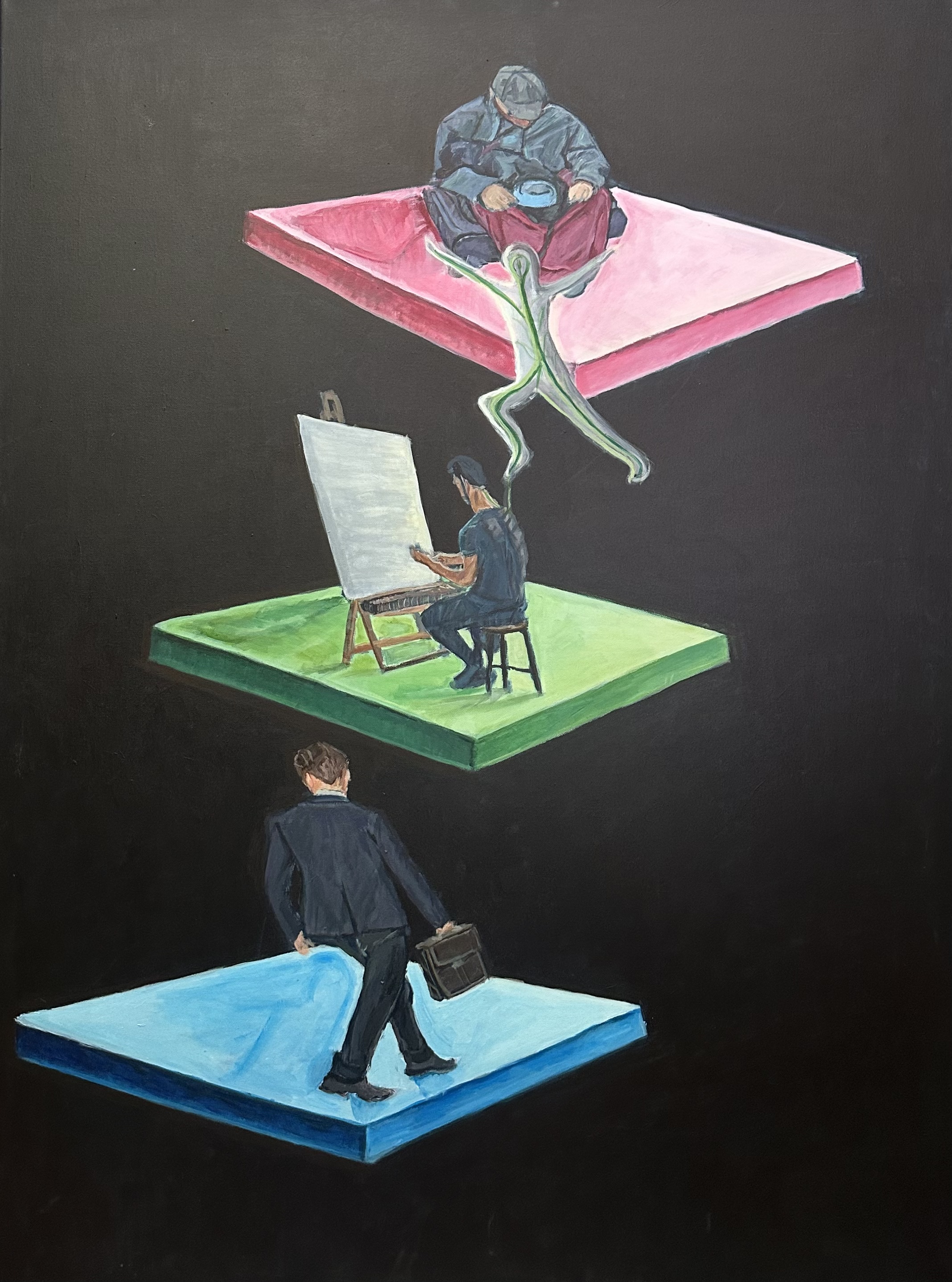
Angela Koua Houphouët, “Spectrum,” 2026. Acrylic on canvas, 91 x 122 cm. Courtesy of the artist
Asakan: What are your artistic inspirations and influences? What themes and emotions do you try to convey in your works?
Angela Koua: I don’t really have a specific artistic influence.
My first major influences were probably the painting students at INSAAC in Abidjan. When I was in school, I’d watch them work, experimenting with colors, shapes, and different techniques. That made me want to explore painting myself.
Today, my inspiration comes mainly from life in general and from my surroundings. I can draw inspiration from my failures, my victories, my sorrows, my doubts, or my own questions.
My inspiration can also come from a friend’s story, a conversation, a movie, a simple video on social media, or even a social issue. I’m very attuned to human emotions and the things we don’t always say out loud.
My latest series, “Behind the Scenes,” is a series of four works that explores the invisible dynamics of human relationships and the inner transformations they can bring about. Through various stages, the series first examines reciprocity—the moment we realize that what we give no longer finds its equivalent in the other person. It then addresses expectation—when our well-being or self-worth begins to depend on what we hope to receive. It also examines how we view ourselves—that need to sometimes step back in order to better understand and readjust. Finally, it explores detachment, represented as an inner separation: a blurred presence that gradually leaves a body to which it still belonged.
Throughout the series, the body thus becomes a symbolic space where realities that are usually invisible take shape: the weight of imbalance, loss, awareness, distance, and transformation.
The choice of a style inspired by CT scans stems directly from the series’ title itself, “L’Envers du Décor,” which seeks to reveal what is usually hidden. Just as a CT scan allows us to see beyond the body’s surface, I use it here as a metaphor to reveal what cannot be observed with the naked eye: emotions, behaviors, inner conflicts, attachments, and psychological transformations.
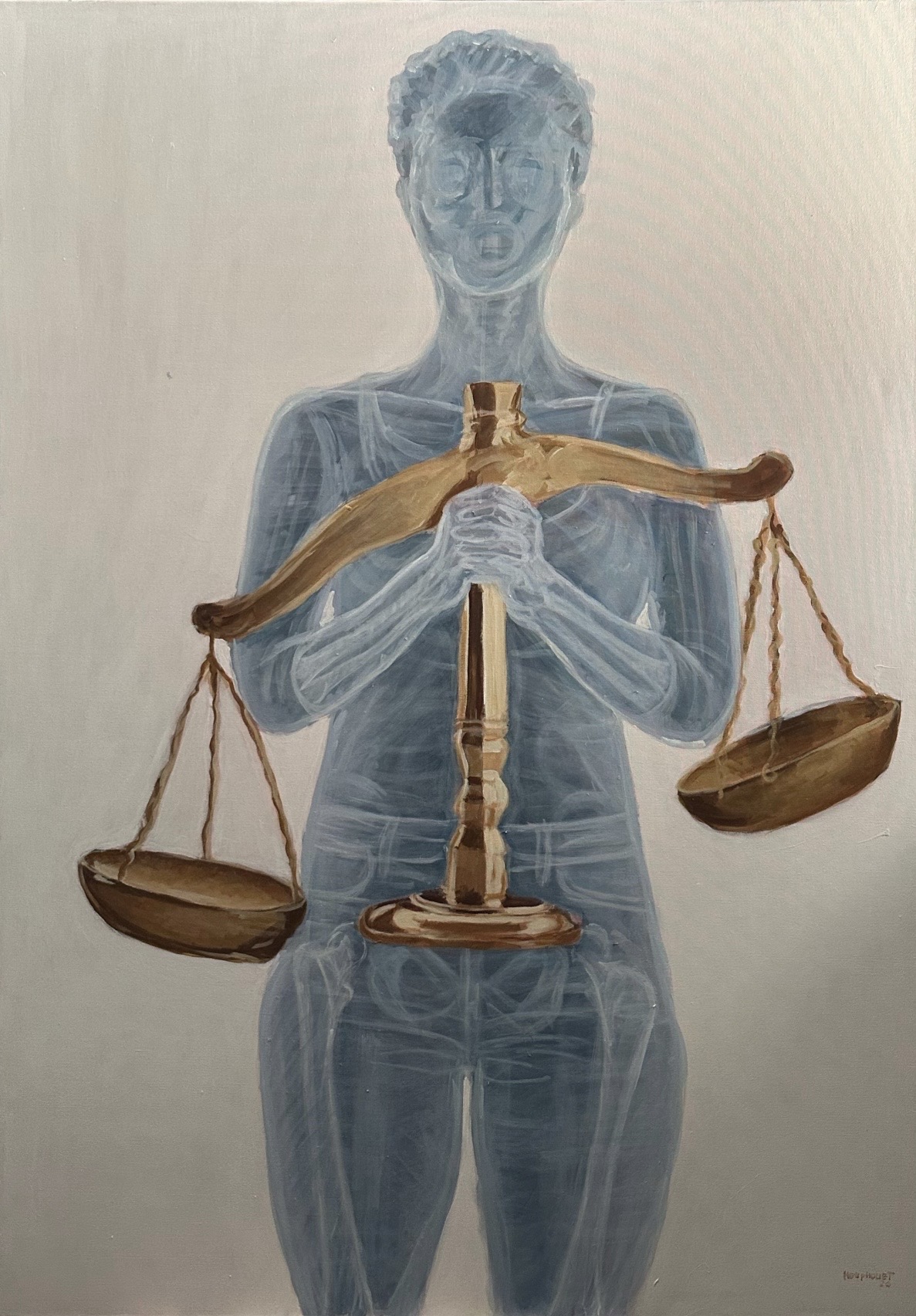
Angela Koua Houphouët, “Mutuality,” 2026. Acrylic on canvas, 91 x 122 cm. Courtesy of the artist
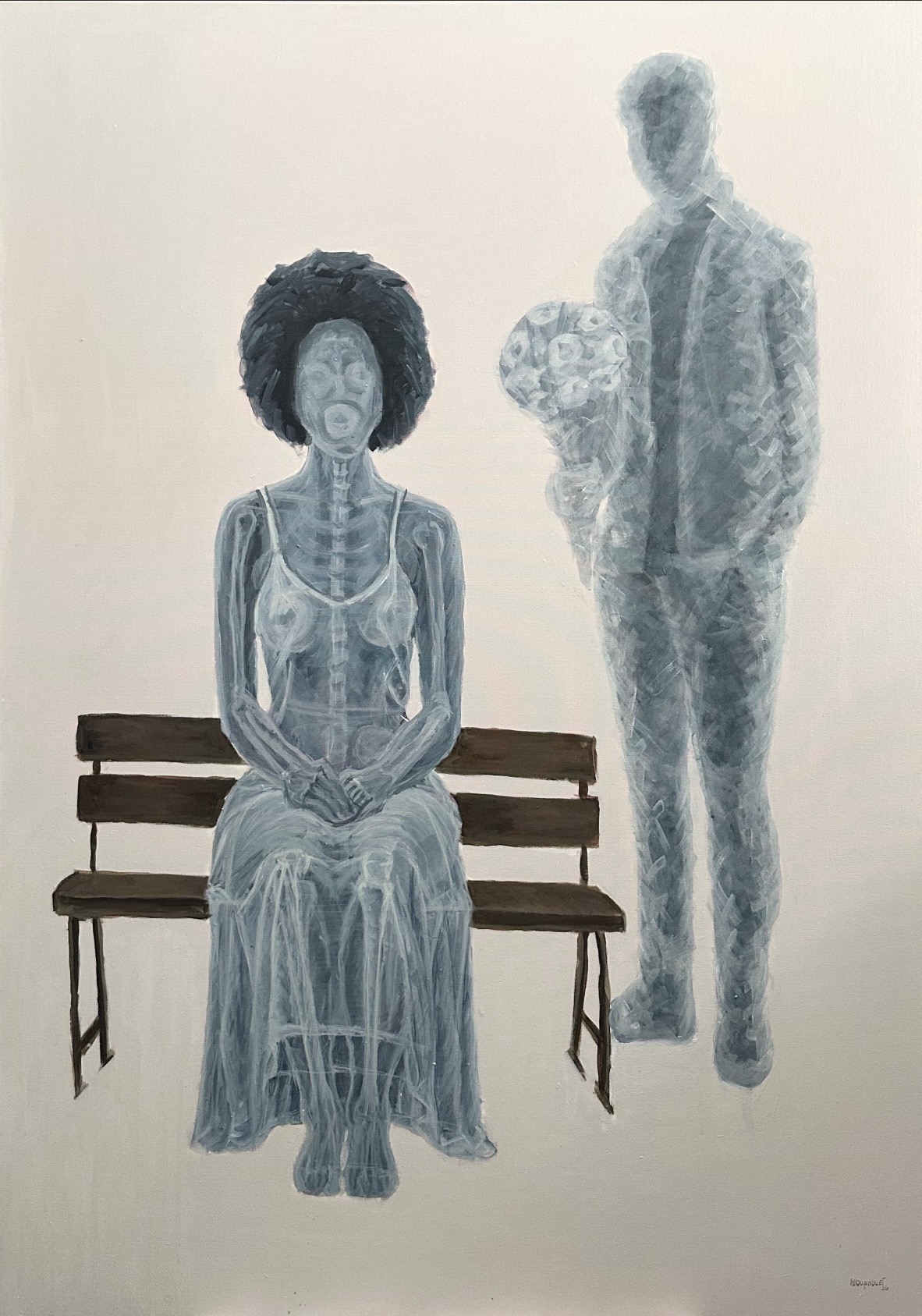
Angela Koua Houphouët, “Longing,” 2026. Medium: Acrylic on canvas, 91 x 122 cm. Courtesy of the artist
Asakan: How is your work perceived by the public? And by the art community?
Angela Koua: I think the reception of my work has been quite positive. Since I started out, I’ve been fortunate to receive a lot of encouragement, especially from other artists who appreciate my work and who have often encouraged me to keep going and never give up on art.
What also touches me is when people are able to see themselves reflected in a piece or feel something when looking at it. For me, the moment a work succeeds in evoking an emotion, sparking reflection, or creating a connection with someone, it has already accomplished something.
Asakan: What advice would you like to share with other young people who want to get started in art?
Angela Koua: Above all, I’d tell them to dare to start, even if what they create at first isn’t perfect. You improve with time, practice, and experience. So, above all, don’t let perfectionism become an excuse for never finishing or never showing your work.
I’d also tell them not to always try to overcomplicate things. Very often, the simplest things are also the most powerful and effective.
Finally, I think you have to learn not to pay too much attention to preconceived notions, to believe in your vision, and above all, to trust yourself. Because you never know how far an idea can take you. You could be the person who brings something new to the table and changes everything.
For more information on Angela Koua Houphouët’s work, visit her website at https://houphouetart.carrd.co or follow her on Instagram @houphouet_koua.
À lire également
With the Franco-Moroccan Illustrator La Bulle
His distorted drawings, often featuring solitary figures suspended in a neutral space, challenge our emotional perspectives on what we know about the…
With Karine Taïlamé, a multidisciplinary artist and exhibition curator from Martinique
Born in Martinique and a graduate of the Fine Arts schools in Martinique, Nice, and Paris, as well as the Haute École de Joaillerie in Aix-en-Provence…

With French Artist and Curator Isabelle Arvers
A pioneer in art and video games in France, as well as a curator and painter, Isabelle Arvers (born in 1972) grounds her work at the intersection of a…
With Violine Jacquot, a French painter based in Lausanne
Violine Jacquot, who was born and raised near Besançon, France, is a self-taught painter who lives and works in Lausanne, Switzerland. Inspired by the…
Commentaires