
Le Grand Entretien
Thiémoko Claude Diarra: “…to draw people’s attention to things that escape our notice, that are barely perceptible, but which, despite everything, make up almost the vast majority of living things.”
From March 21 to May 16, the CHRISTOPHE PERSON Gallery presents the exhibition *Elément(erre)* by the Belgian-Malian artist Thiémoko Claude Diarra. This exhibition will feature a selection of the artist’s recent paintings, never before shown to the public. Driven by a meticulous analytical approach, Thiémoko Claude Diarra, born in Brussels in 1974, casts a careful eye on the structures of living things, observing them in their most intimate manifestations, sometimes down to a nearly microscopic scale. This artistic life, in constant contact with nature, creates a subtle space for questioning identity, presenting forms that reveal a powerful and organized form of life that unites us all. Asakan met with Thiémoko Claude Diarra on your behalf.
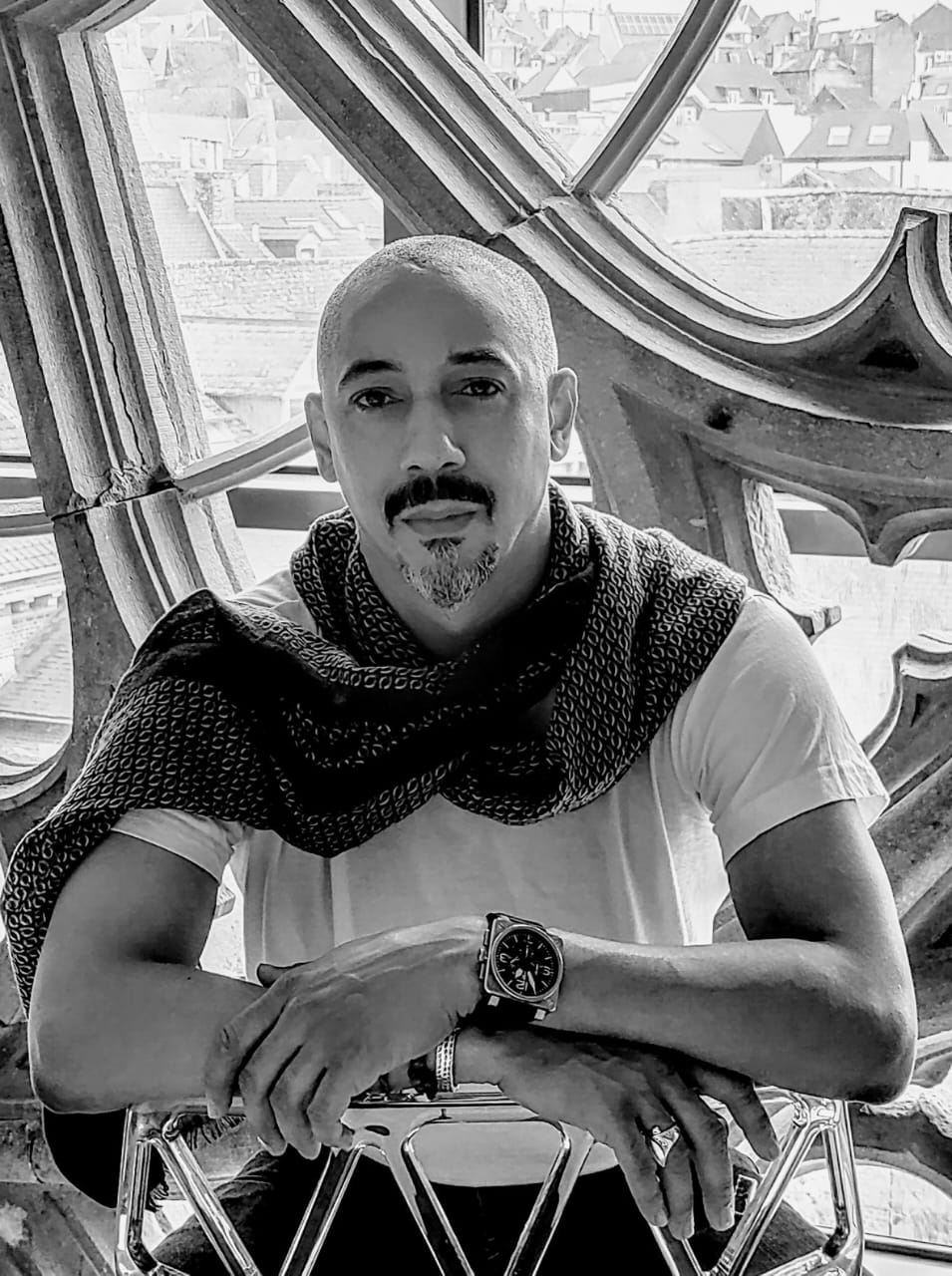
Asakan: You’re featured in the exhibition “Elément(erre),” which opens at the CHRISTOPHE PERSON Gallery on March 21. Who is Thiémoko Claude Diarra, and what is your background?
Thiémoko Claude Diarra: I’m a Belgian-Malian artist who spent my entire childhood and part of my youth in Bamako, Mali. I then moved to Belgium, my mother’s homeland, to pursue a master’s degree in graphic art at the École de Saint-Luc in the Brussels region. What makes this school unique is its multidisciplinary approach, which allowed me to explore a variety of techniques.
After completing my studies in 1998, I had the opportunity to participate in various events and exhibitions in Belgium, including one in Flanders at the Galerie De Zwarte Panter, which is Belgium’s oldest art gallery. I was also fortunate to meet the art advisor and collector Klaus Pas, who opened many doors for me and enabled me to exhibit in major venues, as well as to have my work included in prestigious collections.
Since 2024, I have been working with Galerie CHRISTOPHE PERSON, although this collaboration actually began in Ouagadougou in 2019 during the first edition of BISO. The gallery and I are in a great creative rhythm. That’s what led us to this exhibition, which will take place at two venues: at Galerie CHRISTOPHE PERSON starting March 21 and at Art Brussels in April.
Asakan: What issues do you address in this upcoming exhibition?
Thiémoko Claude Diarra: It’s about drawing people’s attention to things that escape our notice—things that are barely perceptible but which, despite everything, make up the vast majority of living things. For example, if you look at the sea or the ocean, you’ll see marine mammals, fish, and various other creatures. But beyond what’s visible, the biomass of the water contains an incredible amount of plankton that’s invisible to the naked eye. This accounts for nearly 99% of the ocean’s biomass. Similarly, the vast and overwhelming majority of living beings on Earth escape our notice. The same is true of the human body.
This translates into paintings—and sometimes sculptures as well—that draw inspiration from these forms to create blends using earth pigments. I really try to stay as close as possible to what is natural, to what relates to the world in which we live, since I work largely through sensation—through touch, smell, and everything I can see that inspires me. That is the whole point of this exhibition.
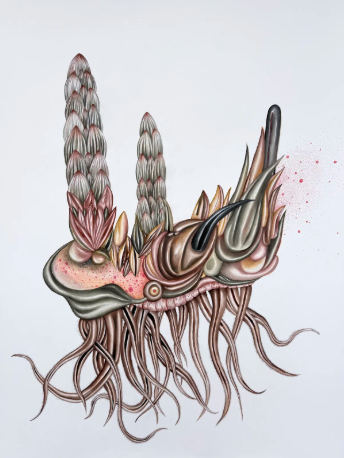
Thiémoko Claude Diarra, “Tragopogon Pratensis,” 2026. Earth pigments and fluorescent paint on paper, 100 x 80 cm. Courtesy of Galerie CHRISTOPHE PERSON
Asakan: How do you manage to perceive these forms that, as you say, are invisible to the naked eye?
Thiémoko Claude Diarra: It’s simply by taking the time to stop, get down on all fours, and look at all the tiny elements found in parks and forests—whether in Belgium or elsewhere during my travels.
You discover completely wild shapes that come to life. Sometimes, it can be as simple as observing a tree. Yes, you see the tree itself. But what people don’t necessarily pay attention to is that a tree never grows in a simple, straight line. The lines we see are the result of repeated cell division, and each branch follows a kind of invisible law—one that’s vital to it—particularly the symmetry of the curves, since nature is always in balance.
Asakan: And once you make an observation like that, what happens next?
Thiémoko Claude Diarra: Well, my approach is to make sketches—little drawings right there on the spot. I also take a lot of photos with my phone, zooming in very closely on the details.
When I draw, I no longer pay attention to whether an element is plant, animal, aquatic, or terrestrial… I take all the elements I consider symbolic and mix them together to simply create a multifaceted form of life. Then, I begin working with color. After that, there’s also a very free-form part because I can work a bit like nature does.
Finally, there’s the fact that in Belgium, we have this tradition of taking something large and making it tiny, or taking something tiny and sculpting it into a monumental size. I do exactly the same thing in my work. I take microscopic elements and present them on a gigantic scale.
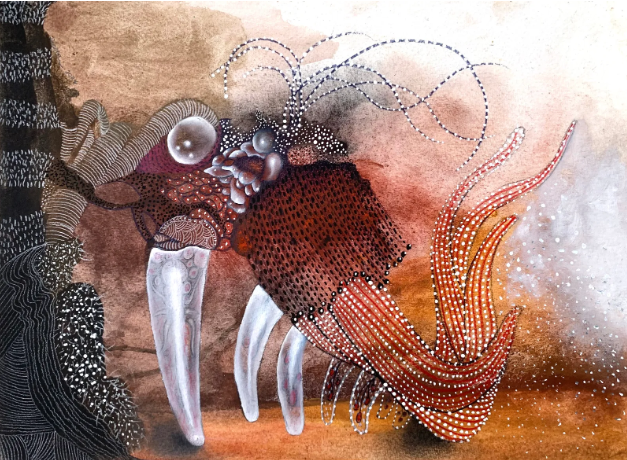
Thiémoko Claude Diarra, “Untitled,” 2025. Earth pigments on paper, 24 x 32 cm. Courtesy of Galerie CHRISTOPHE PERSON
Asakan: You’re also a sculptor. How does sculpture enrich your practice as a painter?
Thiémoko Claude Diarra: It allows me to think outside the box. Because even when you make a free gesture on a sheet of paper, it’s still something bounded by the paper, which may be square or rectangular. So sculpture allows me to transcend the limits of two dimensions. This is something I really enjoy because it allows me to walk around the work, to perceive it in different ways, and to feel closer to nature as well.
Asakan: So, for you, painting is a ritual of artistic recomposition of nature?
Thiémoko Claude Diarra: Absolutely, and I’d go further—it’s a ritual of revelation. Because, in my work, there are many forms found in nature that we’re familiar with but don’t really pay attention to (a microbe, the tentacle of an aquatic animal, a tree root, or a combination of these). So it’s work that reveals, and it also has a certain—I’d say—animistic aspect, since there’s a whole animistic element to my work.
Asakan: Why?
Thiémoko Claude Diarra: If you look at animism, especially in Mali—particularly among the Donso hunters—there’s all this work inspired by nature, by the forms found in nature. For example, there’s a very well-known sculpture called the Shiwara. It depicts a type of antelope that has been stylized—not in the sense of a detailed reproduction, but rather in the sense of capturing the spirit of the animal rather than the animal itself. That is what I also do with painting, trying to capture the spirit of the plant or the microscopic element rather than the element itself.
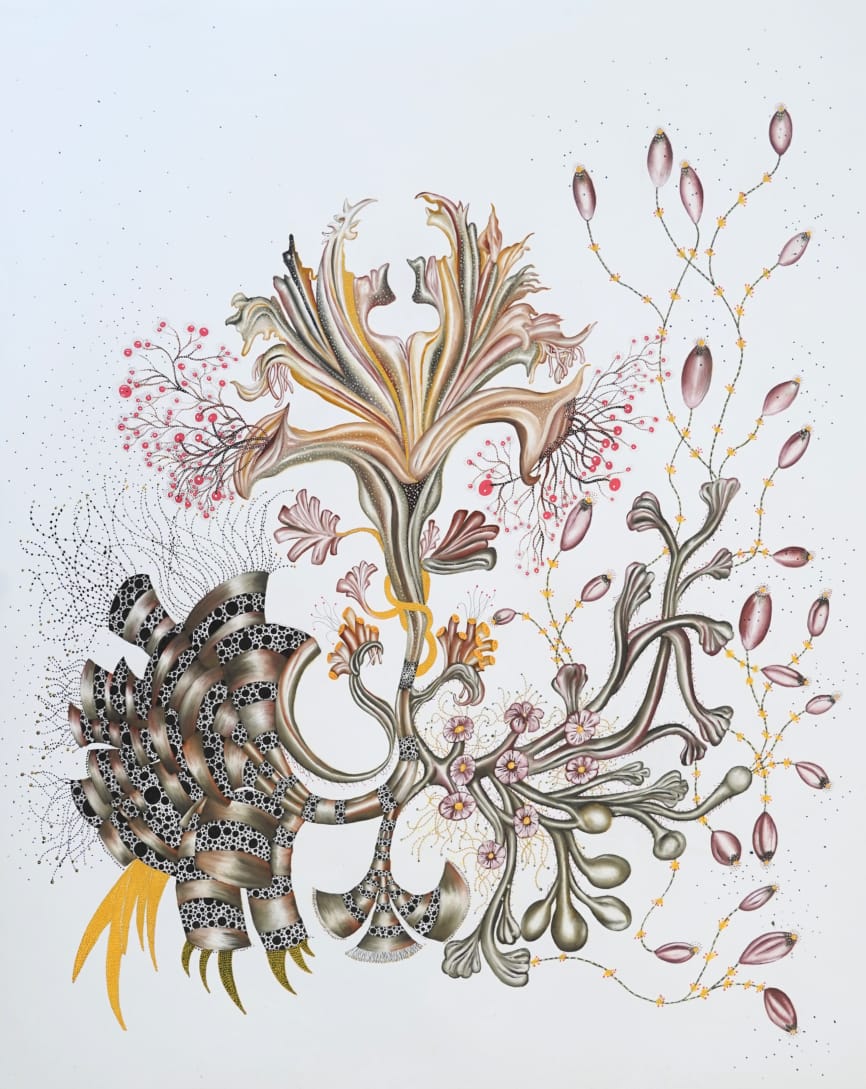
Thiémoko Claude Diarra, “L’Ecoute,” 2026. Earth pigments and fluorescent paint on paper, 99.7 x 79.7 cm. Courtesy of Galerie CHRISTOPHE PERSON. Photo: Laura Pennehouat
Asakan: Is that what you hope the public will take away from visiting the exhibition “Elément(erre)”?
Thiémoko Claude Diarra: Yes. But above all, I hope they’ll take the time to immerse themselves in green spaces, to observe every little moment of flowering, to see how nature changes throughout the seasons in order to understand its mechanisms and make connections.
To do that, there’s no need to go to the Amazon rainforest—the small park right at the end of your street, in your neighborhood, or in your city is enough.
Asakan: In your opinion, is art that important in our lives?
Thiémoko Claude Diarra: Well, I would obviously say yes, since, in fact, everything in our lives serves a purpose. As far back as humanity can be traced, all peoples of the world have created art. None have been able to resist it.
Art allows us to reflect on who we are, on what we’d like to become, and on what we’d like to share as a society. It also helps develop our sensitivity.
Asakan: Do you have any advice to share with young artists who’d like to learn from your experience?
Thiémoko Claude Diarra: The only advice I’d give them is not to rush all the time, but to take the time—often—to reflect and ask themselves questions about themselves, their lives, and what they truly want to do. Because these days, when I talk to some young people, they’re more concerned with which professions are in high demand rather than which ones they’d actually like to pursue.
That said, it’s true that I’m of African descent, and for us, choosing an artistic career isn’t always easy. My parents told me, “You’re doing well in school—what are you going to do in the arts?” But later, when they saw that it had allowed me to work ever since and made them proud, they finally understood that I’d made the right choice. So, you have to go for it—don’t let anyone get you down.
Asakan: Any final words?
Thiémoko Claude Diarra: If I could inspire people and just make them want to look at nature differently—and maybe even make them want to draw something themselves, without necessarily wanting to become an artist—I’d be very happy.
Thiémoko Claude Diarra – “Elément(erre)”, Saturday, March 21 through Thursday, May 16, 2026, at the CHRISTOPHE PERSON Gallery – Brussels, Rue Emile Clause, 63, 1180 Uccle, Brussels, Belgium More info: christopheperson.com
À lire également
Agi: “Through this exhibition, I wanted to pay tribute to these Amazons, symbols of strength and resilience.”
At La Maison Rouge in Cotonou, painter Agi (born in Paris in 1971) is presenting, through November 29, “Les Merveilleuses,” an original exhibition cel…
Raymond Tsham: “Belgians and Congolese, Africans and Europeans—we must overcome the divisions of history, unite, and foster genuine complementarity among our peoples.”
Featured in the exhibition “Living Legacies: Reinventing Forms” at the Galerie Person in Brussels alongside Mozambican artist Reinata Sadimba, Raymond…

Joseph Ntensibe: “… I try to capture the dramatic effect of tropical light on nature and translate that experience into painting.”
Today marks the final day of the group exhibition featuring the renowned Ugandan painter Joseph Ntensibe—who trained at the Makerere University School…

Rodrigue Glombard: “To me, these walls and floors are not merely fragments of urban architecture; they are repositories of the traces of time, human stories, and the transformations of the landscape.”
For some time now, we’ve been introducing you to the artists featured in the exhibition “Martinique, Intimate Cartographies,” on view at the Wall Hous…
Commentaires