
Le Grand Entretien
Joseph Ntensibe: “… I try to capture the dramatic effect of tropical light on nature and translate that experience into painting.”
Today marks the final day of the group exhibition featuring the renowned Ugandan painter Joseph Ntensibe—who trained at the Makerere University School of Fine Art in Kampala—at Galerie Person in Paris. This is an opportunity to take a closer look at the work of this artist, who is best known for his paintings inspired by nature, tropical forests, and African wildlife. His compositions, rich in color and texture, have earned him recognition in both the local and international art scenes. To learn more, Asakan met with him—with the help of Fares Eddine Kechad—on your behalf.

Asakan: It is said that art history is marked by breaks, which is characteristic of the avant-garde. Do you feel that you are experiencing a kind of break in your art compared to what came before (whether in relation to art history in general, Ugandan artistic practice in particular, or your own practice)?
Joseph Ntensibe: I was born in a rural region of Uganda, where life was closely tied to nature. The landscape, the wilderness, and the organic rhythms of daily life played an important role in my childhood, and these memories continue to influence my work today.
When I later entered the educational system, most of the artistic references we studied came from the Western canon. We were introduced to the great European masters, and although we were told that art had no boundaries and depended on how each person perceived the world at a given moment, relatively little attention was paid to African artistic traditions beyond objects such as masks from West and Central Africa. In Uganda, we do not necessarily share the same types of cultural objects, so it was sometimes difficult to fully identify with these examples.
However, my early artistic development was strongly influenced by classical Western painting, and my approach was initially more realistic. It was, however, during my college years that my perception of composition and painting began to evolve. The transition from urban life to rural environments led me to reflect more deeply on my own experiences and the landscapes that shaped me. I then felt the need to create works more directly connected to my personal history and the environment in which I grew up.
Memories of nature and wild spaces thus took center stage in my work, and in my studio, I began to transpose them onto canvas, as if to create a visual archive of these landscapes and their significance.
That said, rather than viewing my work as a break from what came before, I see it more as a way to raise public awareness. My paintings therefore invite reflection on the natural environment and aim to advocate for its preservation, particularly in the context of climate change.
Asakan: What does abstraction mean to you? Do you think it applies to your work?
Joseph Ntensibe: Yes, abstraction applies to my work. For me, it’s above all a matter of perception. I don’t seek to be entirely realistic, but neither am I entirely abstract. I’m looking for a sort of middle ground between the two. My intention is to move from something recognizable to something more abstract and dramatic.
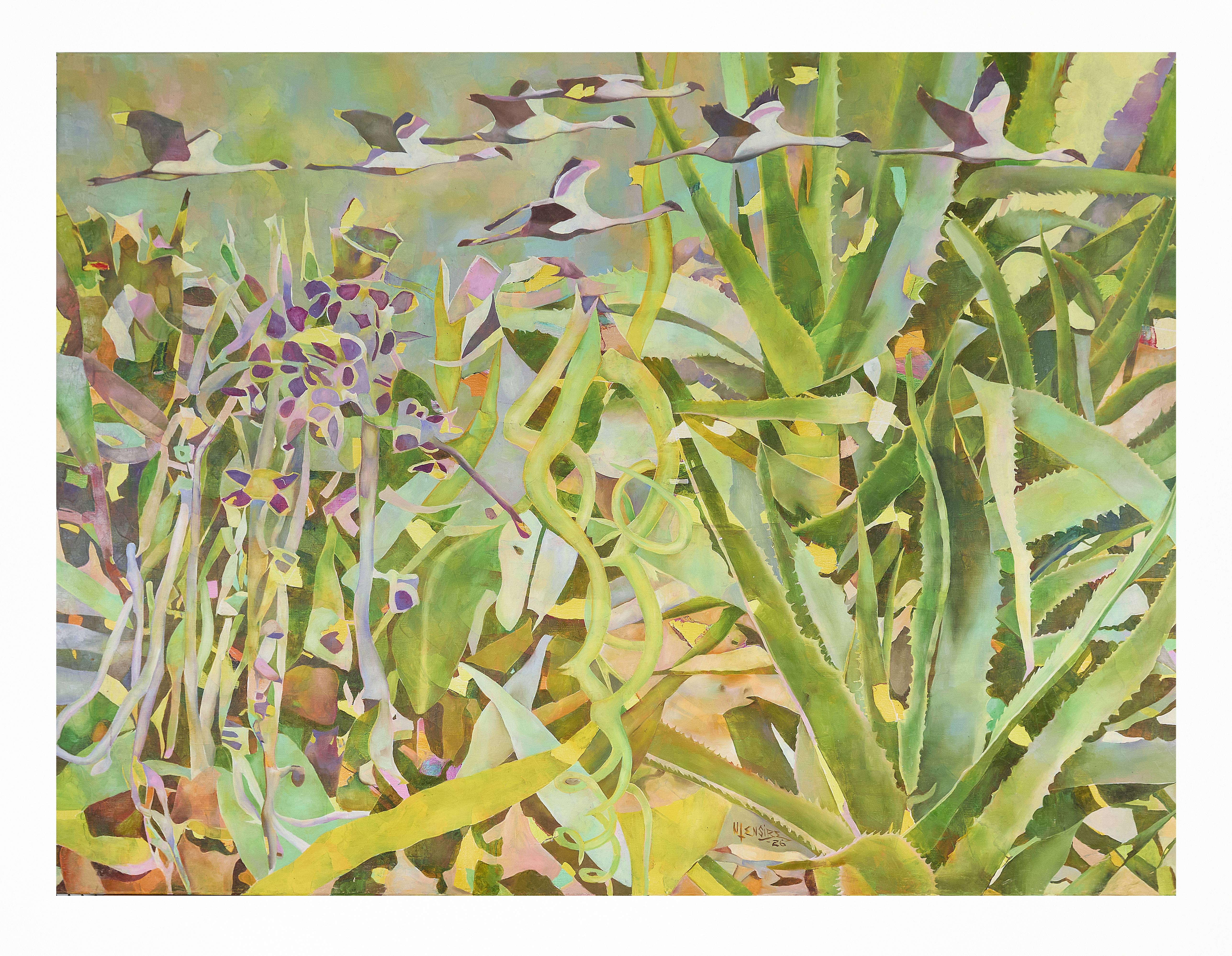
Joseph Ntensibe, “Exuberance of Growth,” 2026 Oil on canvas 150 x 200 cm Photo: Mona AWAD © Copyright of the artist - Courtesy of Galerie PERSON
Asakan: What does abstraction bring to your work?
Joseph Ntensibe: In everyday life, what we see in nature can sometimes seem calm, even passive. Through abstraction, I try to extract certain elements from reality and transform them to create greater intensity and emotion on the canvas. I play a lot with light and shadow, isolating these elements from what I observe in the landscape. Abstraction allows me to introduce a sense of drama and even a certain magical dimension that I seek in my work.
In this regard, I draw inspiration from artists such as Gustav Klimt, particularly for his graphic and geometric motifs and the mosaic-like structures in his paintings. These elements resonate with my own interest in constructing compositions through repetitive forms and structures, combined with the light and atmosphere of the tropics. I am also influenced by Friedensreich Hundertwasser, whose colorful motifs and vibrant energy have shaped my approach to color and rhythm.
Living in a tropical environment has a profound impact on the way I see and paint. The sunlight in the tropics is extremely powerful, particularly in the savanna where I live. The contrast between light and shadow can be very intense, sometimes almost equally strong. As a result, I tend to perceive the world in terms of positive and negative forms—areas of light and areas of darkness. Each tone, whether light or dark, carries its own language and meaning. Light and shadow play different roles in how I convey what I feel when facing the landscape. That is why my paintings often take on mosaic-like structures, composed of different shades and fragments of color. Through these compositions, I try to capture the spectacular effect of tropical light on nature and translate that experience into painting.
Asakan: Why are you participating in this exhibition in Paris at the PERSON Gallery?
Joseph Ntensibe: My participation in this exhibition stems from my relationship with Christophe. We met when he visited Uganda, and we had the opportunity to discuss my work and my artistic approach. I had already collaborated with him before, when he was working at auction houses and had sold one of my works. Since then, he has continued to follow my career.
So, when he later opened his gallery, I thought it would be interesting to explore a collaboration in this new context. For me, it was an opportunity to experiment with how a gallery space can become a platform for my ideas and the message underlying my work.
Through this exhibition, which will close in a few days, I’ve been very interested to see how Galerie Person has helped advance the ideas and concerns that my paintings aim to express.
Asakan: It takes a lot of love, passion, and determination to paint the same subject year after year…. What keeps you going?
Joseph Ntensibe: The first reason is my past. When I was young, the forests were dense, and their beauty filled us with wonder. But today, most of them have disappeared or been reduced to almost nothing. When I think back on everything that’s been destroyed, it really upsets me. So I use art so that the next generation can see what once existed. I also want to raise awareness about the need to green their private spaces and encourage governments to replant trees to restore forest cover.
The second reason is that I love nature. For me, it’s a form of therapy: it brings me back to life in its most vibrant and sacred form.
Asakan: Can you explain the creative process you used to create each of your paintings?
Joseph Ntensibe: When I want to work, I go into the forest to seek inspiration, since my studio is located in an urban setting.
I’m particularly interested in the effects of light on the forest and how shadows change with the seasons and climate change. And when, suddenly, I catch a magical moment, I capture it with my phone—because what’s perfect at one moment may not be a second later. Without that, my paintings would be dull.
After capturing that moment, I sit down to feel the wind, the temperature, and the movements of nature. I also listen to the music of the flowers, the leaves, and the trees as they sway and brush against one another. I then try to translate this rhythm—through drawing and painting—into a sketchbook that I always carry with me. Then, I return to the studio, where I begin painting by applying a succession of colors to the canvas.
That is when I transpose what I have observed: the rhythm, the vibrations, and the colors. In this way, I seek to achieve a rendering that is both dramatic and magical—first for myself, and then for the viewers. Ultimately, it is up to them to judge.
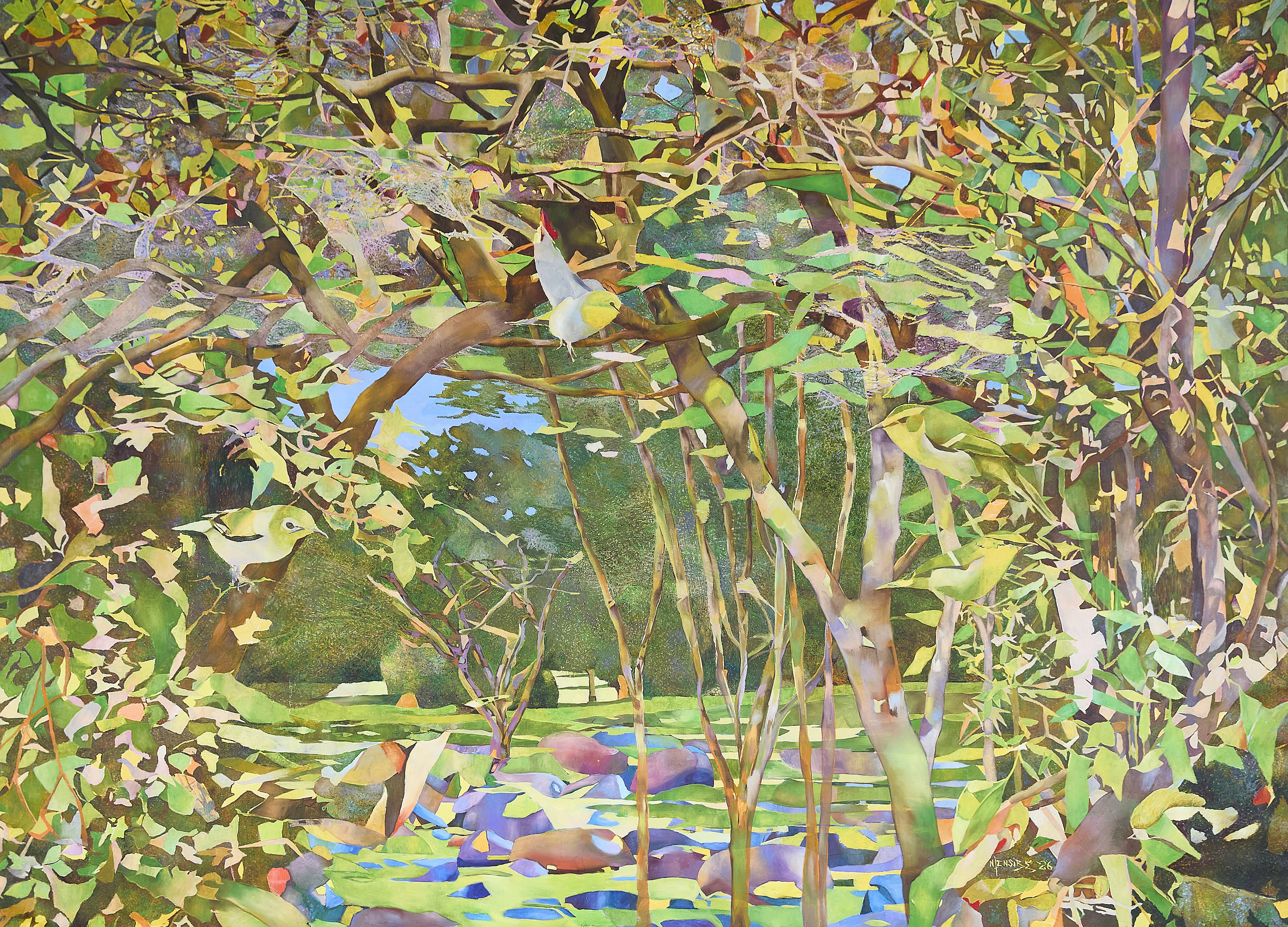
Joseph Ntensibe, “Advent of Spring,” 2026. Oil on canvas, 180 x 250 cm. Photo: Mona AWAD © Copyright of the artist—Courtesy of Galerie PERSON
Asakan: Today, at age 75, your work is gaining increasing recognition from the public and the art world. Is there still a wish you’d like to see come true to make your artistic journey more fulfilling?
Joseph Ntensibe: I’m not really sure—everything has come so naturally… But perhaps my message isn’t always properly understood, and people don’t fully grasp it. Especially in my country, Uganda. They see in my paintings only a plant, nature… So, if art institutions, galleries, museums, the media, and auction houses could help me amplify this message, I would feel much better.
Asakan: What advice would you share in this regard with current and future generations?
Joseph Ntensibe: I’m very concerned about the situation facing young people and future generations. The new generation hasn’t seen the lush environment in which I was born, since the vast majority of them were born in the city. If nothing is done, future generations will have even fewer opportunities to experience such an environment. Today, the destruction of forests even seems to have become commonplace for some, who do not hesitate to justify it.
To artists, I would say: go out and experience the generosity and nobility of nature, and then capture them in your work.
To young people, I would advise them not to give in to anger toward the whole world. Nature is life. Let’s love it and protect it!
Asakan: Is art really that important in our lives?
Joseph Ntensibe: It’s very important. It’s a source of inspiration, and I believe the reason people buy art and display it in their spaces isn’t just for beauty, but to restore and heal themselves. For example, after a hard day at work, when you sit down at home and look at art, it calms you. It’s more than just a decoration or interior design. It’s a part of you!
Asakan: Any final thoughts?
Joseph Ntensibe: Let’s get back to basics—to the way our world was created—and try to live in harmony with nature once again. Nature is both our greatest ally and our best friend.
Exhibition “MATIÈRE À ABSTRACTION: Echoes of a Place’s History” featuring artists Joseph Ntensibe, Donald Wasswa, Mamadou Cissé, Tiffanie Delune, Paul Ndema, and Ghizlane Sahli, April 17–July 30, 2026, at Galerie PERSON, 22 Rue du Bac, Paris 7th arrondissement. Hours: Tuesday–Saturday, 11:00 a.m.–7:00 p.m., or by appointment. More info: christopheperson.com
À lire également
Agi: “Through this exhibition, I wanted to pay tribute to these Amazons, symbols of strength and resilience.”
At La Maison Rouge in Cotonou, painter Agi (born in Paris in 1971) is presenting, through November 29, “Les Merveilleuses,” an original exhibition cel…
Raymond Tsham: “Belgians and Congolese, Africans and Europeans—we must overcome the divisions of history, unite, and foster genuine complementarity among our peoples.”
Featured in the exhibition “Living Legacies: Reinventing Forms” at the Galerie Person in Brussels alongside Mozambican artist Reinata Sadimba, Raymond…

Rodrigue Glombard: “To me, these walls and floors are not merely fragments of urban architecture; they are repositories of the traces of time, human stories, and the transformations of the landscape.”
For some time now, we’ve been introducing you to the artists featured in the exhibition “Martinique, Intimate Cartographies,” on view at the Wall Hous…
Wilfried Mbida: “So I’m not talking here about natural disasters or destruction, although the topic could be broadened to include that interpretation.”
Through August 1, 2026, the PERSON Gallery - Brussels is presenting the exhibition “Living with Water: Spirituality and Resilience,” bringing together…
Commentaires