Le Grand Entretien
Raymond Tsham: “Belgians and Congolese, Africans and Europeans—we must overcome the divisions of history, unite, and foster genuine complementarity among our peoples.”
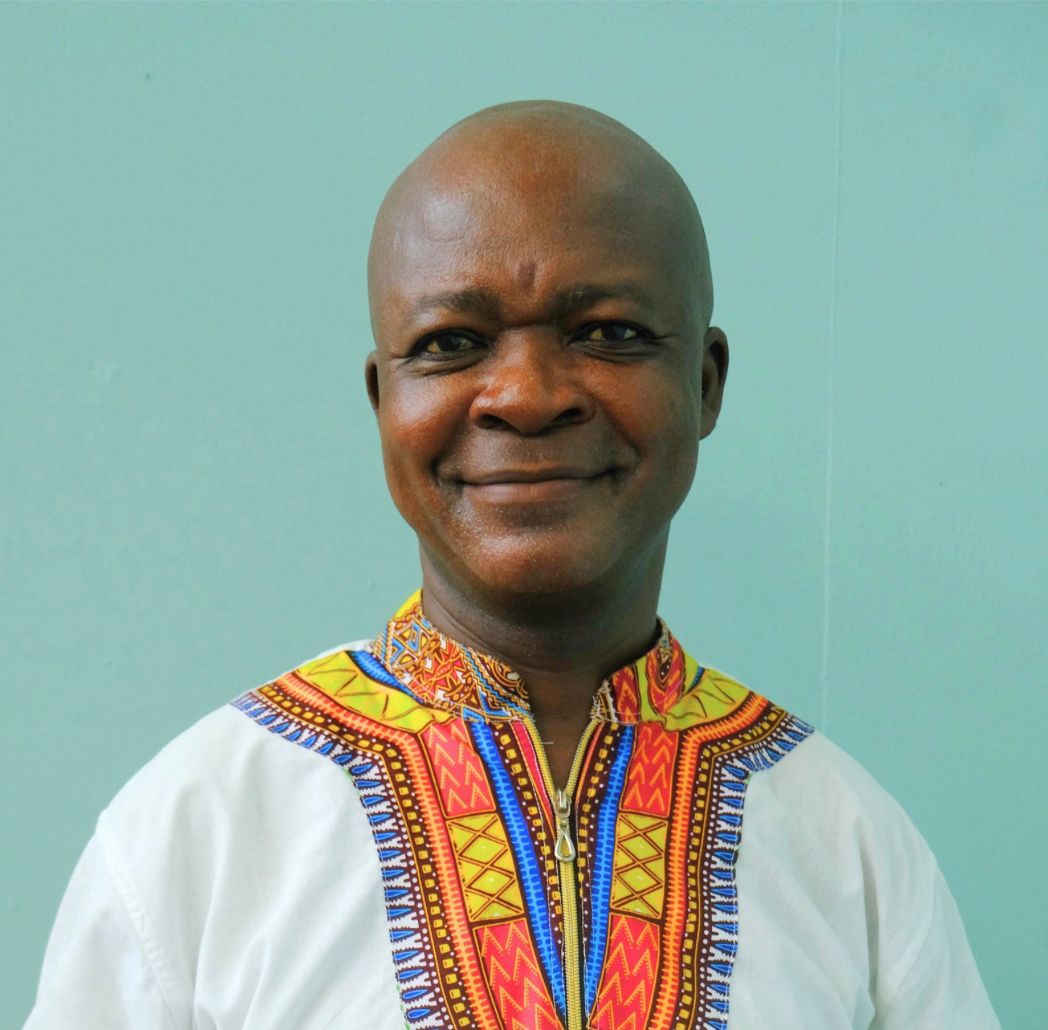
Featured in the exhibition “Living Legacies: Reinventing Forms” at the Galerie Person in Brussels alongside Mozambican artist Reinata Sadimba, Raymond Tsham is an artist recognized on the international art scene for his highly precise drawings created exclusively with a ballpoint pen. Born in 1963 in Lubunza, he lives and works in Kinshasa. In his works, figures from traditional African sculpture come to life and take center stage, sometimes to explore the place of African heritage in today’s world, and sometimes to confront us with contemporary realities. A conversation with a cheerful man in his sixties whose passion for drawing is inseparable from his passion for life.
Asakan: How did your passion for art begin?
Raymond Tsham: My passion for art began when I was very young. I lived with my parents, and whenever we visited the canton chief, I was impressed by the statuettes displayed in his courtyard. Every time we visited, I would ask why they were on display there. They would tell me that the gods liked to be in the sun.
One day, seeing those same statuettes again, I wondered what happened when rain threatened or when it was raining, My mother told me that if no one helped them get back into the hut, one of them would take care of it herself. From then on, I was more than intrigued, and I also started drawing little figurines on the ground.
Asakan: Those drawings probably didn’t last very long, did they?
Raymond Tsham: Yes, they were ephemeral works that faded away after a while. The people around me really liked them, and that helped me realize that what I was doing mattered.
Asakan: When did you start drawing on paper?
Raymond Tsham: In school, I started making drawings for my classmates in exchange for money. They were pencil drawings on paper; people were really into them, but to be honest, I didn’t know that one day I’d make a career out of it.
Asakan: You graduated from the Academy of Fine Arts in Kinshasa in 1989. How has your artistic practice evolved since then?
Raymond Tsham: I studied at three art schools in the Democratic Republic of the Congo: in Kassaï in the center of the country, in Katanga in the south, and then in Kinshasa. It was in Kinshasa that I began to make a name for myself. Since I couldn’t afford to buy paints—which were very expensive—I worked with pen, and that work was quickly noticed.
I also dabbled in painting at one point in my career. But every time I picked up a brush to paint a picture, I felt that my talents as a draftsman weren’t fully expressed. So I chose to remain a draftsman. And the truth is, I really love to draw. Especially since the themes I explore are primarily Congolese and African.

Raymond Tsham, “Art Cinétique Bruxelles,” 2026. Ballpoint pen on paper. Courtesy of Galerie PERSON ©Monaawad
Asakan: How do you work on a daily basis? What are the steps that take you from an initial idea to a finished work?
Raymond Tsham: First of all, I wake up very early. As soon as there’s enough daylight, I get to work, because I don’t work under artificial light. I draw until 5 p.m. every day, including Sundays and holidays. I’ve never completed a piece that took me less than five days. Even my small 30 x 40 cm works can take up to eight days to complete.
On the page, I tell stories where memory, history, and imagination converge through my characters. These are not real people, but Baoulé, Senoufo, or Luba figurines that I bring to life like humans to evoke life in the Democratic Republic of the Congo and across the African continent.
Asakan: For the first time, the characters that populate your work have left their usual environment to explore the Belgian urban landscape as part of the exhibition “Living Legacies: Reinventing Forms” at the Galerie Person in Brussels. Why did you make this choice?
Raymond Tsham: I wanted Congolese and other Africans to set out to discover Brussels’ iconic landmarks—such as the Atomium, the Grand-Place, the Manneken-Pis, and Place Rogier—and to encounter figures associated with the city, such as Tintin and René Magritte. This choice is not insignificant: I want to remind people that Africans were brought here and put on display in cages, as if they were subhuman.
But it is also about showing that the world today is a global village. Belgians and Congolese, Africans and Europeans—we must transcend the divisions of history, unite, and foster genuine complementarity among peoples. That is where the world of tomorrow lies.

Raymond Tsham, “Visit to Place Rogier,” 2026. Ballpoint pen on paper. Courtesy of Galerie PERSON ©Monaawad
Asakan: In the works on display, you give black and white a prominent place. What attracts you to this visual language?
Raymond Tsham: At my last exhibition in Brussels, Christophe Person pointed out that all the paintings were in black and white (smiles). For me, black and white is first and foremost an aesthetic choice—it’s not just a color, but a choice born of love. With black and white, there’s no fuss; you get straight to the heart of the matter. What also draws me to black is the fact that I myself am black. I’m not just talking about my African identity, but also about my skin tone, which could be described as ebony. It’s a beautiful skin tone, and I always want to create my paintings with black pens.
Asakan: But you also work in color. How did color find its way into your practice? What does it allow you to express differently?
Raymond Tsham: I started using color because there were certain figures and statuettes that called for being rendered in color. Unlike black and white, color allows me to emphasize a figure by giving it more impact.

Raymond Tsham, “La Rencontre,” 2026. Ballpoint pen on paper. Courtesy of Galerie PERSON ©Monaawad
Asakan: You base all your work on traditional African masks and sculptures. What kind of relationship do you have with collectors of ancient African art? How do they respond to your contemporary work?
Raymond Tsham: They greatly appreciate my work (the technical mastery, the finished pieces, their ability to resonate with the general public...). The exhibition has been a huge success in this regard because it’s not easy to find an artist anywhere in the world who works with a pen the way I do. In fact, I’m starting to become just a tiny bit well-known (laughs).
Asakan: Speaking of which, today you’re a master of drawing in Africa, with more than thirty years of artistic practice. How do you view this rich journey?
Raymond Tsham: Yes, I consider my journey a success when I look at where I came from and where I’ve ended up. My work is known around the world and is included in the collections of many institutions worldwide. For example, six months ago, one of my works was added to the collections of the Musée du Quai Branly–Jacques Chirac. But financially speaking, it’s a different story.
Asakan: So you can’t make a living from your art?
Raymond Tsham: No, no, I make a very good living from my art; it’s just that I don’t think I’m getting what my works are truly worth. The art market is very competitive worldwide, and even more so in Africa, where there are many artists.
Asakan: Are there any encounters or moments that have particularly left a mark on you in your career? If so, which ones?
Raymond Tsham: Yes, of course. I was in Kinshasa when I got a call asking me to exhibit in Mauritius. I was young and had always dreamed of visiting that country. And then I was invited—all expenses paid. I hopped on a plane, and when I arrived, they explained that the President of the Republic—a highly educated intellectual—had asked to meet me because of the uniqueness of my artistic style. I did indeed meet her at the opening reception, and then I was invited to dinner at the presidential residence.
A second memorable moment, among so many others: my invitation to Abidjan, in Côte d’Ivoire, in 2011, for an exhibition. During the opening reception, there were two gentlemen standing in front of me, and the gallery owner introduced me to them. One of the two gentlemen spoke up and said, “My name is Michel Gbagbo, son of President Laurent Gbagbo, who was in power at the time. I really like your work; I came to buy a painting to give to my father.” ” The second one said to me, “I’m Minister Amara Essy. I have a painting of yours that was given to me by the President of the Republic, and I keep it in a place of honor right in front of me in my living room.”
Asakan: Given your rich career, do you have any advice you’d like to share with young artists?
Raymond Tsham: I love young artists, and I encourage them a lot when I have them over to my home or meet them on my travels. All I can tell them here is to be patient. If someone offers me 10,000 euros for a painting measuring 1.50m by 1.50m, it will take me two to three months to finish it. However, whenever I’ve welcomed young artists to work with me, none of them has stayed a full week with me in my studio because young people today lack patience. Without patience, talent often doesn’t get you very far.
Asakan: Is art really that important to our lives?
Raymond Tsham: Oh yes, when we lose art, we automatically lose our culture. Art is essential to the way the world works. It also helps build bridges between peoples and different cultures.
As my work shows, art exists so that people don’t forget themselves or where they come from. Artificial intelligence or not, art will continue to nourish the world.
Asakan: Any final thoughts?
Raymond Tsham: I’d like to talk about the restitution of works of art looted from Africa. As for my country, the Democratic Republic of the Congo, I advocate that the works of art currently in Belgium and elsewhere remain where they are until a generation of political and social leaders becomes aware of the importance of this heritage, develops a cultural policy commensurate with the challenges of its preservation and display, and, above all, raises awareness among the Congolese population. Because in the DRC, there is a new phenomenon—the revivalist churches—which seek to erase our entire precolonial history, including the objects our ancestors bequeathed to us. Religion has gone to their heads.
Otherwise, those who have the time are always welcome to stop by and see my exhibition at the Person Gallery. They won’t be disappointed.
Exhibition “Living Legacies: Reinventing Forms” by Raymond Tsham and Reinata Sadimba through November 28, 2026, at Galerie Person – Brussels, Rue Émile Claus, 63, 1180 Uccle. More info: christopheperson.com
À lire également

Agi: “Through this exhibition, I wanted to pay tribute to these Amazons, symbols of strength and resilience.”
At La Maison Rouge in Cotonou, painter Agi (born in Paris in 1971) is presenting, through November 29, “Les Merveilleuses,” an original exhibition cel…

Joseph Ntensibe: “… I try to capture the dramatic effect of tropical light on nature and translate that experience into painting.”
Today marks the final day of the group exhibition featuring the renowned Ugandan painter Joseph Ntensibe—who trained at the Makerere University School…

Rodrigue Glombard: “To me, these walls and floors are not merely fragments of urban architecture; they are repositories of the traces of time, human stories, and the transformations of the landscape.”
For some time now, we’ve been introducing you to the artists featured in the exhibition “Martinique, Intimate Cartographies,” on view at the Wall Hous…
Wilfried Mbida: “So I’m not talking here about natural disasters or destruction, although the topic could be broadened to include that interpretation.”
Through August 1, 2026, the PERSON Gallery - Brussels is presenting the exhibition “Living with Water: Spirituality and Resilience,” bringing together…
Commentaires