Le Grand Entretien
Rodrigue Glombard: “To me, these walls and floors are not merely fragments of urban architecture; they are repositories of the traces of time, human stories, and the transformations of the landscape.”
For some time now, we’ve been introducing you to the artists featured in the exhibition “Martinique, Intimate Cartographies,” on view at the Wall House Territorial Museum in Saint-Barthélémy through Saturday, August 1, 2026. Rodrigue Glombard (born in Fort-de-France in 1963) is a visual artist whose work revolves primarily around temporality: the passage of time, memory, the ephemeral, and traces. In this interview, he talks about his work and his piece “Somewhere in Terres-Sainville,” from the series “Walls and Floors,” in which he transforms the walls and floors of his native Martinique into sensory archives where past and present constantly overlap.

Asakan: You are one of the 25 artists featured in the exhibition “Martinique, Cartographies intimes,” which is on view through August 1, 2026, at the Wall House Territorial Museum in Saint Barthélémy. Who are you, and what is your background?
Rodrigue Glombard: For as long as I can remember, I’ve always been passionate about drawing. Around the age of 13, I began painting all sorts of subjects in a frenzied and disorganized manner, ranging from charcoal portraits to oil landscapes and still lifes.
Around age 17, I met the artist Hector Charpentier (Jr.), who encouraged me to draw and paint on a larger scale than I had been working at the time.
At age 20, I left Martinique to enroll at the Beaux-Arts in Besançon, where I learned to structure my artistic practice. There, I developed a particular interest in sculpture and photography. Sculpture would eventually become my area of specialization.
In 1991, I moved to Lyon, where I still live today. I then decided to showcase my work by participating in numerous exhibitions in France and abroad.
Today, my practice takes various forms: painting, drawing, collage, photography, sculpture, as well as temporary and permanent installations.
Asakan: Can you tell us about your artistic approach?
Rodrigue Glombard: At the heart of my artistic approach is an exploration of temporality. This question has been with me for a very long time, long before I was fully aware of it—even when I thought I was working primarily on memory.
This realization came to me during a project I undertook between January 1, 1997, and December 31, 2013. For sixteen years, I created a drawing or painting every day in sketchbooks. In this way, I became part of a long-term project, in which the repetition of the gesture gave rise to a profound reflection on time. Building on this realization, I have developed several lines of inquiry.
First, I seek to express duration through works that take varying amounts of time to complete, fully immersing myself in the present moment through particularly time-consuming drawing techniques. It is a way of being here and now, of taking the time needed to do things. I see this as a form of resistance in the face of our era, where everything is accelerating and our environment constantly pushes us to move faster.
Another approach to this reflection takes the form of a series titled “Temporal Sequences.” Through a conceptual process, I incorporate into the work the dates and times spent creating it, through meticulous filling-in.
Using an extremely fine pen, each mark comprising the work is outlined so that it appears white against a black background. Next, each number is colored according to a specific code: * 0: neutral, * 1: gray, * 2: purple, * 3: green, * 4: blue, * 5: yellow, * 6: orange, * 7: brown, * 8: ultramarine blue, and * 9: red. I have always been a synesthete in this regard; I perceive numbers as colors.
All numerical data, as well as the punctuation marks associated with the creation of the work, are then translated into sounds to produce a musical composition that can be performed by any musician.
A third approach, titled “Walls and Floors,” allows me, through photography, to select fragments of walls and floors marked by time, the elements, and human activity in the urban space.
These photographs are printed on paper and then enhanced with drawings made with a very fine pen, as well as collages applied directly to the print. This process creates an ambiguity between the photographic image and the drawing.
This reflection on temporality is also evident in my installations, created primarily from natural materials. They evoke both the fragility of our environment in the face of our actions and the potential danger that results, as well as our own vulnerability when that environment runs amok.
Asakan: Could you describe a work on display as part of “Martinique, Intimate Cartographies” that helps us better understand your work?
Rodrigue Glombard: The work presented as part of “Martinique, Intimate Cartographies” was created specifically for this event. This project grew out of an artistic relationship that developed over time. Karine Taïlamé and I met in 2010, when we both participated in the International Triennial of Contemporary Art in the Dominican Republic. That first encounter had already revealed certain affinities in our respective approaches, particularly our shared interest in territory, memory, and the emotional ties that bind us to our environment.
When Karine Taïlamé invited me to participate in *Martinique, Intimate Cartographies*, I was particularly moved by this invitation. Beyond the invitation itself, what struck me was the quality of our exchanges. I felt that she was truly listening, and that she offered a sensitive and particularly accurate interpretation of my artistic practice. She was able to perceive what has run through my work for many years: this way of creating a dialogue between time, memory, and the urban landscape.
Our discussions naturally led me to conceive this work, created specifically for the Wall House. I wanted to propose a piece that was more graphic and more poetic, while remaining true to my artistic approach.
It builds upon the “Murs et Sols” series while introducing a new body of work in which the photographic print is mounted and then combined with drawing, ink, and collage on a blank sheet of paper.
The subject remains the same. While wandering the streets of Fort-de-France, I photographed the walls of the Terre-Saint-Ville neighborhood: weathered walls, faded paint—all traces left by time and the elements. For me, these walls and floors are not merely fragments of urban architecture; they are repositories of the traces of time, human stories, and the transformations of the landscape.
This work thus offers a personal interpretation of Martinique, where materials, the scars of time, and surfaces become elements of a sensory geography. Karine Taïlamé’s vision has skillfully revealed this dimension with great subtlety and given it its rightful place within the exhibition’s theme.
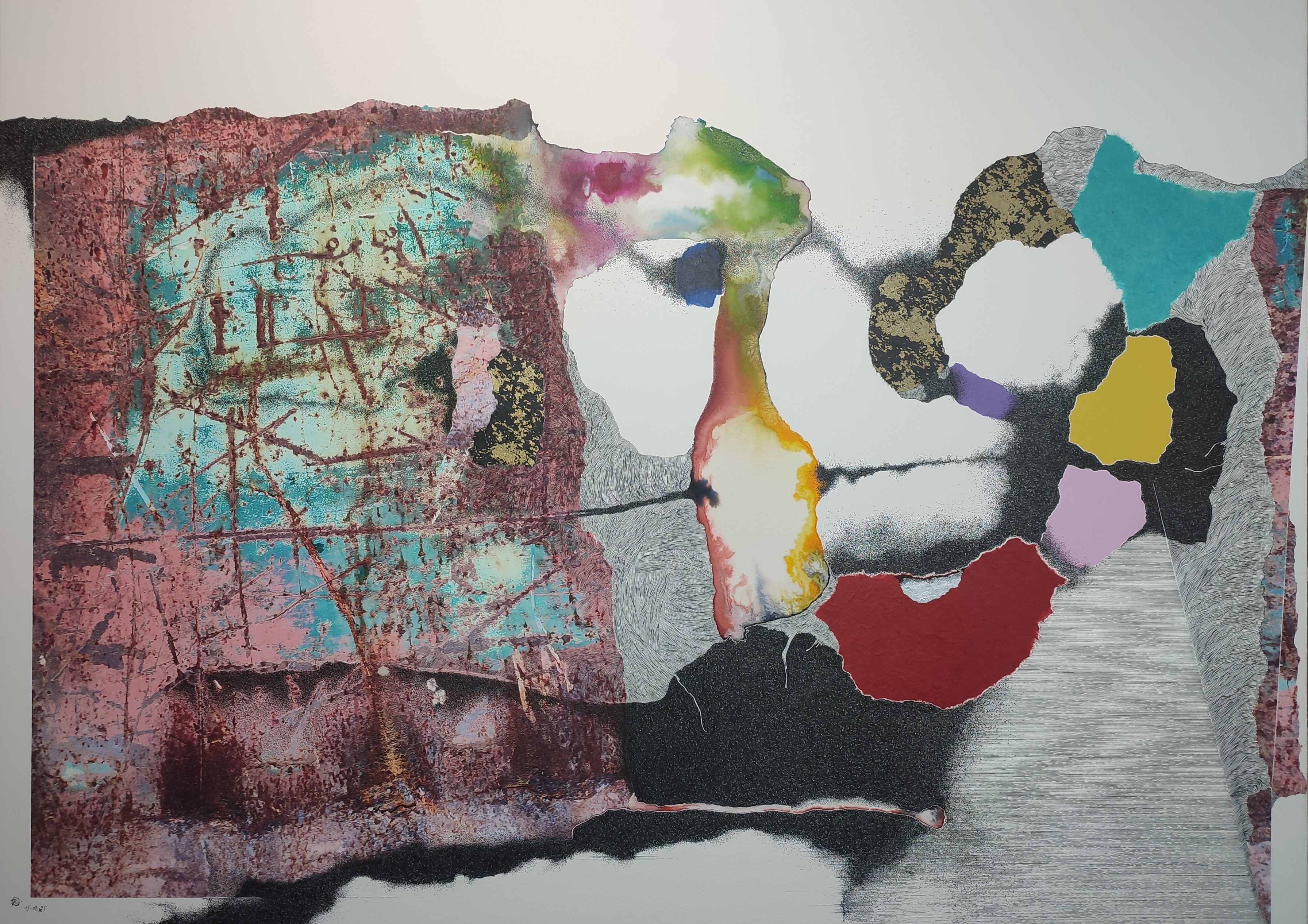
Rodrigue Glombard, “Somewhere in Terres Sainville” – “Walls and Floors” Series, 2025. Fine-line pen, collage, ink, and photograph on paper mounted on wood, 106 x 78 cm Courtesy of the artist and the Wall House Museum
Asakan: Any final thoughts?
Rodrigue Glombard: I am very happy and honored to have been part of this adventure. Participating in *Martinique, Intimate Cartographies* and sharing my unique vision of Martinique there is a source of great pride for me.
Finally, I’d like to note that, for the past four years, I’ve resumed my daily practice in a new format titled “Daily Temporal Sequences.”
Group exhibition “Martinique, Intimate Cartographies” featuring Rodrigue Glombard and 24 other artists, through August 1, 2026, at the Wall House Museum, 2 rue de Pitéa, La Pointe Gustavia 97233, Saint-Barthélemy, France Opening hours: Tuesdays from 2:00 p.m. to 7:00 p.m. and Wednesdays through Saturdays from 9:00 a.m. to 12:00 p.m. and from 2:00 p.m. to 7:00 p.m. More info: museesstbarth.com/fr/page/wall-houseLa Editorial staff.
À lire également
Agi: “Through this exhibition, I wanted to pay tribute to these Amazons, symbols of strength and resilience.”
At La Maison Rouge in Cotonou, painter Agi (born in Paris in 1971) is presenting, through November 29, “Les Merveilleuses,” an original exhibition cel…
Raymond Tsham: “Belgians and Congolese, Africans and Europeans—we must overcome the divisions of history, unite, and foster genuine complementarity among our peoples.”
Featured in the exhibition “Living Legacies: Reinventing Forms” at the Galerie Person in Brussels alongside Mozambican artist Reinata Sadimba, Raymond…

Joseph Ntensibe: “… I try to capture the dramatic effect of tropical light on nature and translate that experience into painting.”
Today marks the final day of the group exhibition featuring the renowned Ugandan painter Joseph Ntensibe—who trained at the Makerere University School…
Wilfried Mbida: “So I’m not talking here about natural disasters or destruction, although the topic could be broadened to include that interpretation.”
Through August 1, 2026, the PERSON Gallery - Brussels is presenting the exhibition “Living with Water: Spirituality and Resilience,” bringing together…
Commentaires