Le Grand Entretien
Drawing Now 2026 / Ernest Dükü: “…it’s interesting to showcase and explore the hidden meaning of life in order to help people understand the idea that everything is connected”
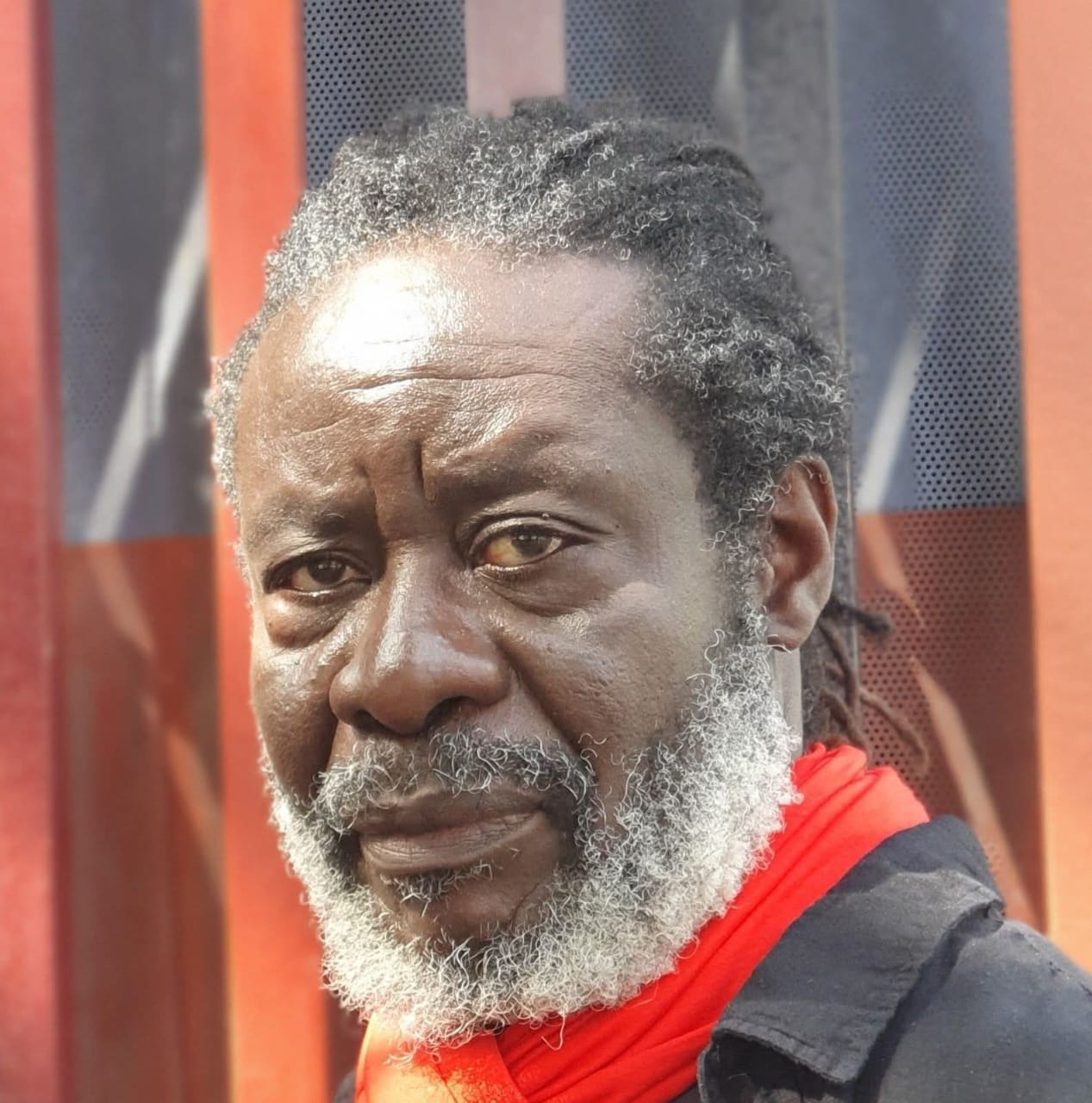
Starting March 26, the CHRISTOPHE PERSON Gallery will present a selection of three artists—including the Ivorian visual artist Ernest Dükü—at the 19th edition of the Drawing Now Paris fair. His highly distinctive style transports us to a world where Akan symbolism blends with quantum physics and inspirations from around the globe. Asakan met with him for the occasion.
Asakan: You’re presenting your work for the first time at Drawing Now alongside the brilliant Tiffanie Delune and Amadou Seck. Can you tell us about the works you’ll be exhibiting there?
Ernest Dükü: The collection of works to be presented at the Drawing Now exhibition consists of elements through which viewers can discover some of my reflections on what I call the “Boson Equations.” This is a parallel I draw between the bosons of the spiritual reality of the Akan universe—which embody the idea of guardian spirits, in short, what one might call the “spirit world”—and the invisible realm of Higgs bosons, those elementary particles linked to the invisible field that permeates all matter.
Asakan: So this is your work on the connection between ancestral memory, African cosmogony, and quantum physics?
Ernest Dükü: Indeed, this work involves a quest to find meaning in the infinitely small. It involves examining ancestral memories through the various frameworks of African cosmogony, in relation to other sites of memory around the world. I draw on these diverse symbolisms to chart the history of our evolving humanity. Thus, inquiries into these ancestral connections and quantum physics lie at the heart of my current work.
Asakan: In that case, can we say of your drawings—much like research in quantum physics that describes the behavior of matter and light at the atomic and subatomic scales, and to quote Paul Klee—that they make the invisible visible?
Ernest Dükü: Making the invisible visible… it’s interesting to reveal and reflect on the hidden meaning of life to help us understand the idea that everything is connected. This complexity of life reminds us that “absolutely everything is connected.”
Asakan: So these works are by no means intended solely for visitors to this contemporary drawing exhibition?
Ernest Dükü: Indeed.
Asakan: How do you work?
Ernest Dükü: I work with a collection of artifacts drawn from human histories around the world—and particularly from Africa—to create a body of work that challenges each of us to reflect on our own life journeys.
The various symbols that make up humanity’s library help me construct this pictorial language.
Asakan: Could you describe a work of your choice from your body of work that helps us better understand this language?
Ernest Dükü: Dollattitude is a portmanteau, like many of the titles in my work. “Doll” refers to childhood, innocence, and the fresh perspective of a child eager for knowledge. This innocence bears all the traces of the boson particle field as well as various aspects of the Boson-spirit. It is this childlike gaze, curious about the world, that I seek to convey in this work.
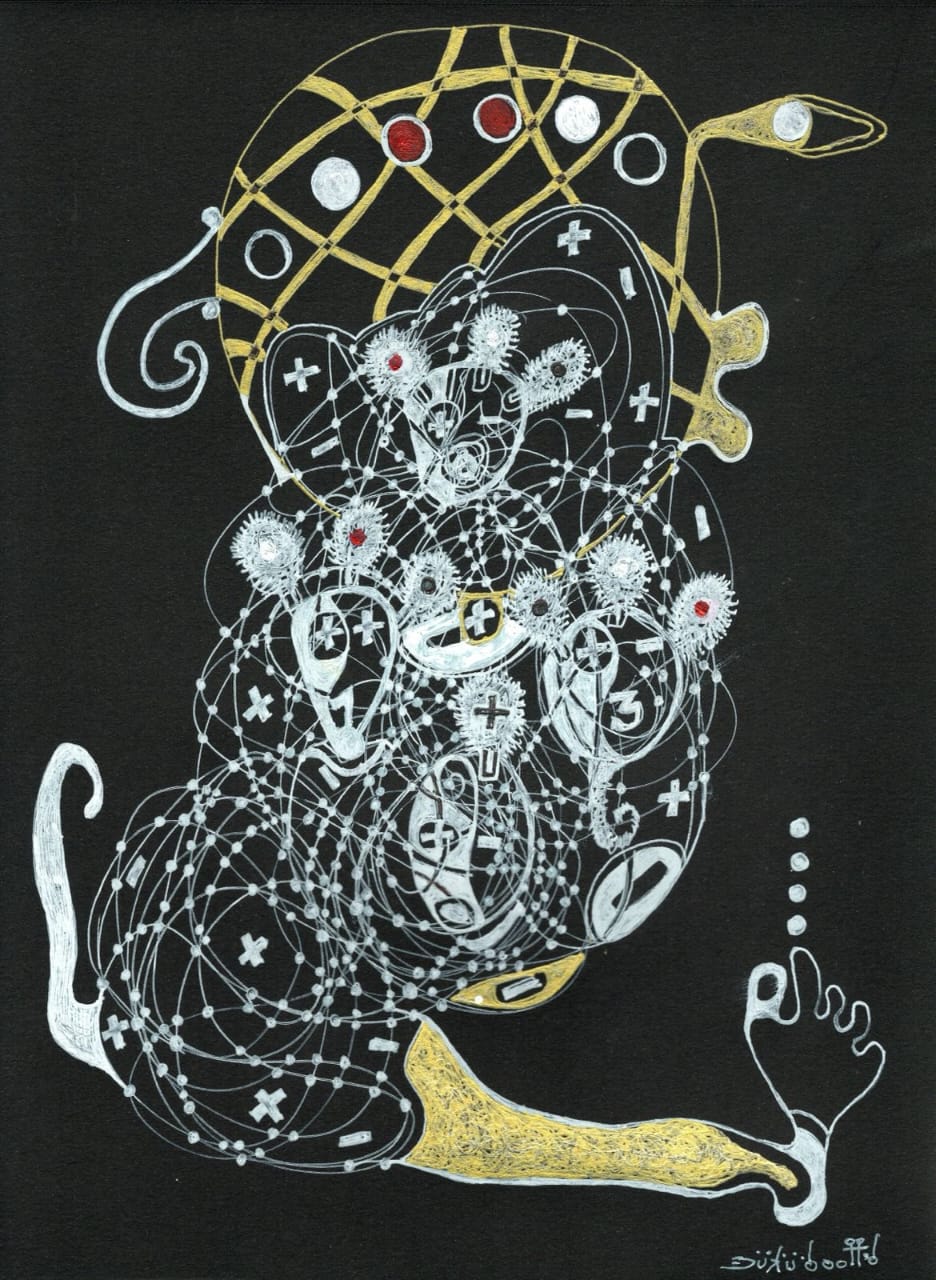
Ernest Dükü, “969-2022_Dollattitude @ Just a Boson Carrier,” 2022 Ink and acrylic drawing on black Canson paper, 28.10 x 21 cm Courtesy of the Artist and Galerie CHRISTOPHE PERSON
Asakan: You are Akan, born in 1958 in Bouaké, and a graduate of the École Nationale Supérieure des Beaux-Arts in Abidjan. Do your memories of your homeland and animism still haunt your creative world?
Ernest Dükü: The Akan carry the word, and thus wisdom… knowledge; so I won’t use the term “haunt” to describe this place of ancestral memory. I carry within me a reality of spiritual momentum surrounding issues related to “animism” in order to explore other spiritual mediums that form the foundation of the humanities within the diverse horizons of the world.
Asakan: So there’s certainly France—where, among other places, you currently live and work after earning a DEA in Art Sciences and Aesthetics from the University of Paris 1—as well as other places around the world that also inspire you?
Ernest Dükü: Yes. In my approach, there is a desire to bring different perspectives into dialogue. A desire to explore the various sites of memory that allow us to understand our humanity in all its complexity.
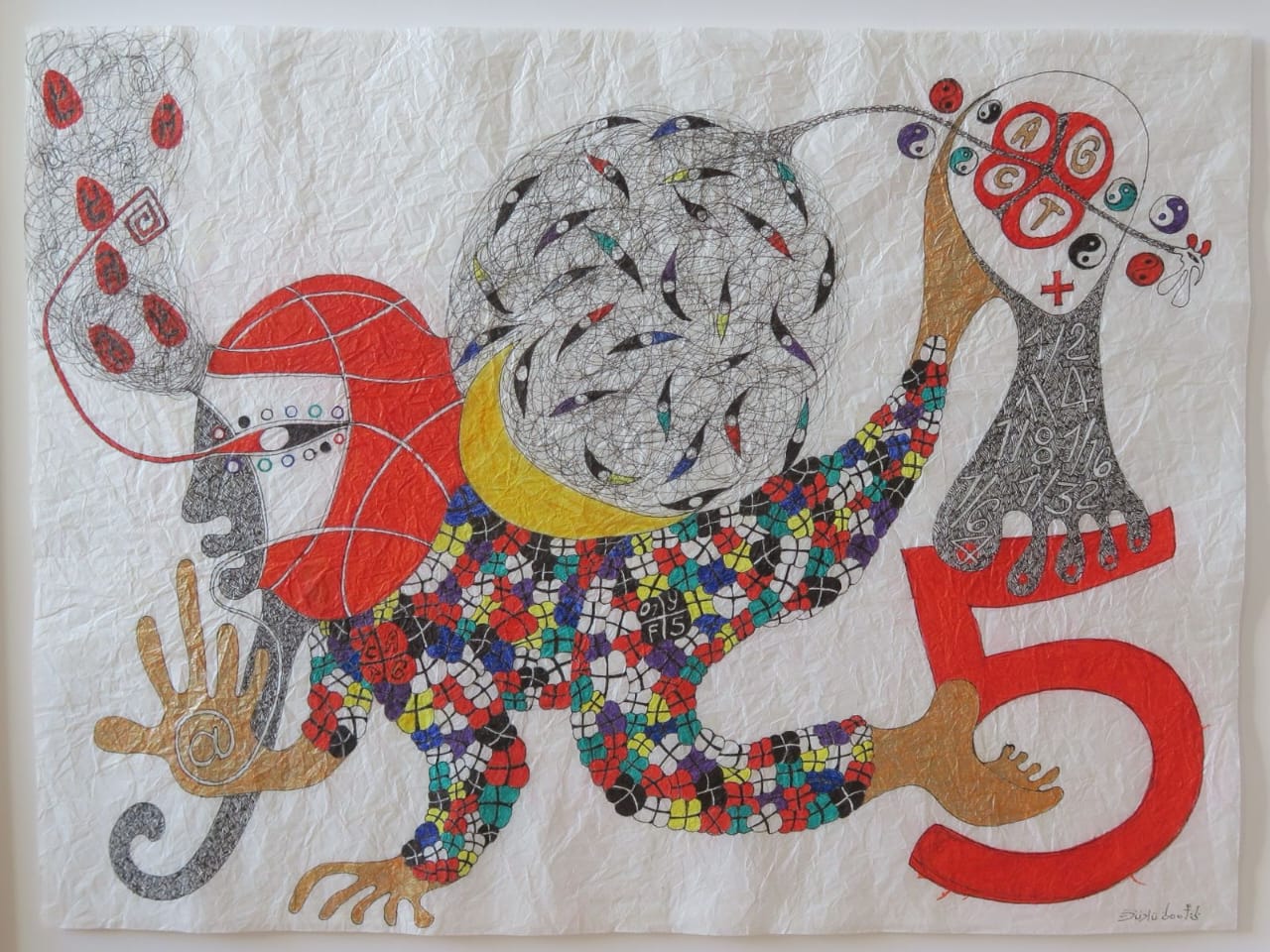
Ernest Dükü, “Kurumaawale@ What a wonderful world,” 2014. Ink, pen, and gouache on crumpled paper, 44 x 65 cm. Courtesy of the artist and Galerie CHRISTOPHE PERSON
Asakan: You’re also a sculptor. How does sculpture enrich your creative process on paper?
Ernest Dükü: Through my approach to drawing on crumpled paper or black paper, I strive to achieve a sculptural effect where volume emerges without any sense of construction. Forms intersect and intertwine to convey this quest for the perception of the infinitely small.
Asakan: Is art that important in our lives?
Ernest Dükü: Art elevates and reveals the power of life. It bears witness to the meaning that human societies ascribe to our existence. Art illustrates our journey through material reality—the reality of the visible—and has done so since the dawn of time. Our ancestors living in caves had already understood the impact of art on their humanity.
Asakan: Do you have any advice to share with young artists who would like to draw on your experience?
Ernest Dükü: Work, work, and more work to develop a level of reflection, inquiry, and questioning that will underpin the creative act. That seems essential to me…
Asakan: Any final words?
Ernest Dükü: I’ll quote a line from the musical legend, singer Pierre Claver Akendengue, who says in his album *Carrefour Rio*, in the song “Ne O”—and I quote: “Art is the advocate of living beings; art pleads for love of one’s neighbor; the purpose of art is to understand, but to understand is already to love. Can we understand something or someone we don’t love?” In a nutshell, what I take away from this quote is that art nourishes our desire for humanity.
Thank you.
Ernest Dükü – Drawing Art Paris 19th edition, March 26–29, 2026, General Section, Booth C10 – Carreau du Temple, 4 rue Eugène Spuller, 75003 Paris More info: christopheperson.com
À lire également
Agi: “Through this exhibition, I wanted to pay tribute to these Amazons, symbols of strength and resilience.”
At La Maison Rouge in Cotonou, painter Agi (born in Paris in 1971) is presenting, through November 29, “Les Merveilleuses,” an original exhibition cel…
Raymond Tsham: “Belgians and Congolese, Africans and Europeans—we must overcome the divisions of history, unite, and foster genuine complementarity among our peoples.”
Featured in the exhibition “Living Legacies: Reinventing Forms” at the Galerie Person in Brussels alongside Mozambican artist Reinata Sadimba, Raymond…

Joseph Ntensibe: “… I try to capture the dramatic effect of tropical light on nature and translate that experience into painting.”
Today marks the final day of the group exhibition featuring the renowned Ugandan painter Joseph Ntensibe—who trained at the Makerere University School…

Rodrigue Glombard: “To me, these walls and floors are not merely fragments of urban architecture; they are repositories of the traces of time, human stories, and the transformations of the landscape.”
For some time now, we’ve been introducing you to the artists featured in the exhibition “Martinique, Intimate Cartographies,” on view at the Wall Hous…
Commentaires