
Le Grand Entretien
Baudouin Mouanda: “…I try to capture the viewer’s attention through an aesthetic that allows the work to be hung on a wall without losing its power to engage.”
A leading figure in contemporary African photography, Baudouin Mouanda, known as Photouin (born in 1981 in Ouesso, Republic of the Congo), welcomed us to his exhibition “Habiter l’eau: Spirituality and Resilience,” which continues at the PERSON Gallery – Brussels through August 1, 2026. In this interview, he discusses his series “Ciel de saison,” in which he poignantly and uniquely explores the impact of global warming on his native Congo and, beyond that, frames it as a universal issue that transcends geographical and social boundaries.
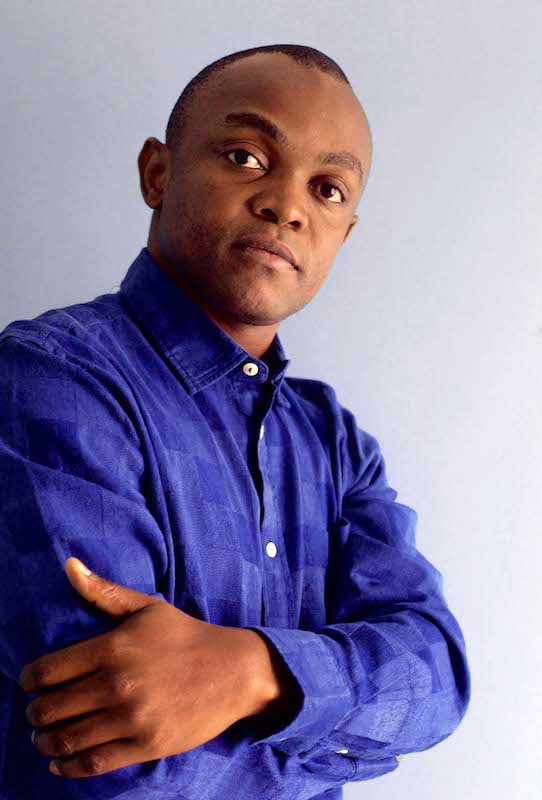
Asakan: You first discovered photography at a very young age before going on to study law at the University of Brazzaville and beginning your career as a photographer. Where does your passion for this medium come from?
Baudouin Mouanda: I discovered photography in 1993, when the Congo was in the midst of a civil war. My father, who was a physics teacher at the time, had made me a promise. He often called me “Little Baudouin” and would say, “If you pass your middle school entrance exam, I’ll give you a gift.”
Without my realizing it, that famous gift turned out to be a camera.
Then my father took it a step further: he gave me my first photography lessons. Through lots of practice and exercises, I started bragging to my classmates that I was the best photographer in school—especially since my physics teacher was also my photography teacher, since he’d talk about converging lenses, the aperture… But that’s how my love for photography was born.
Asakan: How did you eventually get into photojournalism and fine art photography?
Baudouin Mouanda: When I started out in photography, it wasn’t easy at all, because there were no photography schools in the Congo. So I enrolled at the French Cultural Center in Brazzaville—now the Institut français—the only place where I could find photography books to improve my skills by studying books and magazines. I was particularly drawn to the work of photojournalists from magazines like *Paris Match*, *Jeune Afrique*, *Courrier International*, and *Afrique Magazine*… That’s when I realized that photography could become a real career.
I decided to enter various competitions, notably the Prix Pector in the Democratic Republic of the Congo, where, in 2003, I won the trophy for best photographer of the Deux Rives (Brazzaville-Kinshasa). That same year, I was also selected as one of the 30 best photoessays created by students—out of more than 3,500 entries—as part of the Paris Match Student Photoessay Grand Prix. I repeated this achievement in 2004 and 2005, which earned me a scholarship and an internship at the Center for Journalist Training (CFPJ), specializing in photojournalism.
Subsequently, I began collaborating with the local press, as I had a deep interest in daily life and everything happening in Congolese society. Later, I developed a growing interest in fine art photography. That’s why my work combines both a documentary dimension and an artistic approach, while remaining deeply rooted in Congolese reality.
Asakan: In fact, one of your most critically acclaimed series, “Ciel de saison,” created in 2020 during the lockdown, is currently on view in the exhibition “Habiter l’eau: Spirituality and Resilience” at Galerie PERSON in Brussels. How did you conceive this series?
Baudouin Mouanda: The effects of climate change are becoming increasingly visible. In 2019, I was in Paris and witnessed the terrible floods that ravaged the suburbs. Shortly afterward, I returned to Brazzaville, where we faced the same problem. So I took on this subject by getting closer to the communities most affected.
I was deeply moved by the extreme precariousness of their living conditions. They also complained about journalists who came only to cover their situation, without offering any concrete solutions.
I then thought about another way to advocate for their cause, combining documentary photography with a more aesthetic approach to draw more attention to the issue.
So I went to meet them, armed only with my smartphone, to document this disaster. I photographed the water levels, the interiors of their homes, the locations of their living rooms, dining tables, and bookshelves—in short, everything that the floods had submerged.
Around the same time, I needed to find a location to carry out this project. And since I was in the process of building a cultural center with a 120 m² basement, I decided to use that space. At the time, the basement wasn’t yet covered: there was no concrete slab, and it naturally filled with rainwater. We were in the midst of a lockdown and the airports were closed, so I decided to take advantage of being stuck in Brazzaville to create a new series about these floods, while also sharing the stories of those who had lost everything.
So I went back to visit several families affected by the floods. I presented my project to them and promised to pay them to pose as models, as well as to cover their transportation and provide them with a snack. Even though some families probably thought I was crazy, many of them came with their personal belongings and agreed to submerge them in the water that was still standing in my basement, in the service of this artistic endeavor.
After the first few sessions, which were done without artificial lighting, I showed them the photographs. They were extremely happy to see themselves portrayed in this way. That’s when I realized that my work could have a real impact, because the people directly affected recognized themselves in these images.
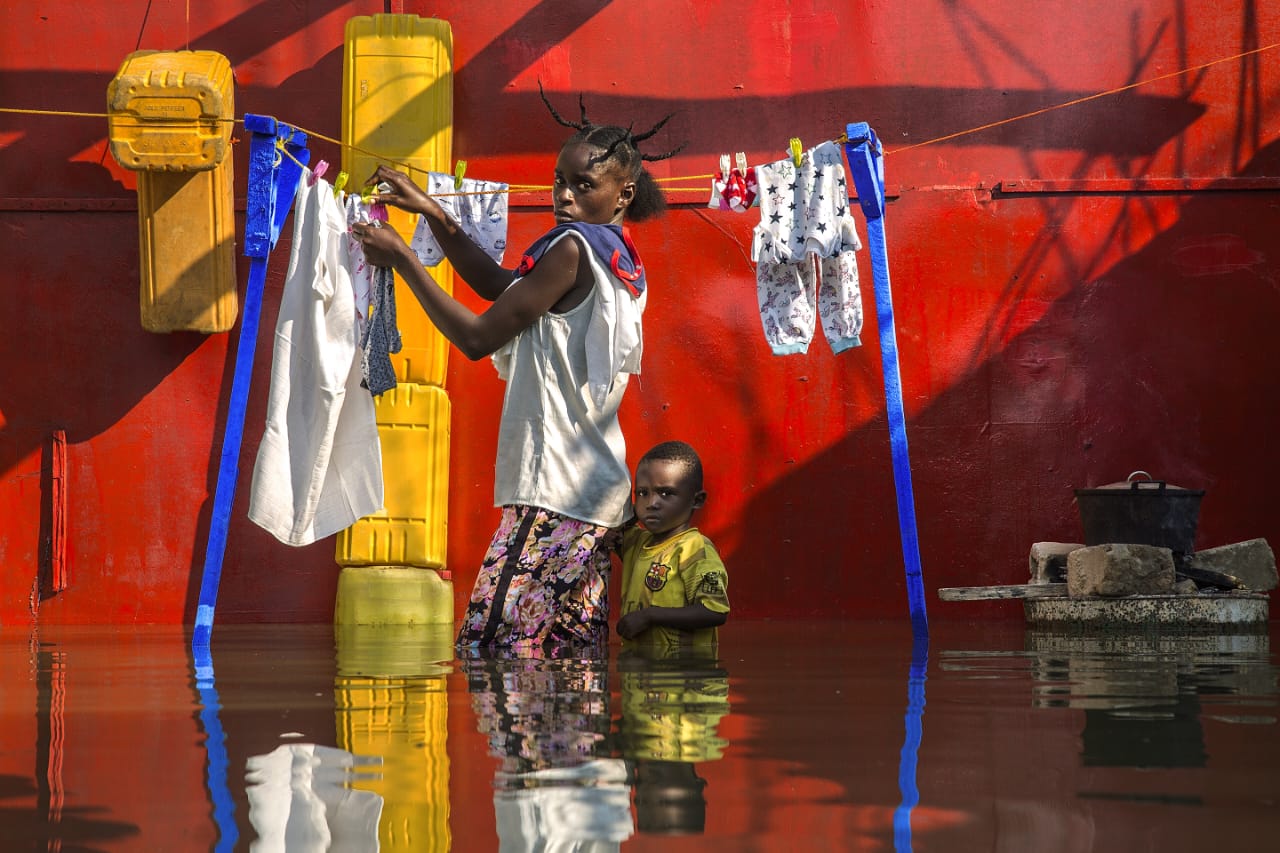
Baudouin Mouanda, “A Mother Takes Advantage of the Sun to Hang Laundry in the Courtyard,” “Ciel de Saison” series, 2020. Hahnemühle Fine Art Baryta 325g inkjet print, 60 x 90 cm. Courtesy of the artist and Galerie PERSON
Asakan: What do you hope to convey through your work?
Baudouin Mouanda: An unconventional image, yet one that is positive and respectful of the dignity of disaster-stricken communities. I could have gone to take documentary photos like everyone else; however, they would not have had the same intensity, the same poetic power, or the same commitment. We cannot continue to tell a story by exploiting the distress of the destitute, as has so often been done by presenting Africa solely through the lens of war, poverty, famine, and all manner of scourges.
I want us to be able to tell our stories without belittling ourselves. We must always be positive in what we do. That’s why I try to capture the viewer’s attention through an aesthetic that can be hung on a wall, without the work losing its power to challenge. Because we are all human beings, whether we were born in Benin, Togo, Cameroon, Mali, France, Germany, Switzerland, the United States, Brazil, and so on. That is why, as you will notice, there is a lot of color and humor in my photographs.
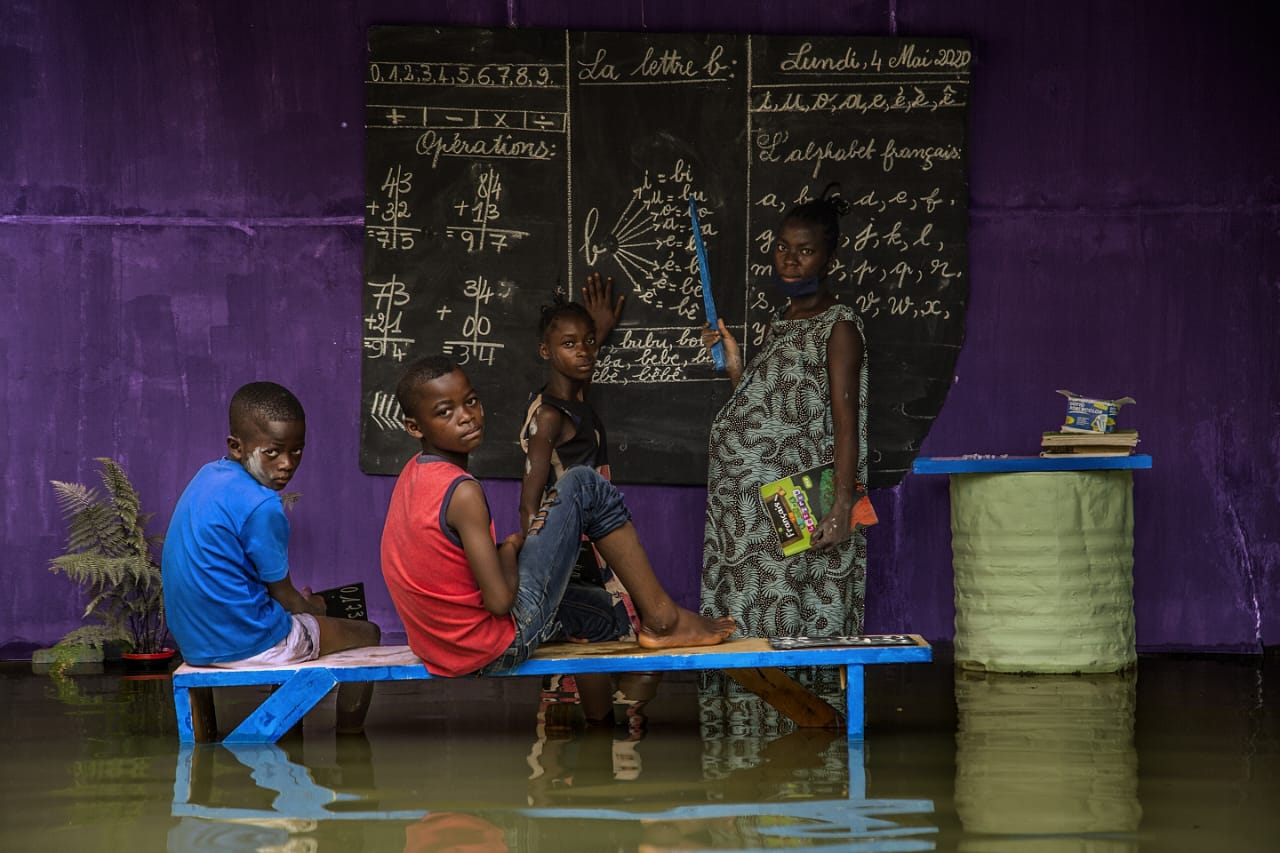
Baudouin Mouanda, “Anna, a young teacher, helps the children review their lessons,” “Ciel de Saison” series, 2020. Hahnemühle Fine Art Baryta 325g inkjet print, 60 x 90 cm Courtesy of the artist and Galerie PERSON
Asakan: More than five years after creating this series, do you feel you’ve helped shift perspectives on the floods that affect the most vulnerable populations?
Baudouin Mouanda: I’m glad this work was presented right from the start at COP 27 in Sharm el-Sheikh, Egypt, in 2022. That allowed me to serve as a voice for these communities. Even today, whenever conferences, symposia, or exhibitions on climate change are organized, this project is regularly featured.
Furthermore, the “Ciel de saison” series won the prestigious Roger-Pic Prize from SCAM in 2022, as well as the Singulart Awards, presented by a jury of art professionals in recognition of the artist’s talent in exploring the theme of human connection, in Paris (France). She was also a finalist for the Pictet Prize last year. These accolades now allow me to address these concerns—with great respect and legitimacy—to decision-makers around the world.
Asakan: Do you plan to continue this series?
Baudouin Mouanda: A book on this subject is in the works, but I can’t say more about it at this time. Besides, as you know, there are other issues surrounding us that are just as crucial.
Asakan: What issues do you have in mind?
Baudouin Mouanda: The issue of access to drinking water. For example, right now, I’m working on a project called “La Sueur du Robinet” (The Sweat of the Faucet).
Today, in many parts of the world, the wealthy pay less for water than the poor, who must buy a 25-liter jug every day for 150 CFA francs. When you factor in the number of jugs needed per day, the number of family members, and the number of days in the month, this can amount to as much as 65,000 CFA francs (about 100 euros) per month—for a monthly income that often does not exceed 50,000 CFA francs (about 77 euros).
Through this work, I’m trying to help the world understand this inequality.
Asakan: What are your other most notable series?
Baudouin Mouanda: The “SAPE” series, which I dedicated to the sapeurs—a movement in the two Congos (Brazzaville and Kinshasa) driven by enthusiasts of the art of dressing well and “sapology.” I can also mention “The Aftermath of War,” dedicated to the wars of 1993, 1997, and 1998 in the Congo; “On the Sidewalk of Knowledge,” which shows schoolchildren and students studying under streetlights after dark; or “Congolese Dreams,” in which I took a single wedding dress around the world (Congo, China, Germany, the United States, Switzerland, Japan, France) to have it worn by several women, in order to explore the deep and universal motivations behind marriage.
Asakan: Why did you choose everyday life as the central theme of your work?
Baudouin Mouanda: It’s important to me so that those who view my work, wherever they may be, can see themselves reflected in our social realities—which are simply a reflection of life—to which I bring a touch of beauty and poetry through my images.
Asakan: In your photographic work, one can indeed sense the need to examine reality with humanity, individuality, and humor. How do you work with the light you capture in your subjects’ gazes, postures, and facial features?
Baudouin Mouanda: I want to serve my subjects, to give voice to their stories. When they arrive, for example, and I know them, the first thing I always ask them is to forget I’m there.
If, on the other hand, it’s our first time working together, I tell them to act as if we’ve known each other for a very long time—and above all, not to be self-conscious around me, but to be natural. Then I get to work.
However, the image—the photograph—I want to create doesn’t come all at once. I observe the model closely, and sometimes I wait until they’ve completely forgotten I’m there before I press the shutter.
I don’t retouch my photos either. I like to capture my subjects just as they are in their everyday lives. This is reflected in the natural feel of my photographs and evokes emotion.
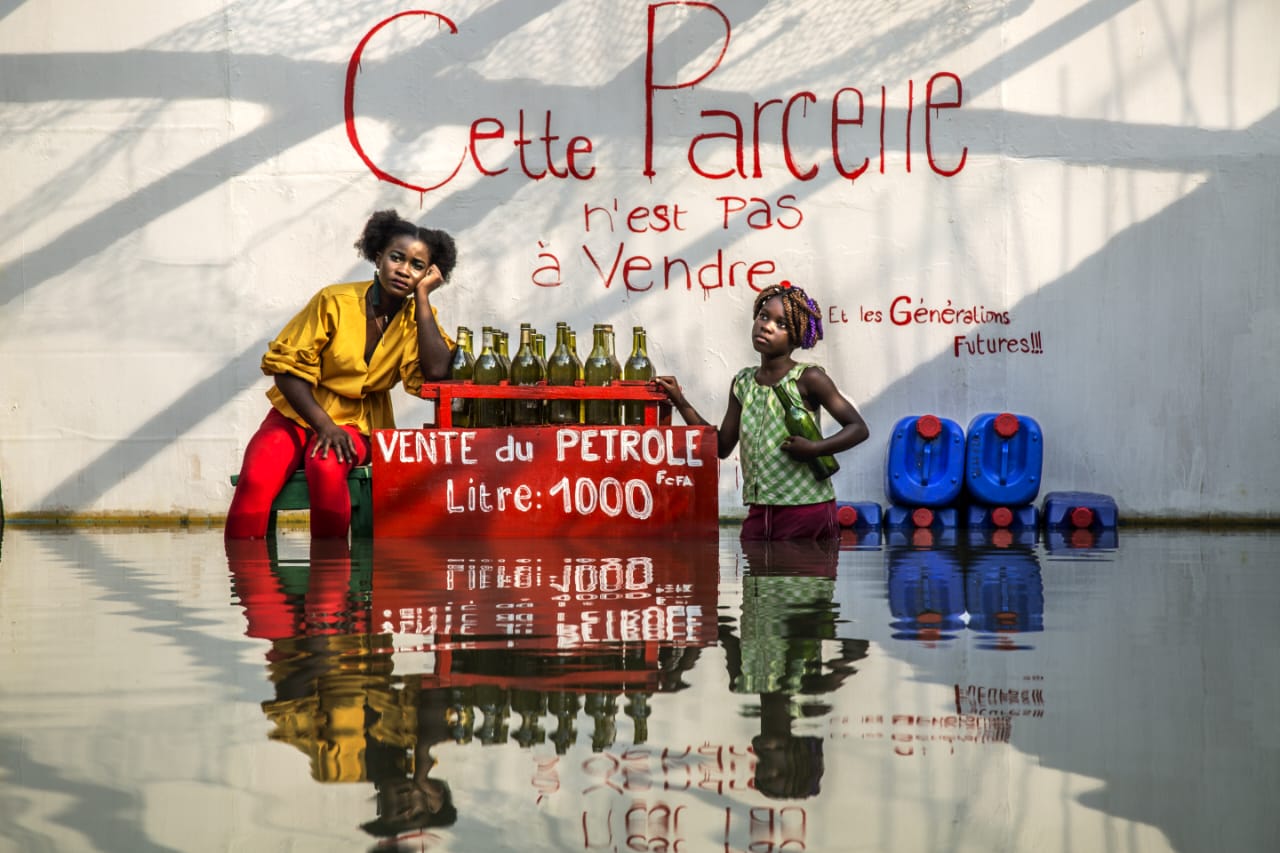
Baudouin Mouanda, “Street Oil Vendor,” “Ciel de Saison” series, 2020 Hahnemühle Fine Art Baryta 325g inkjet print, 60 x 90 cm Courtesy of the artist and PERSON Gallery
Asakan: When you say, “I like to capture my subjects just as they are in their everyday lives,” does that mean you always work with natural light?
Baudouin Mouanda: Yes, always. Natural light is my favorite. I don’t work with flash either. It’s in natural light that I find the contrasts and emotions I’m looking for in a photograph.
Asakan: If someone asked you today what you’ve learned about yourself through your work, what would you say?
Baudouin Mouanda: I’d say patience, respect for others, and humility.
Asakan: When you first started photography, did you ever imagine that one day you’d become so well-known?
Baudouin Mouanda: Back then, I was already convinced that I wanted to be a photographer, but my parents hoped I’d become a lawyer. So I had to explain to them that this would be my way of living my life—my time on this earth—and of leaving a mark in a way other than through the monotony of an office job. But it wasn’t until I built my own little villa at the age of 26—while my father didn’t even have one yet—that they began to believe in me.
In a word, when you have a vision, never turn your back on it. Always do what you have to do well. It brings me immense joy to be able to work as a professional photographer. Even if people judge me based on the present without taking the time to understand the path I’ve taken to bring my project to life.
I often say that with a project, only the person who defines it knows exactly what they want. Collaborators may one day abandon you because, in their minds, they want immediate results—especially in a field where it’s difficult to secure grants.
Asakan: Do you have any other advice to share with young artists who would like to learn from your experience?
Baudouin Mouanda: For artists who work in photography, I urge them to be passionate about what they do and also to read the press and specialized publications extensively, to visit exhibitions and museums, and to enroll in art workshops.
They should also take the time to live life fully, to savor every moment—even when they’re just walking. That’s how you develop your imagination.
Asakan: Is art that important in our lives?
Baudouin Mouanda: Yes, very important. Without art, we cannot deepen our understanding of ourselves and our world.
We often live with art without even realizing it. When we frame our photos or those of our family members and hang them on the wall, that’s art; or when we create monuments in our cities to explore our identity and serve as landmarks.
I’m happy to see that today, many Africans are starting to collect art—not just for the sake of collecting, but because it enriches them spiritually, intellectually, socially, and culturally.
Art allows us to see our surroundings in a new light.
Asakan: Indeed, and in fact, you’re trying to donate a portion of what you earn from art to establish a cultural center in Brazzaville?
Baudouin Mouanda: Absolutely, and next September I’ll be inaugurating the ClassPro Culture center, which has been the focus of all my savings since I started out. It’s a center that will offer photography workshops, an artist residency, a media library, exhibitions, and many other cultural services to people living in the suburbs of Brazzaville, as well as to Congolese, African, and European photographers.
Right now, we’re in the middle of the World Cup, which will end on July 19. I’ve set up a big screen to broadcast the 2026 World Cup matches on the center’s esplanade, so that people can come every evening to watch their teams compete. It’s a way to connect with people and promote art and a better sense of community. That, too, is the beauty of artistic projects born from photography.
Asakan: Any final thoughts?
Baudouin Mouanda: I’d like to invite the people of Brussels, as well as anyone passing through the capital of Europe, to visit the exhibition “Living with Water: Spirituality and Resilience” at the PERSON Gallery. And in September, ClassPro Culture will open in Brazzaville. Anyone interested in pursuing a professional photography program or an artist residency is welcome to contact me.
Exhibition “Living on Water: Spirituality and Resilience” featuring artists Baudouin Mouanda and Wilfried Mbida, June 7–August 1, 2026, GALERIE PERSON – Brussels, Rue Émile Claus, 63, 1180 Uccle, Brussels, Belgium Opening hours: Tuesday through Saturday from 2:00 PM to 6:00 PM or by appointment Information: christopheperson.com
À lire également
Yasmine Kechad: “I would describe KECHAD as an independent organisation that allows me to engage with art in different ways, depending on the artists, the projects and the people I meet.”
The newly launched KECHAD platform is participating in its first Paris Photo fair through November 15, 2026, in collaboration with the Carole Kvasnevs…
Agi: “Through this exhibition, I wanted to pay tribute to these Amazons, symbols of strength and resilience.”
At La Maison Rouge in Cotonou, painter Agi (born in Paris in 1971) is presenting, through November 29, “Les Merveilleuses,” an original exhibition cel…
Raymond Tsham: “Belgians and Congolese, Africans and Europeans—we must overcome the divisions of history, unite, and foster genuine complementarity among our peoples.”
Featured in the exhibition “Living Legacies: Reinventing Forms” at the Galerie Person in Brussels alongside Mozambican artist Reinata Sadimba, Raymond…

Joseph Ntensibe: “… I try to capture the dramatic effect of tropical light on nature and translate that experience into painting.”
Today marks the final day of the group exhibition featuring the renowned Ugandan painter Joseph Ntensibe—who trained at the Makerere University School…
Commentaires