Le Grand Entretien
Aïda Patricia Schweitzer: “I had no choice but to fight, and subsequently, more broadly, to reject and denounce injustices, including the neglected realities faced by women.”
Known for her spectacular performances that explore the conditions faced by women in our contemporary societies, Aïda Patricia Schweitzer—a self-taught artist of Egyptian, Chaouia, and French descent—has developed a transdisciplinary practice. She creates a dialogue between textile art—particularly through her socially engaged approach to embroidery—drawing, and video, with the aim of blending codes, forms, and materials. A true activist for art and feminism, her practice captivates with its raw quality and keenly reflects the dynamics of patriarchal domination, the memory of diverse cultural heritages, and a mystical dimension that permeates her entire body of work. We met with her on your behalf.
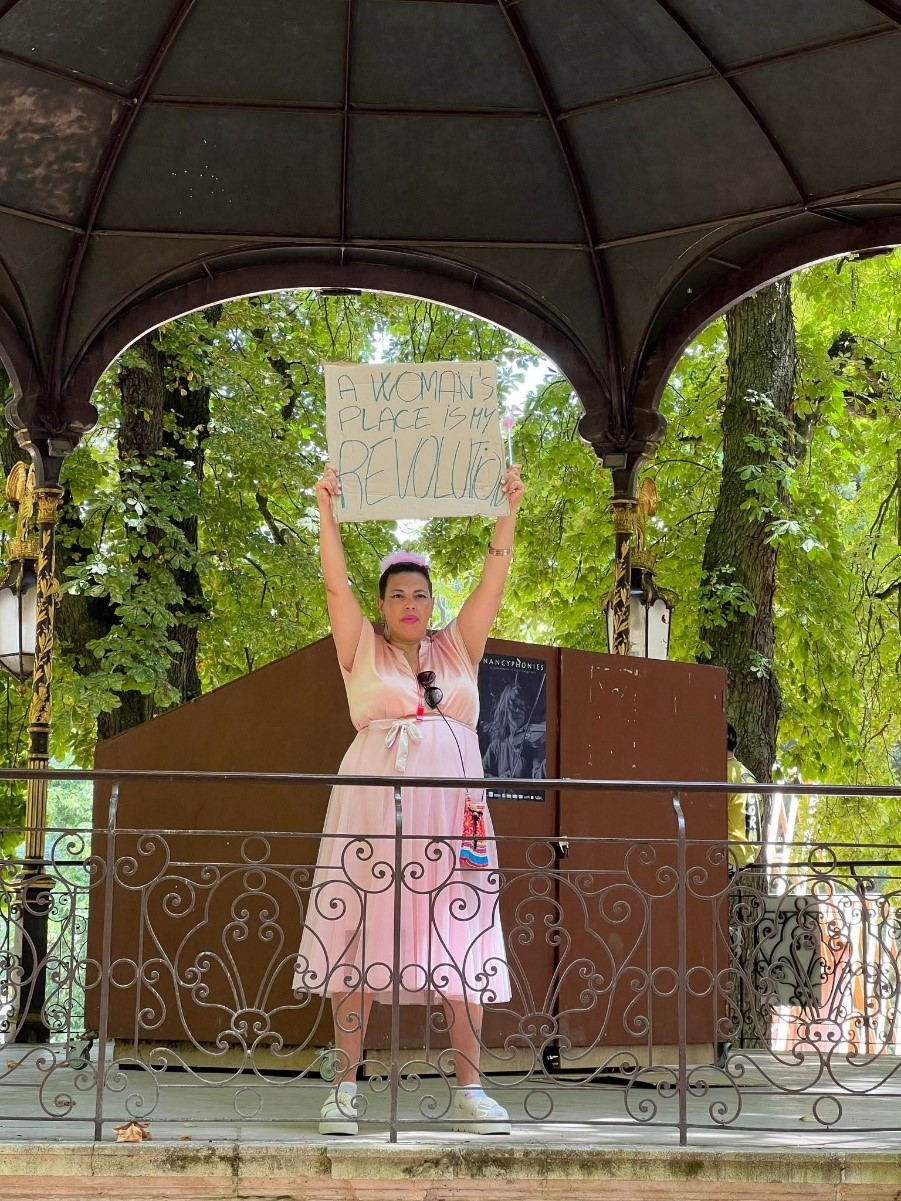
Asakan: You were born in Metz, and at a very young age, you decided to travel to Egypt and Morocco in search of traces of your history. What is that history?
Aïda Patricia Schweitzer: A story of uprooting and rebuilding. The traumatic silence of an orphanage at a time when such institutions mistreated and broke children. I didn’t speak (I’ve caught up since then, laughs), and then my adoption by a French family. My childhood in Lorraine was an early confrontation with systemic violence.
On the playground, racist insults and blows rained down: I was called “Arab, nigger, thick-lipped.” My only ally was a classmate with a disability—an alliance of outsiders: together, we were stronger. My first act of resistance was therefore drawing—my refuge.
Traveling to Egypt at the age of seventeen then allowed me to reconnect with the missing piece of my story. I needed to find “my Teta,” my Egyptian grandmother. To find the missing piece of this identity puzzle in which I was the “outsider.” I met an elderly woman, a rebel, proud of her self-education, an activist who had never wavered in the face of her condition as a woman. In fact, I’m a lot like her.
My connection to the desert is also very strong. In Morocco, I met some Malian Tuaregs. They invited me to travel with them. Crossing the desert and living alongside them was a revelation. Travel deconstructs our perspective. Romanticizing it is a cliché unless we seek a profound encounter—one that takes time and requires us to accept our cultural differences. It’s a learning process: staying humble and never arriving with a domineering attitude. I’ve been enriched by my contact with these communities, and today I draw on the awareness of what has been given to me—and never taken away—to fuel my artistic practice.
Asakan: Is that why you became an artist?
Aïda Patricia Schweitzer: Undoubtedly. At age four, I already knew I would be a hairstylist. I spent hours styling my dolls’ hair. They were all white: diversity didn’t really exist in toys. For me, styling hair was like a ritual: an intimate act, a dialogue, a deeply creative gesture of beautification. In fact, hair has now regained its rightful place in my visual art.
Making the transition from hairdressing to the world of contemporary art wasn’t easy. As a woman of color, I had to prove myself twice as hard in a predominantly white and very self-centered environment. It was brutal at times, but it shaped me. In fact, I’m currently writing a critical essay on this subject, “The End of Docility.”
I started making art later than many artists. Being self-taught—I realize now—is a strength that gives me real freedom.
Asakan: Later on, you used your body to explore your multifaceted identity through travel and nomadism in particular. Can you tell us more about that?
Aïda Patricia Schweitzer: It is the body that carries us, but it is also the body that is abused, violated, used as a weapon of war, or mutilated. It is viewed differently depending on the region, culture, and religion. My own body has become a weapon of expression: it has resisted; it has survived.
Nomadism and travel have allowed me to experience it differently each time. This is what has shaped my multifaceted identity: the way this body expresses itself, the way it is viewed, and the care and respect shown toward it.
My body is unconventional; it does not conform to Western beauty standards. Paradoxically, this same body is a symbol of richness in certain African cultures… Showing it is an act of activism in the face of our society’s dictates.
The body is also sacred: in many of the cultures I’ve encountered, beauty rituals are performed during significant events. Adornment is never purely decorative; it is always imbued with meaning, memory, and tradition. This is reflected in my textile practice and beyond.
Moving my body also means questioning myself, on a deeply personal level. The way I’m perceived changes depending on where I perform. A memory comes to mind: I performed among my Maasai friends in Tanzania. This performance arose from their invitation and a sincere sharing, far from any opportunistic pretense. It made them laugh; they have other concerns, so far removed from our own. The Maasai are warriors; their bodies must withstand harsh conditions. Their way of life demands a different kind of endurance from the body. Taking on these challenges in this foreign place stimulates me: putting my body and my thoughts to the test, outside my comfort zone.
Asakan: One example of how you use your body is your performance at the 2017 Venice Biennale, at the invitation of Nigerian artist Jelili Atiku…
Aïda Patricia Schweitzer: Yes… Performing at the Venice Biennale is impressive. Jelili Atiku is an artist for whom I have great respect. He allowed me to reconnect with my roots and strengthen my ties to the African continent. It was a very powerful moment, and an honor to perform alongside him.
There were 72 of us—women of all ages—wearing costumes inspired by Yoruba rituals, for a two-hour procession along the canal and past the old shipyard. It was sweltering hot; we waited a long time under the sun before we even started. Journalists were taking photos, and we had to face another challenge: not falling into the water and staying focused. We drew water from a carved gourd, evoking the Igba Iba, to gather the world’s feminine energy, purify it, and add it to the exhibition installation.
Through Jelili, we forged connections and discovered common ground in our practices: ritual, feminine forces, and the various Africas that bind us together. I also owe her a debt of gratitude for the visibility she provided, as the video of the performance was screened throughout the entire duration of the Biennale.
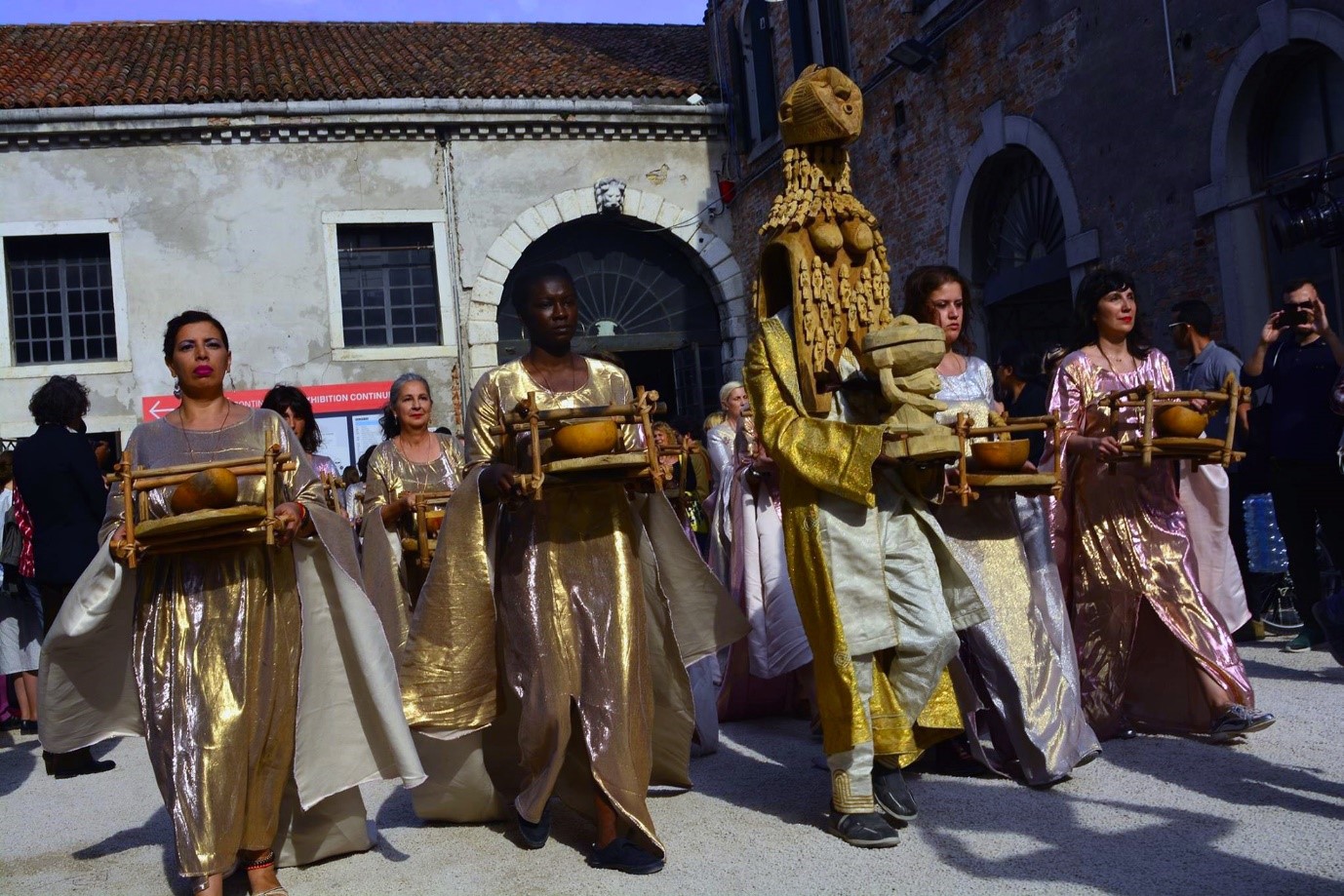
Performance by artist Jelili Atiku, “Mama Say Make I Dey Go, She Dey My Back.” 57th Venice Biennale (Viva Arte Viva), Venice, May 2017. Photo: © La Biennale di Venezia
Asakan: We could also mention nearly twenty performances, each more activist than the last, as a body of tools for raising awareness and mobilizing action around the often-neglected realities of women in contemporary society. Why this artistic feminism?
Aïda Patricia Schweitzer: When you’re adopted and beaten as a child because of the color of your skin or your origins, it shapes your character. There’s an urgent need to survive. I know my roots, and I’m proud of them. I had no choice but to fight, and later, more broadly, to reject and denounce injustices—including the neglected realities faced by women.
You just have to look at society: the wage gap between men and women, for example. Look at museum exhibitions and other venues for public display: do you see many women there? We still have a long way to go. There’s also the silence imposed by fear, and women’s knowledge being dismissed and relegated to folklore.
And as a woman of color, I have heard many deeply moving accounts of mechanisms of domination and privilege. I understand them; I know them, because I experience them too. Through my art, I can raise awareness of these issues, as they are central to my research. The feminist struggles we’re seeing today are legitimate—hence “The End of Docility.”
Our voices can reach a wider audience, bring to light what is silenced, and give a voice to those who have none. I stand in the lineage of the witches’ heirs. We must not forget all those who were burned at the stake because they were marginalized, because they were a nuisance. The misunderstood, the rebellious. Those who are still being burned with acid today, to disfigure them, to make them pay the price for being women! I carry them loud and clear in my heart. It is important to pay tribute to them. What we need today is an end to impunity.
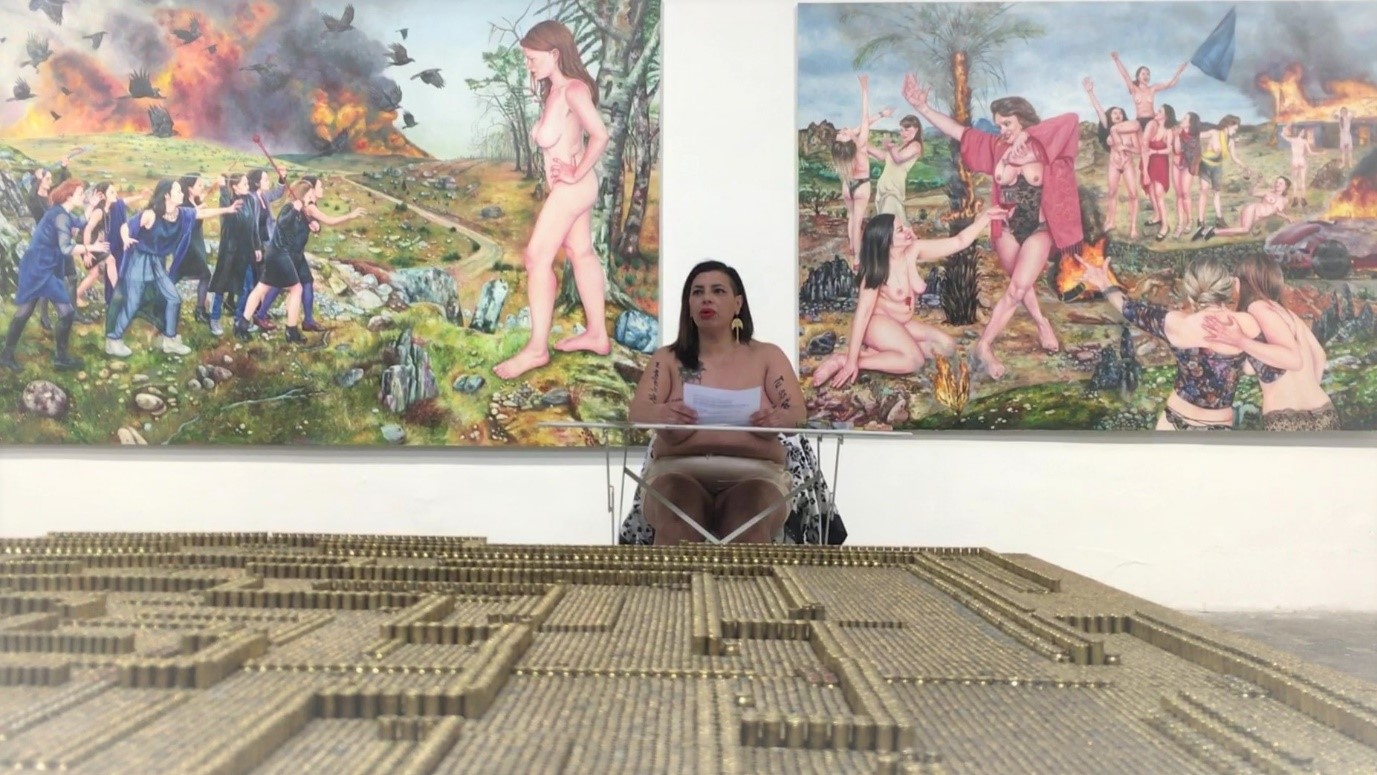
Performance by Aïda Patricia Schweitzer, “Warrior Women, Women in Combat” (Curated by Isabelle de Maison Rouge), Topographie de l’Art, Paris, 2022. In the background: Paintings by Nazanin Pouyandeh. In the foreground: Installation by Léa Le Bricomte. Photo credit: © Jean-Noël Martin.
Asakan: That’s where we sense all the strength you pour into your performances. What draws you so much to performance art?
Aïda Patricia Schweitzer: Performance opens up a whole new world for me. It places me in the midst of movement and action. I love this contrast with the other art forms I explore: embroidery requires time and patience. The preparation beforehand is also akin to a ritual, a form of meditation, with its own codes.
What draws me in is the act itself: the ephemeral nature that extends beyond the moment. I occupy a space for a set amount of time, and there’s a real element of risk involved. The message encourages me to reexamine my own questions—and those of the audience as well. A performance can exist without a physical audience, preserved in memory through photos or video. But its impact won’t be the same: it’s the audience’s gaze, in real time, that gives it its full dimension.
The body is exposed without artifice. I can’t hide; I reveal something profound—a laying bare of emotions. Women have confided in me: “You gave me the strength to accept my body better.” That moves me deeply. Showing other bodies—bodies with lived experiences, including those that are older, with their scars—is important in a society that renders invisible and rejects anything that deviates from images of perfect bodies and the prevailing culture of youth worship. These pressures are toxic; they cause real suffering. My performances are a mapping of bodies that resist: marginalized voices, discrimination, and above all, the violence inflicted on women’s bodies.
I like to perform outside institutional walls—life happens out there. Public space allows us to step outside confined settings, to encounter different audiences—sometimes those further removed from this world—who interpret the gestures and content in new ways. It’s very interesting. Performing without being invited is also a way to push boundaries. There’s also the element of the unexpected: I’ve already experienced some surprising situations.
Asakan: And when situations like that arise?
Aïda Patricia Schweitzer: You just have to deal with them calmly, without letting yourself get thrown off balance (laughs).
Asakan: How has your perception of performance evolved over the years?
Aïda Patricia Schweitzer: My early days were more punk. I dared to be radical in a way that I see differently today. But that’s also an advantage: maturity and more focused research have allowed me to explore other dynamics.
My thinking and preparation are more refined. My reading feeds into my favorite themes and ties in with my visual research. I enjoy discovering the work of other artists: it gives me a clearer understanding of the international scene, allows me to explore new realms of possibility, analyze contemporary societal influences, and broaden my line of inquiry. My multifaceted identity is also more deeply rooted in these new approaches.
Currently, common themes run through my work, though each is approached through its own unique lens. Performance art has really gained ground, and African scenes stand out for their power, their approaches, and their demands. We can no longer continue to render them invisible. It’s time to rectify this lack of recognition.
Asakan: Speaking of which, if you were asked today to choose the venue and context, what would your ideal performance be?
Aïda Patricia Schweitzer: I’m thinking of certain countries where being a woman means having your rights trampled upon—and which the international community pays no attention to. Here in Europe, I take no risks: I’m protected, despite everything, by freedom of expression.
We’ve seen those images of the Iranian woman who ripped the turban off a mullah—a gesture that carries powerful symbolism. Such an act can lead to imprisonment; the death penalty is being imposed at very high rates in a country like that. Afghan women, who are being erased from history, no longer have access to anything—they’re simply condemned to disappear. War-torn territories… I think about them often; they haunt me and sadden me terribly. Performing in those territories is impossible for me—I’d be risking my life.
I am aware that freedom comes at a price, so I try, in my own modest way, to shed light on this disparity. Because, in my view, the true performance is that of these women who struggle every day for their survival, for the right to exist.
Asakan: In your work, you also engage with drawing and painting, as well as installation, embroidery, and video, for purposes that are both critical and poetic. How do you work with such a wide range of media?
Aïda Patricia Schweitzer: Drawing has always been a part of my destiny. Even as a young child, I was already drawing as a way to escape: on walls, in the sand, on my dolls. It’s my inner, most secret language. I have a whole world that comes to life inside me, somewhere between mysticism and a bestiary, like a television that turns on from time to time. As a child, I even believed that people were drawing in the sky (laughs).
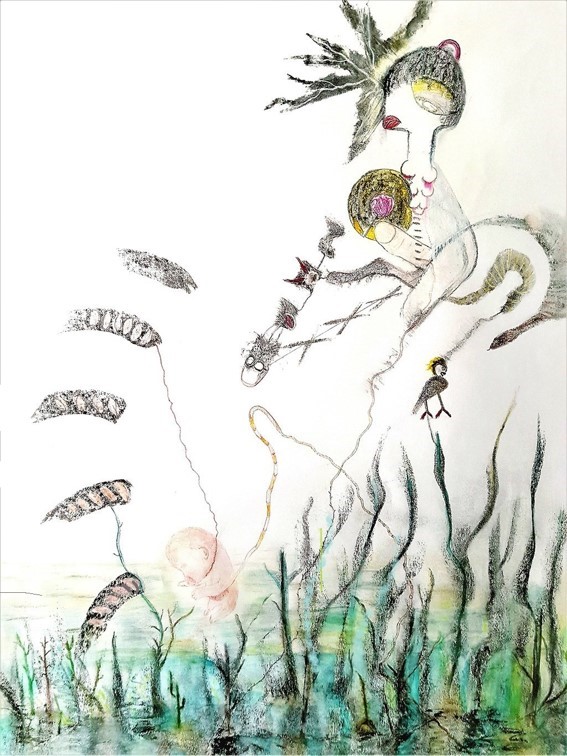
Aïda Patricia Schweitzer, “Fœtus in paradise,” 2019. Mixed media on paper, 80 x 100 cm, Luxembourg
For now, painting is on hold in my practice. Drawing and embroidery, on the other hand, function like communicating vessels: embroidery is a different way of drawing, on a different medium.
So, for me, embroidery is transcribing, stitch by stitch, what time and society try to erase or silence. It is a labor of remembrance, but also of confrontation. I am reclaiming a craft historically confined to the domestic sphere. Long relegated to the anonymity and passivity of housewives, the art of thread is now becoming a powerful tool for activism: the needle is transformed into a weapon of protest to denounce systemic violence and advance feminist struggles.
It is no longer mere decoration; it is a form of healing, an act of political resistance, a way to inscribe an indelible message into the material. In one of my works, I incorporated a symbolic and intimate material: the surgical thread from an operation I underwent. By transposing this medical thread—designed for suturing and healing the body—into my artwork, the artistic gesture becomes a true tool for mending memories.
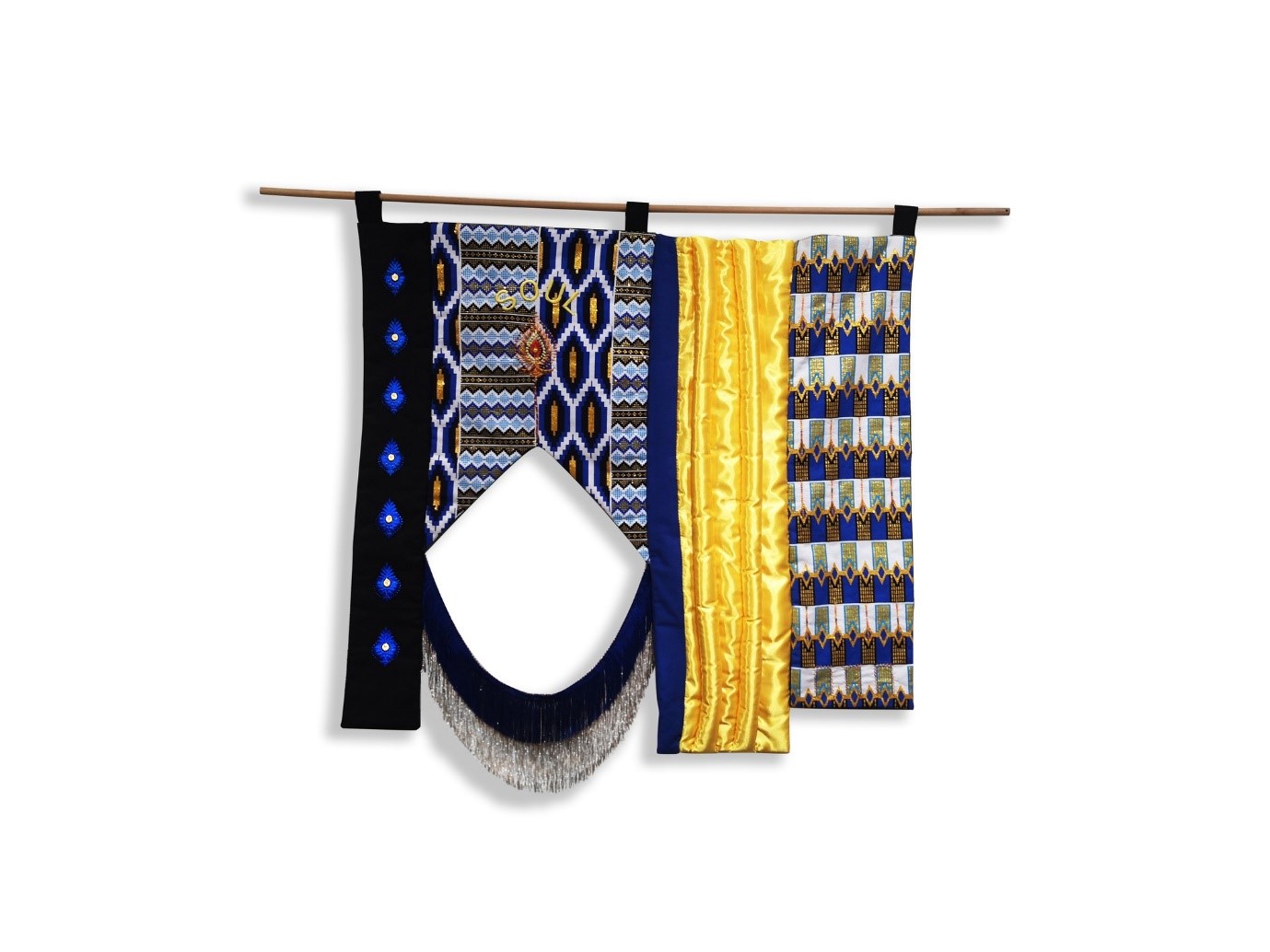
Aïda Patricia Schweitzer, “Africada,” 2025. Assembled wax print, satin, and cotton; embroidery; fringe. Dimensions: 80 × 76 cm. Photo: © GIE Luxembourg @ Expo2025 Osaka – Ondrej Piry
The installation, meanwhile, brings all these elements together in a single space, where the pieces respond to one another, engage in dialogue, and sometimes clash.
The video extends this gesture: it captures the intensity of life, transforms the ephemeral action into a lasting work, and tells other stories. I am also deeply interested in new technologies. During my residency at “Out of the Circle” in Cairo in 2024, I used artificial intelligence to deconstruct traditional Egyptian motifs, before reworking them myself, entirely by hand.
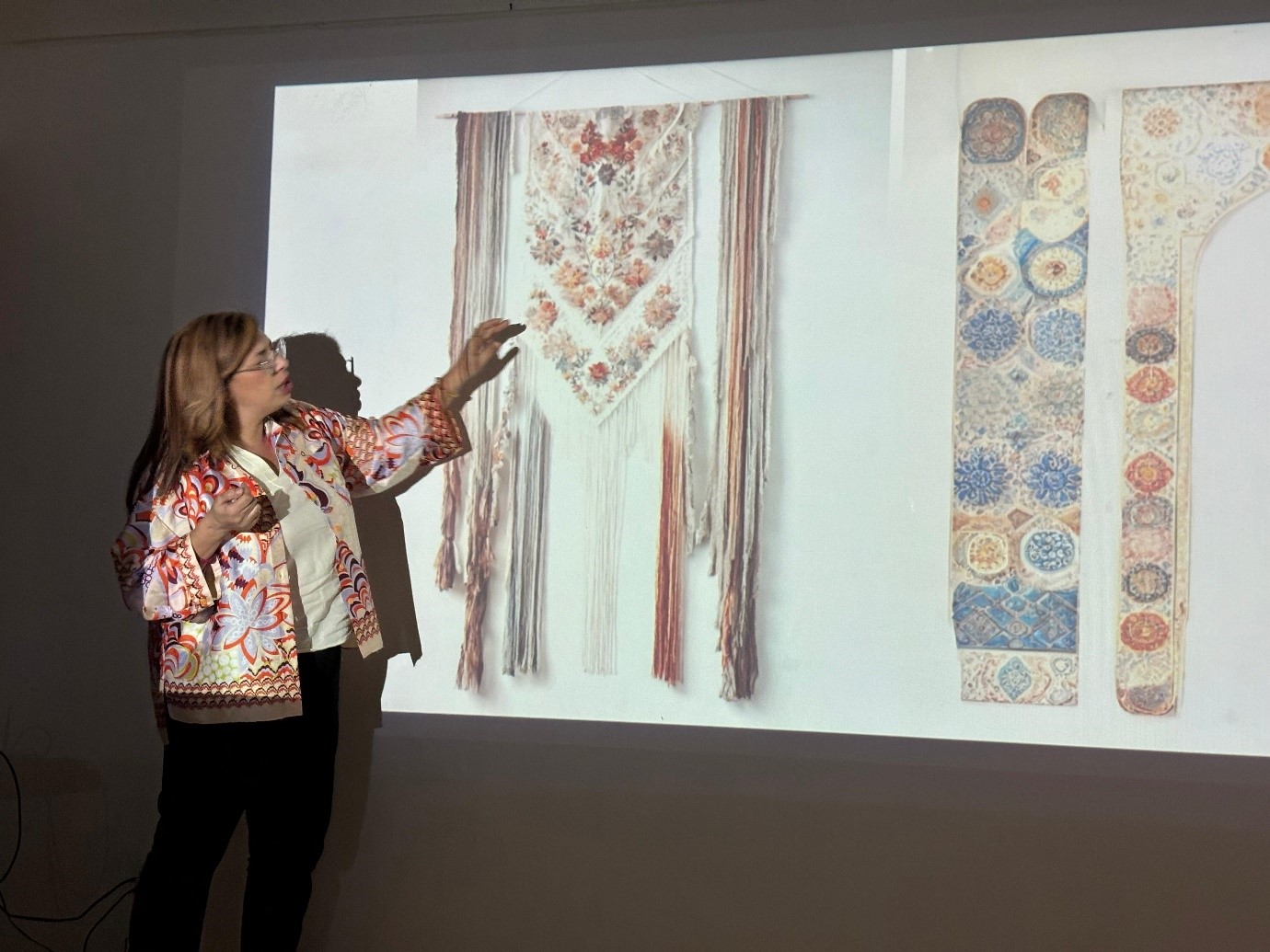
Out of the Circle Artist-in-Residence – “Back to the Roots,” 2024. Medrar for Contemporary Art, Art Talk as part of the Out of the Circle residency, Egypt, November 2024 – Photo credit: © Out of the Circle / Elham Khattab – With the support of Kultur | lx – Arts Council Luxembourg Link: “Back to the Roots” Art Talk by artist Aïda Schweitzer – Medrar
Asakan: What message do you most want to convey? In other words, what is the underlying poetics of your work—I mean, what is your conception of the creative act, or your way of questioning art and its purpose?
Aïda Patricia Schweitzer: It’s actually art that questions me (bursts out laughing)!
Poetry lies in subtlety, at the intersection of philosophy, anthropology, and all the readings that nourish my practice. When I’m weary of the world, I feel just how sorely it lacks poetry. Poetry brings a sense of lightness, a healthy distance from an increasingly anxiety-inducing reality.
I find this poetry precisely in certain works, in that feminine aspect. It brings gentleness; it provides balance, because being sensitive to all these realities takes a lot of energy. But it’s a balance that has developed quite naturally—and one that I need.
My conception of the creative act? It is the research—the intellectual material—that first raises questions, which in turn lead to others. This journey is an integral part of the creative process, and doubt inevitably sets in along the way. Then comes the sculptural form: this is where the heart of the work takes concrete shape. It’s a conception of creation that places thought before matter, research before action. As for the goal, it’s directly embedded in the very interpretation of my work. An interesting fact: I often dream about my finished works—a form of visualization, a “before” of the “after.”
Asakan: What inspires you in this regard?
Aïda Patricia Schweitzer: My sources of inspiration are wide-ranging. Authors from the Arab world, racialized feminist theorists like Fatima Mernissi, and other scholars working on postcolonial and feminist issues.
There are also more traditional readings, particularly in philosophy, and seminal essays on art and decolonial thought, such as Françoise Vergès’s *Programme de désordre absolu*, which raises the crucial question of the decolonization of museums.
More recently, Mona Chollet’s essays on “the undefeated power of women,” which I’ve reread, have enriched my reflections on these historically persecuted figures of resistance.
There are also so many artists whose work is inspiring. Etel Adnan’s drawings move me particularly deeply. I can spend a very long time analyzing a work when it moves me. I think of all those women artists who paved the way and gave a voice to future generations: powerful women.
And then, quite simply, observing the world, which sometimes fills me with despair… Nature and silence are essential.
Asakan: Can you tell us about your latest work?
Aïda Patricia Schweitzer: “In Your Golden Hair, I Found Lead” opened the door to the ARMURE series. It just fell into place naturally. ARMURE, a series of armored bodies. “In the silence of the night, while the world sleeps, I create my armor.” That says it all.
I develop these “armored bodies”—figures that protect as much as they carry memories, a history, and secrets. It’s a patchwork process where I mix hair, wool, and other materials. Braiding, knotting, sewing—repeating the same movement for hours while the world sleeps—is an act of resistance. It’s a political and introspective stance, where the process unfolds like a ritual of active fortification. The thread becomes a weapon of delay: as long as you’re braiding, you stand tall; you resist.
Hair is making a stronger comeback than ever in my work, as I mentioned earlier! It’s a resilient material, tied to my past as a hairstylist.
ARMOR also means being armed to face certain situations. I recently wrote a post, “White Privilege and Network Extraction in Art”: why do our research trajectories become trend catalogs for other careers? This post generated a lot of positive reactions on Instagram. It’s part of what drives me and is deeply rooted in my personal experience.
Check out the Instagram post mentioned here
Asakan: Aside from the essay, what other projects do you have in the works or coming up?
Aïda Patricia Schweitzer: I was supposed to go on a three-month residency in Cairo in mid-April, with some exciting collaborations planned. I’d put a tremendous amount of energy into it. Unfortunately, that residency didn’t work out, but the thread hasn’t been broken—it’s simply shifted to other timeframes…
Otherwise, to live happily, you shouldn’t reveal everything. There’s an exhibition planned for next year, and new pieces in the works. I received an email that made me very happy, and perhaps there will be more great news by then, Inch’Allah!
Asakan: You’ve been living and working in Luxembourg for several years. What are the challenges of working in this country that we hear so little about?
Aïda Patricia Schweitzer: Luxembourg is my adopted country: a small country with a vibrant cultural scene. Having been featured at the Luxembourg Pavilion at the 2025 Osaka World Expo remains a true honor. From the orphanage to Osaka: I never would have imagined such a journey.
Speaking of challenges: there aren’t many artists of color here, which creates a certain disconnect from international debates on the subject. I had to carve out my own space outside the established institutions, facing a lack of visibility that remains a reality within the permanent collections of our major national museums, despite the acquisition of my works by the Ministry of Culture and a well-established international career. But, paradoxically, that gave me a boost.
What I’ve built—for a long time on my own, tirelessly—sustains me today.
My projects find a more natural resonance elsewhere, in connection with my research work. It’s a complicated in-between space, much like my own story.
Another challenge: in such a small country, everything is on display—and competition is part of that. Issues surrounding marginalized artists, as well as the concerns that stem from them, are much more prominently addressed on the international stage. I remain optimistic: things are shifting, slowly, and we have a very active Minister of Culture.
Asakan: Is art really that important in our lives?
Aïda Patricia Schweitzer: That’s a philosophical question. Art isn’t vital in the literal sense, like air: we can survive without it. But its contribution is essential: it allows us to communicate and convey emotions—even contradictory or unsettling ones—and to see realities we were previously unaware of. It is a universal language.
Art is also the pulse of society: it is what remains when discourse collapses—an indelible trace of memory. Art contains the memory of world history. There is also its more intimate, almost physical aspect: when faced with a work that truly moves us, we feel a sense of calm, like a breath settling back into the chest, a necessary pause. The body doesn’t lie about that. And yet, I’ve met people who don’t share the same sensitivity to art; I must admit that intrigues me.
Asakan: Do you have any advice to share with young artists—both women and men—who would like to follow in your footsteps?
Aïda Patricia Schweitzer: Some relatively young artists are already building impressive careers—following all the conventions, with a very strong body of work and excellent visibility—and that delights me. Being an artist remains very difficult, however; I don’t want to romanticize reality. Here is my humble advice.
Hang in there. Your portfolio is important. Reach out to curators whose focus aligns with your themes. Participate in as many group exhibitions as possible to present your work to the public and build your network. An unconventional background isn’t a weakness, so there’s no need to feel like you don’t belong. Know your rights; review your contracts—or have them reviewed—and protect your work. Knowing how to say no is undoubtedly the hardest part when you’re young…
Ground your work in a genuine research process—not just aesthetics—and find your own voice. Ask yourself what drives your practice: why and how? Apply to international calls for submissions, and if rejected, don’t get discouraged. This field can be as harsh as it is supportive.
Every artist goes through difficult times from time to time. It’s essential to take care of yourself and not isolate yourself. Many artists keep their struggles to themselves in a field that wrongly promotes the image of an artist who is always in control of their own path. When faced with toxic behavior or abuse of power, don’t hesitate to speak out. The #MeToo movement has also impacted the contemporary art world—let’s not forget that.
Behind every successful project, there have been challenges that go unspoken. To those who might want to follow in my footsteps: the path won’t be straight, but it will be entirely your own. That’s already a lot.
Asakan: Any final words?
Aïda Patricia Schweitzer: You don’t build a career on your own. I’d like to thank Julie Crenn, the first person to open a door for me when others remained closed, as well as all the curators who have placed their trust in me and supported my work, both in Luxembourg and along my nomadic journeys: they’ll know who they are. Elham Khattab and her team at Out of the Circle in Cairo, Wahib Anton of the Egyptian Museum in Cairo, and so many others.
And finally, my son Nicolas, my unwavering ally, and Luxembourg, for its invaluable support and the bonds that unite us.
A big thank you to Asakan.
To learn more about Aïda Patricia Schweitzer’s work, visit her website at aidaschweitzer.com or follow her on Instagram @aidaschweitzer.art.
À lire également
Nana Poulot: “Black Art in Japan is aimed at anyone who wants to develop opportunities, create or strengthen ties between these cultures, and foster this artistic and commercial dialogue in a space for meeting, (re)connecting, and
At just 23 years old, Nana Poulot has already made art her uncompromising calling. After gaining extensive experience in the field, she decided to con…
Christophe Person: “My goal when I exhibit an artist’s work is to show how a subject that at first glance seems specific to a particular geographical reality can also convey a universal message.”
A leading figure in the contemporary art scene and co-founder of the Ouagadougou Sculpture Biennial (BISO), Christophe Person opened Galerie PERSON in…
Marie-Sophie Eiché-Demester: “I’m very lucky because the artists I collaborate with are building amazing international careers.”
As an art advisor to private individuals and public organizations and a founding member of the ATOKE Association—Les Enfants de Saint Dominique, which…
Agnès Brézéphin: “I don’t create activist art in the strict sense; I create art that focuses on healing and resilience.”
Agnès Brézéphin is the first Caribbean artist to win, on November 7, 2024, of the Léopold Sédar Senghor Grand Prize at the Dakar Biennale, with a priz…
Commentaires