Le Grand Entretien
Agnès Brézéphin: “I don’t create activist art in the strict sense; I create art that focuses on healing and resilience.”
Agnès Brézéphin is the first Caribbean artist to win, on November 7, 2024, of the Léopold Sédar Senghor Grand Prize at the Dakar Biennale, with a prize of 20 million CFA francs, for her poignant work titled *Cabinet of Curiosities | Chamber of Wonders:* “Fil(s) de soi(e).” Through this installation, the artist—a mixed-race woman of Guadeloupean origin living and working in Martinique—weaves a connection between suffering and beauty, personal memory and collective history, art, healing, and resilience. In this interview with asakan.art, she reflects on this powerful work, her rich career spanning more than 40 years dedicated to art, and her current and upcoming projects.
Asakan: Congratulations on winning the Léopold Sédar Senghor Grand Prize at the most recent edition of the Dakar Biennale of Contemporary African Art. Aside from the substantial cash prize, what does this recognition mean to you?
Agnès Brézéphin: Receiving the Léopold Sédar Senghor Grand Prize is an immense honor, made all the more symbolic by the fact that it bears the name of a thinker, poet, and humanist deeply committed to dialogue between cultures. Beyond the prize money, this recognition serves as a powerful validation of what I champion through my work: the possibility of transcending pain through art, of making the invisible visible, and of healing through artistic expression.
It is a strong message to all those who carry silent wounds and untold stories within them, but also a message of hope: our voices have value, and our scars can become works of art.
This award gives me greater legitimacy to continue creating with sincerity, patience, and commitment. It also opens up spaces for dialogue, knowledge-sharing, and international collaboration.
Finally, in a part of the world where certain realities—such as incest or violence against women—remain taboo or legally invisible, this distinction is, I hope, a modest yet essential contribution to a collective awakening.
Asakan: Was the award-winning work *Cabinet of Curiosities | Chamber of Wonders: “Fil(s) de soi(e)”* created exclusively as part of your application for the Biennale?
Agnès Brézéphin: *Cabinet de Curiosités | Chambre des Merveilles: “Fil(s) de soi(e)”* was born out of urgency and a vital impulse. It wasn’t initially conceived for the Biennale, but it imposed itself upon it, as if it were inevitable, almost like a calling. From a hospital bed, caught between bated breath and a silk thread, I felt the urgent need to bring this piece into being—just as one tries to grasp a fragile light before it vanishes.
It was born at the very last moment, yet it carries within it an entire life: that of a memory seeking to express itself, to weave itself anew. The Biennale was the setting for its public debut, yet its origins are older, more intimate. It draws from my childhood silences, from the gestures I learned from my ancestors, from my unspoken wounds and my patiently embroidered rebirths.
So yes, it was created for the Biennale—but above all, it was created to survive.
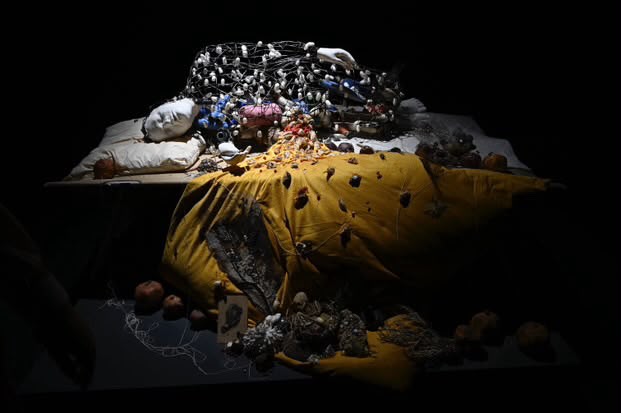
Agnès Brézéphin, “Cabinet of Curiosities | Chamber of Wonders: ‘Fil(s) de soi(e)’” Courtesy of the Artist Photo Credit: Paola Lavra
Asakan: Why, specifically, a Cabinet of Curiosities?
Agnès Brézéphin: Because I needed a space for revelation and mystery, a place where fragments of memory, intimate objects, and invisible wounds could interact freely. The Cabinet of Curiosities, by its very nature, brings together the strange, the precious, the rare—things that fall outside the norm yet deserve to be looked at closely.
It is an architecture of the intimate, a sanctuary where I can reveal what has long been silenced. Each element there becomes a trace, a memory, a spark of life. This is not about collecting out of vanity, but about gathering out of necessity—the need to repair, to reconstruct a body, a story, a breath.
The Cabinet of Curiosities allows me to invite the viewer to slow down, to contemplate, to feel. It offers the public a path toward the invisible, toward what is whispered, embroidered, and reconstructed. In this sense, it is an act of gentle resistance and of re-enchanting the horror that incest represents.
Asakan: How did you go about creating *Cabinet of Curiosities | Chamber of Wonders: “Threads of Self (Silk)”?
Agnès Brézéphin: This work was born out of urgency, but also out of a kind of inner necessity. I was hospitalized, in that liminal space where the body grows fragile but where the mind, paradoxically, becomes clearer, more radical. I decided to submit my application to the Dakar Biennale three days before the deadline, driven by a deep intuition that I had to transform my pain into an artistic gesture.
The installation was built around a bed, a powerful symbol of both trauma and rebirth.
I worked with materials that carry my memories: silk threads, embroidered cocoons, buttons passed down from my artisan grandparents, haute couture beads… Each element was chosen with care, like a word embroidered directly onto the skin of the past. The bed, at the center, became a sanctuary: it embraces the pain, but it also becomes a space for healing.
I was guided in this creation by Paola Lavra, curator and co-author of the project, who was able to put into words what I sometimes could not express other than through textiles or symbols. Our dialogue was essential.
This Cabinet of Curiosities is not a static museum; it is a living room where the intimate meets the universal. It is a work for survivors, for buried silences, for the beauty that endures.
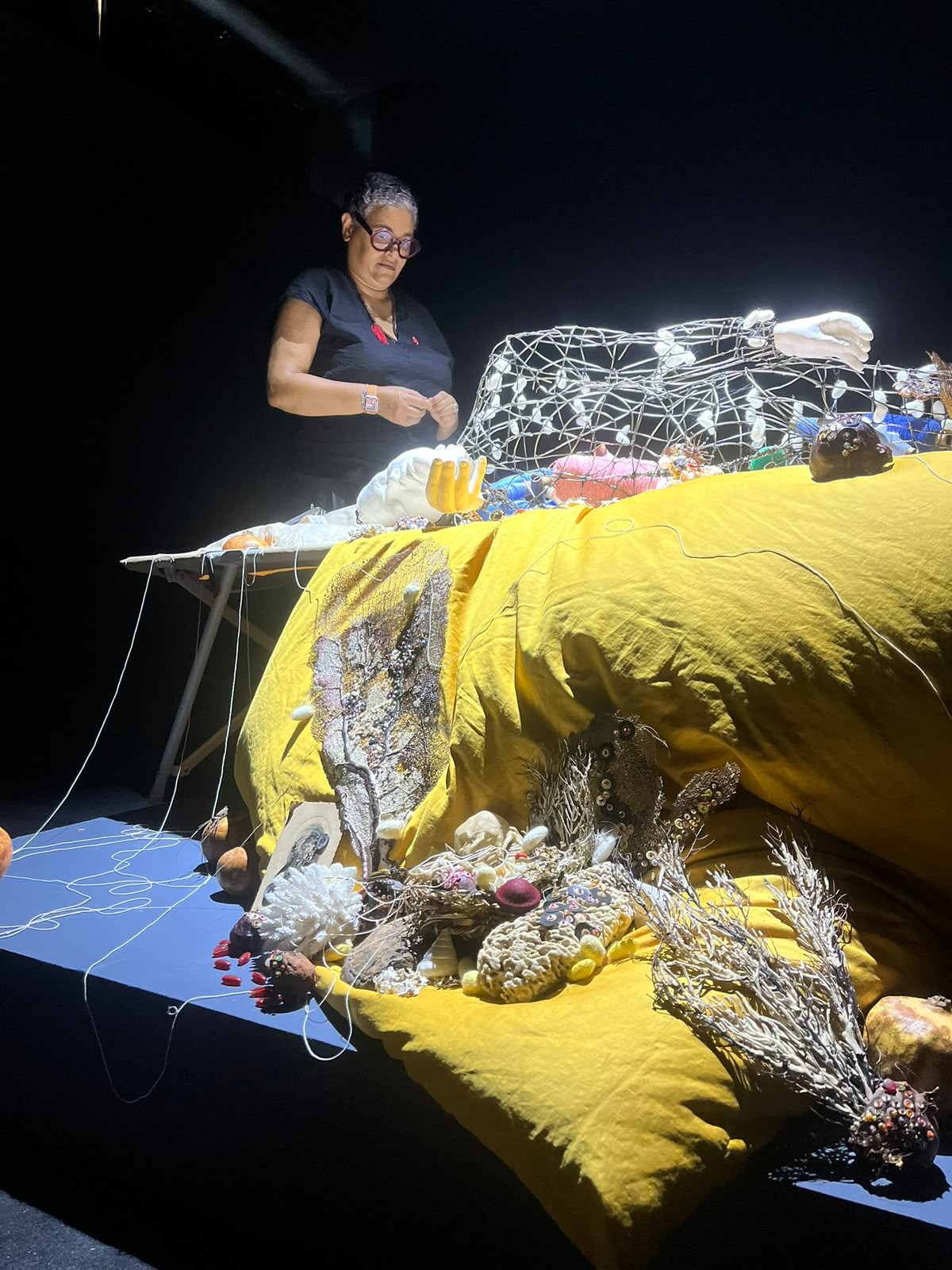
Agnès Brézéphin at work during the installation of *Cabinet of Curiosities | Chamber of Wonders: “Threads of Self (Silk)”* Photo credit: Paola Lavra
Asakan: You mean a work for survivors of incest. So are you seeking to denounce this vile and despicable act?
Agnès Brézéphin: What I’m seeking, above all, is to give form to what has been silenced. Incest is a silent, underground form of violence, often kept hidden—out of shame, fear, or misplaced loyalty. My work doesn’t stem from a desire for direct denunciation, but from a need for transformation. I don’t make activist art in the strict sense; I make art of healing and resilience.
By telling my story through the materials I love—thread, textiles, intimate objects—I seek to create a poetic space where others might recognize themselves, feel less alone, or simply begin to view this reality in a different light.
Of course, being able to convey such a message to audiences who come primarily from countries where incest remains a taboo, and where abortion is still banned even in cases of rape, the very act of being heard, seen, and honored… becomes a political act, despite myself. Nevertheless, my primary intention is to bring healing, not to accuse. It’s about creating a space where people can breathe again, even after the unspeakable.
Asakan: As early as 2019, you starred in the film *Scolopendres et papillons* to denounce this silent crime in your own way. Can you tell us more about that?
Agnès Brézéphin: In 2019, the release of the film *Scolopendres et papillons*, directed by Laure Martin Hernandez and Vianney Sotès, marked a turning point in my artistic and personal journey. This project, which explores the healing journeys of three women who survived incest, is a deeply intimate and moving work. Through this film, I wanted to shed light on the silent pain that many women—often rendered invisible by society—carry within them.
The film gives a voice to Fabienne, Daniely, and me, each of whom, in her own way, is trying to rebuild her life after profound trauma. With this documentary, the filmmakers have accompanied us; they wanted to allow us to open windows onto our experiences, to offer us a space to express what we have endured and how we are fighting to survive and heal.
This documentary thus reflects both the fragility and the resilience of these women. It is a call for dignity and hope, despite everything we have been through. Through this film, I wanted to give a voice to those who, all too often, remain in the shadows, and to remind us that art can be a form of healing and liberation.
Asakan: How do we live with and despite it all?
Agnès Brézéphin: Thank you for this question, which is at once immense, intimate, and so profoundly human. There is no single, straightforward answer to “How to live with incest and despite it all”—there are paths. Painful, winding paths, but real ones. And above all: there is a possibility for life, for momentum, for creation, for connection—even after the unspeakable. Living with incest and despite it all involves a difficult but possible journey. It’s about transforming the pain, seeking support, expressing oneself, and reconciling with oneself through Beauty and Art.
This installation shows us that, even in suffering, there are paths toward healing and resilience; that even in the greatest fragility, there is a possibility to reinvent oneself, to heal, and to live despite everything.
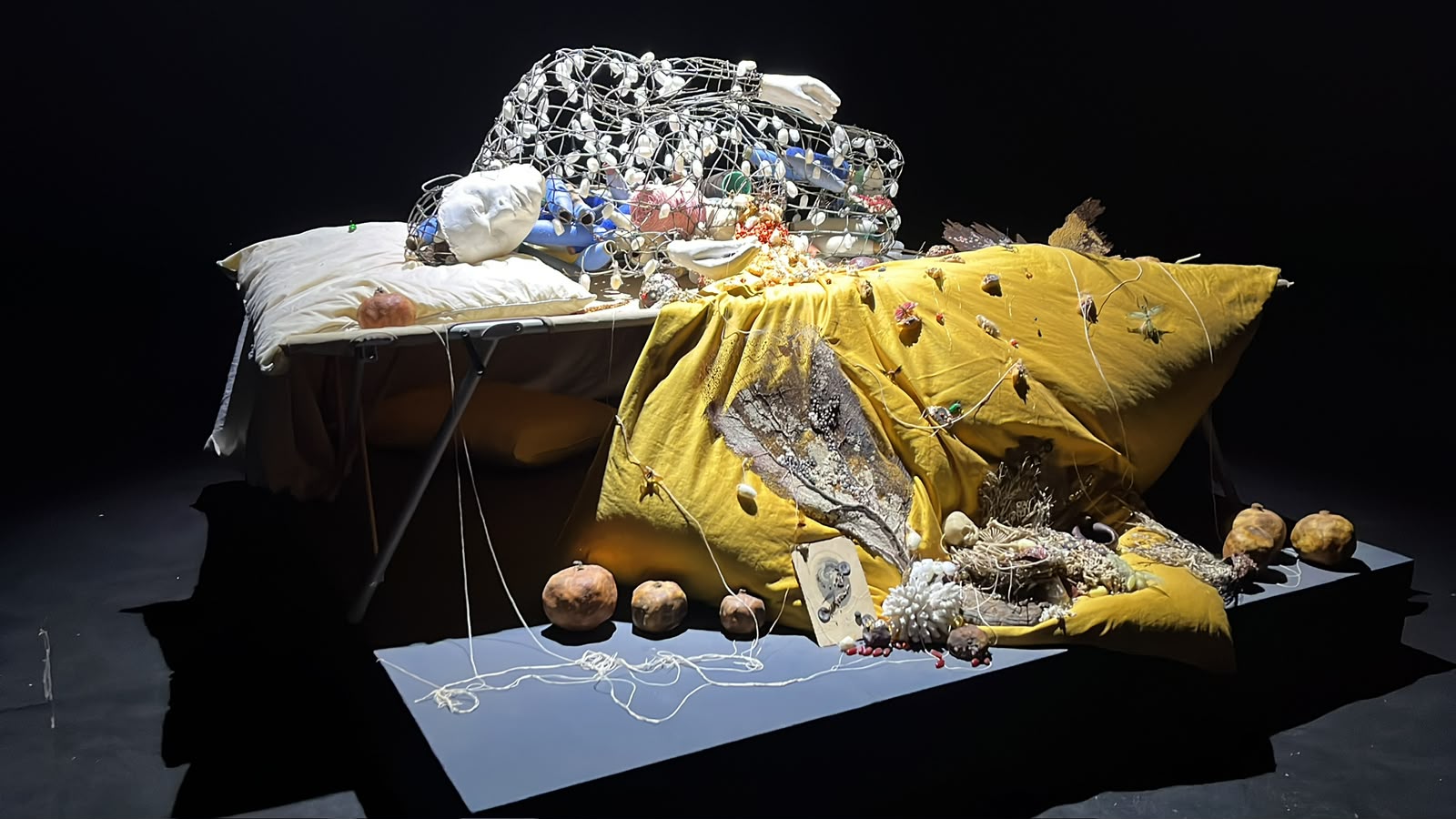
Agnès Brézéphin, “Cabinet of Curiosities | Chamber of Wonders: ‘Fil(s) de soi(e)’” detail. Courtesy of the artist. Photo credit: Paola Lavra
Asakan: We also read in the conceptual note for this work: “The ‘Chambre des Merveilles’ was built over time upon embers—the ashes of an ancestral wound, those of colonial violence that shaped social relations from the very beginning.” Can you explain this to us?
Agnès Brézéphin: The sentence refers to how the “Chambre des Merveilles” is built upon the suffering and violence of the past, particularly those linked to colonization. The embers and ashes symbolize these ancient wounds that continue to shape social relations today. This colonial violence, which shaped power dynamics, still influences contemporary society.
In my work, this idea can be seen as a way to process and understand these historical and personal sufferings. The “Chambre des Merveilles” thus becomes a space where one can reflect on these traumas, confront them, and perhaps, through art, begin a process of healing. This work transforms the pain of the past into a place of remembrance and reconstruction.
Asakan: Let’s return to your artistic journey… You began your artistic career with photography. You have become a multidisciplinary artist, exploring ceramics, Indian crochet embroidery, book illumination, graphic design, screen printing, and the cyanotype technique. How do these practices influence your creative work today?
Agnès Brézéphin: These practices profoundly influence my current creative work in several ways:
- Family heritage: My introduction to crafts and sewing by my grandparents has shaped how I use fine materials and techniques—such as embroidery and illumination—to explore themes of healing and memory.
- Typography & graphic design: My training in typography and my work on the Creole language enrich my approach to linking text and image, offering a more distinctive and relevant visual voice in my work as a Caribbean graphic designer and typographer.
- Mixed media: My multifaceted approach, which incorporates ceramics, cyanotype, and other techniques, allows me to create visual and tactile works rich in symbolism.
- Cultural engagement: My connection to Caribbean culture fuels my reflections on colonization, memory, and resilience.
- Personal introspection: My personal themes, such as incest and resilience, give my work a therapeutic and reconstructive dimension.
Thus, her current practice combines heritage, social engagement, and personal exploration to create deeply moving and symbolic works.
Asakan: You have also been a professor of graphic arts at the Caribbean Arts Campus since 1997…
Agnès Brézéphin: My relationship with my students at the Caribbean Arts Campus is a key element of my work. As a professor of graphic design for 27 years, I don’t just teach technical skills in graphic design and typography; I also encourage students to think critically about art and culture. Through my teaching, I encourage them to explore their own cultural identity, engage in meaningful artistic practices, and address complex themes with sensitivity and creativity.
My role as an educator is intimately linked to my own artistic practice. By sharing my experience, my research, and my personal concerns with my students, I create a space where issues of memory, trauma, and reconciliation are explored collectively. Her students are thus not only trained technically but are also invited to view art as a means of social and personal transformation—a powerful tool for expressing realities that are often ignored or painful.
In my work, one can perceive the influence of these exchanges with my students, who, in turn, are developing their own artistic practices in response to social and cultural issues. This connection I’ve established with them nourishes my work, allowing it to remain rooted in a dynamic of transmission and innovation, where art becomes a dialogue between generations, a means of shared transformation and healing.
Asakan: What are your current or upcoming projects?
Agnès Brézéphin: Surprises!
Be sure to follow my Instagram (@agnesbrezephin) regularly to see new pieces, creations, and ongoing projects.
Asakan: What advice would you give to young artists who want to pursue a career in the arts?
Agnès Brézéphin: For young artists hoping to pursue a career in the arts, it’s essential to stay true to themselves in their creative process. Art is a form of personal expression, so it’s crucial not to try to please others at all costs, but rather to focus on what resonates deeply within yourself. Experimenting with different mediums and techniques can also enrich your artistic practice and open up new perspectives.
Participating in events and exhibitions and interacting with other artists and professionals helps you build a reputation and expand your network. Furthermore, it’s important to never stop learning. Art is constantly evolving, and continuing to develop your skills—whether through workshops or meetings—helps you stay creative and relevant.
Perseverance is also essential on this path, as the journey is often fraught with obstacles. You must know how to bounce back after a setback and keep working. At the same time, building an online presence has become essential for sharing your work and attracting a wider audience.
It’s also important to stay true to your values. Art is often a powerful way to convey messages or demonstrate a commitment, and this always resonates with certain audiences.
In short, an artistic career requires a genuine journey of self-discovery, a commitment to society, perseverance in the face of difficulties, a desire to communicate, and an openness to creative versatility.
To put it more poetically: an artistic career becomes a dance between dreams and reality, where one is constantly reinventing oneself, with the horizon as the only limit.
For more information on Agnès Brézéphin’s work, you can follow her on Instagram.
À lire également
Aïda Patricia Schweitzer: “I had no choice but to fight, and subsequently, more broadly, to reject and denounce injustices, including the neglected realities faced by women.”
Known for her spectacular performances that explore the conditions faced by women in our contemporary societies, Aïda Patricia Schweitzer—a self-taugh…

Nana Poulot: “Black Art in Japan is aimed at anyone who wants to develop opportunities, create or strengthen ties between these cultures, and foster this artistic and commercial dialogue in a space for meeting, (re)connecting, and
At just 23 years old, Nana Poulot has already made art her uncompromising calling. After gaining extensive experience in the field, she decided to con…
Christophe Person: “My goal when I exhibit an artist’s work is to show how a subject that at first glance seems specific to a particular geographical reality can also convey a universal message.”
A leading figure in the contemporary art scene and co-founder of the Ouagadougou Sculpture Biennial (BISO), Christophe Person opened Galerie PERSON in…
Marie-Sophie Eiché-Demester: “I’m very lucky because the artists I collaborate with are building amazing international careers.”
As an art advisor to private individuals and public organizations and a founding member of the ATOKE Association—Les Enfants de Saint Dominique, which…
Commentaires