Expositions et événements
Ouagadougou: “Rupture” Exhibition: A World in Crisis Under Scrutiny
Since September 18, the National Museum of Burkina Faso has been showcasing the work of four prominent artists living in the country and their perspectives on the concept of “rupture.”
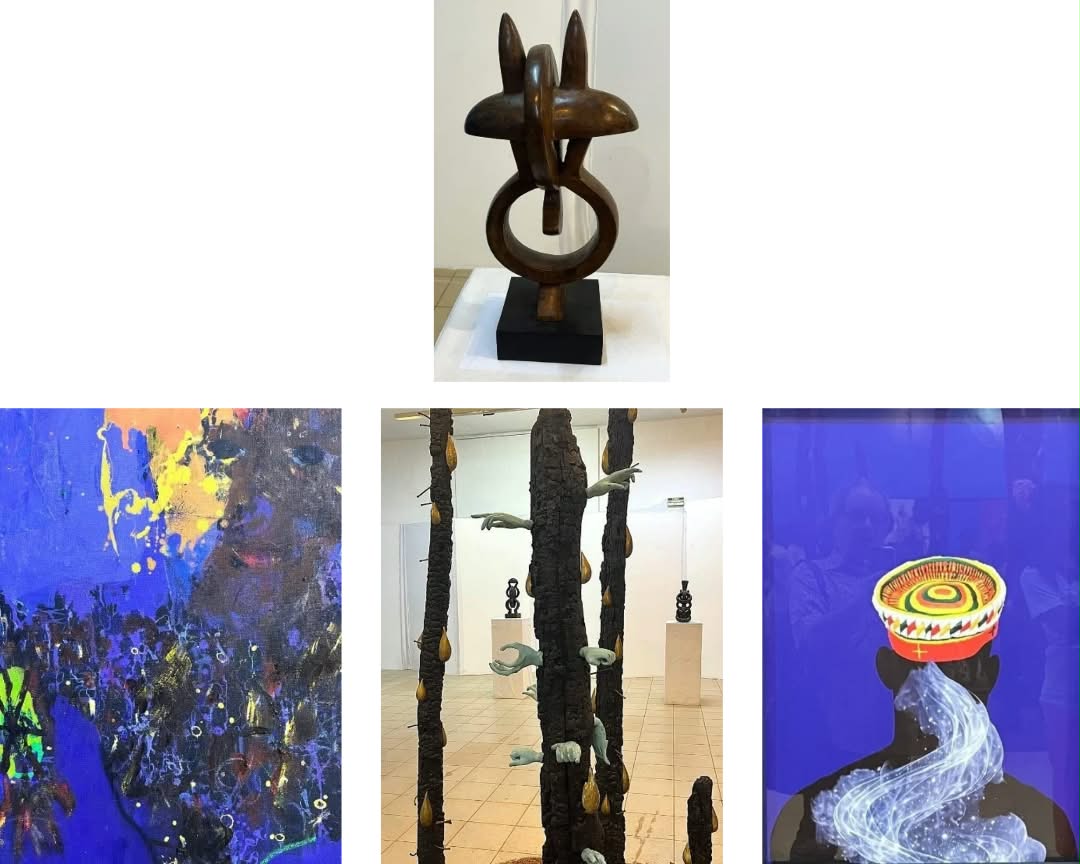
Ky Siriki
Christophe Sawadogo
Nyaba Ouedraogo
Abou Traoré
They were asked: “What ‘Rupture’?”
Have these renowned artists exchanged their artistic practices? Questions abound before the exhibition hall opens.
We heard: “Rupture = Continuity,” just as the present both separates and connects the past and the future.
Ky Siriki suggested that the question should be directed at young artists.
They share their thoughts: “transmission and creation”
The doors open…
We are immediately struck by the artistic intensity that fills the Jean Rouch Hall, and it is difficult to tear our eyes away from the exhibition design to read the four presentations of our great artists’ reflections on “Rupture.”
Ky Siriki’s “The Tears of the Pelican” occupies the center of the space, reaching all the way to the very high ceiling. The charred rafters of the “Le Pélican” bar in Dapoya… artistically rising from their ashes, bearing the tears of the grieving owner and “imbued” with a new form of life.
Next to it, Ky Siriki presents a highly didactic (even discursive) work on the living memory of Norbert Zongo, whose murder has yet to be brought to trial: “Broken Pen of a Brilliant Mind.”
The newspaper “L’Indépendant,” depicted in Ky Siriki’s work, is the journalist’s weapon, much like the giant “Tata” built by Samory Touré to halt the advance of the French army. Hence Norbert Zongo’s adoption of Samory Touré’s motto, “Bory bana” (“The race is over”), at the launch of his newspaper.
For Christophe Sawadogo, “Rupture” unfolds as:
“Excision,” straddling the line between traditional practice and crime;
“Transmission”;
“Around Africa” (or “Through Africa”)? Enigmatic or didactic? The map of the continent and its peoples—one people?;
“Council of Elders”;
“The Silence of the City,” suggesting a distancing from what the “Council of Elders” represents?…
“The Fish Seller” is my favorite work from an artistic standpoint. It is typical of the artist’s ability to bring into being a beautiful and powerful presence—not in a “finished” drawing ” but in a sort of fireworks display of composite colors united in a superb blue—sky or ocean, or the night of our dreams—much like the letters of the alphabet, which Christophe Sawadogo has often used to create portraits of women emerging from a sort of puzzle. This work bears witness, in a way, to the stylistic evolution of a creative artist, instantly recognizable among thousands.
One takes in Abou Traoré’s works at a glance. Of masterful abstract beauty, they are “powerful” in their evocativeness. The bronze material radiates energy. Through rings, links, bracelets, and “handcuffs”—whether articulated or welded—they express resistance to fracture, corrosion, and rupture; they embody “eternity”… the solidity of values expressed in Dioula, in the form of a dialogue between tradition and modernity:
“Horonya,” “dignity, integrity.” Close to “Horoya,” “freedom, liberation”;
“Tilé kun bo,” “the side where the sun rises”;
“Djôrô,” “charting the path,” a Lobi initiation rite.
“Vigui-Vigui,” “Speed”
Two interlocking gears connected like chain links to evoke the action of shaking vigorously, of setting something in motion that is supposed to be fixed, immutable…
“Â friguira” (not AFRIGUIRA): “Intertwining” of the broken rings…
Nyaba Ouedraogo “contrasts” two series of art photographs:
- “Abstract” photos of traditional headdresses in vibrant colors. Chief’s headdresses, “Pugla,” on an “erased” head; traditional headdresses of commoners.
Traces of the cotton fruit, in drawings or photographs, unite these images of headdresses around the idea of the same material from which they are woven.
The representation and legitimacy of power are called into question.
THE PUGLA (CAP)
The Pugla, the insignia of the Naba, transcends the object itself. Photographed from behind, it downplays the individual to highlight the role. Customary power thus appears as a relational construct: it exists only through the gaze and recognition of the community.
These photographs explore customary legitimacy in a world shaped by modernity, social mobility, and the plurality of authorities. The Pugla, woven from fiber and cotton, is a metaphor for the sons and daughters who weave Moaga society together through solidarity, respect for hierarchy, and so on.
And the young people—"traditional" villagers—seem to "blend" somewhat into the black background of the photos, and into the reflections of the room and of ourselves in the glass of the frames, while the "sharpness" of the photographic prints lends them great beauty: … an “unreal” artistic presence. We find ourselves both in front of and within the images, both in front of and within the artist’s questioning.
An exhibition not to be missed
These artists create by sharing meaning, by offering ways of looking—and thus of seeing. They reflect on their art and invite us to reflect, so that we may create right where we are.
“Rupture” exhibition featuring Ky Siriki, Sawadogo Christophe Ouedraogo, Nyaba Ouedraogo, and Traoré Abou at the National Museum of Burkina Faso in Ouagadougou, through the end of October 2026
Lucien HUMBERT.
About the Artists:
SIRIKI KY
A leading figure in contemporary Burkinabé sculpture, Siriki KY belongs to a generation of artists who, beginning in the 1980s, helped revitalize sculptural practices and establish Burkinabé art within the dynamics of contemporary African and international art.
Through these two works, Siriki KY anchors the rupture in concrete experiences of loss, destruction, and disappearance. But his work goes beyond the mere representation of trauma. The material itself becomes a means of preserving traces, bringing memory to the surface, and transforming absence into presence. The rupture thus appears as a fracture that remains active in both individual and collective consciousness.
CHRISTOPHE SAWADOGO
Born in Tikaré, Christophe Sawadogo has been developing a body of pictorial work since the 1990s, drawing inspiration from writing, poetry, materials, and the careful observation of transformations in the contemporary world.
Water, drought, population displacements, migration, urban upheavals, health and security crises, and territorial transformations are all situations through which the artist examines the fragilities of the contemporary world. For the artist, security and health crises have forced individuals to make choices that are sometimes basic but fundamental: to leave or to stay, to expose oneself or to protect oneself, to maintain connections or to distance oneself.
ABOU TRAORE
Born in Bobo Dioulasso, Abou Traoré is a contemporary bronze sculptor from a long family tradition of sculptors and bronze casters.
Within the context of the “Rupture” exhibition, Abou Traoré’s approach takes on a special resonance. Here, rupture is viewed not as a simple fracture but as a human experience that leaves a mark. It may be silent before becoming perceptible; it may separate, but it may also create a new space. Between what disappears and what remains, between what ends and what seeks to be born, the fault line becomes a territory of transformation.
NYABA LEON OUEDRAOGO
Nyaba Léon Ouedraogo belongs to a generation of African photographers who have profoundly transformed the way we view, narrate, and think about the realities of the continent.
Thus, rupture does not necessarily mean disappearance. It becomes a space of tension between heritage and transformation, memory and the present, authority and freedom. The artist invites us to consider tradition not as a static reality, but as a living substance that reinterprets itself through contact with the contemporary world.
À lire également
Nigeria: The Lagos Biennial Announces the List of Artists for Its 2026 Edition
In the run-up to the fifth edition of the Lagos Biennial, the organizers have announced the artists who will be participating.
Senegal: The Dakar Biennale Has Announced the 75 Artists for Its 2026 Edition
Gone are the uncertainties and rumors of all kinds surrounding the 16th Dakar Biennale of Contemporary African Art. It will indeed take place from Nov…
Commentaires